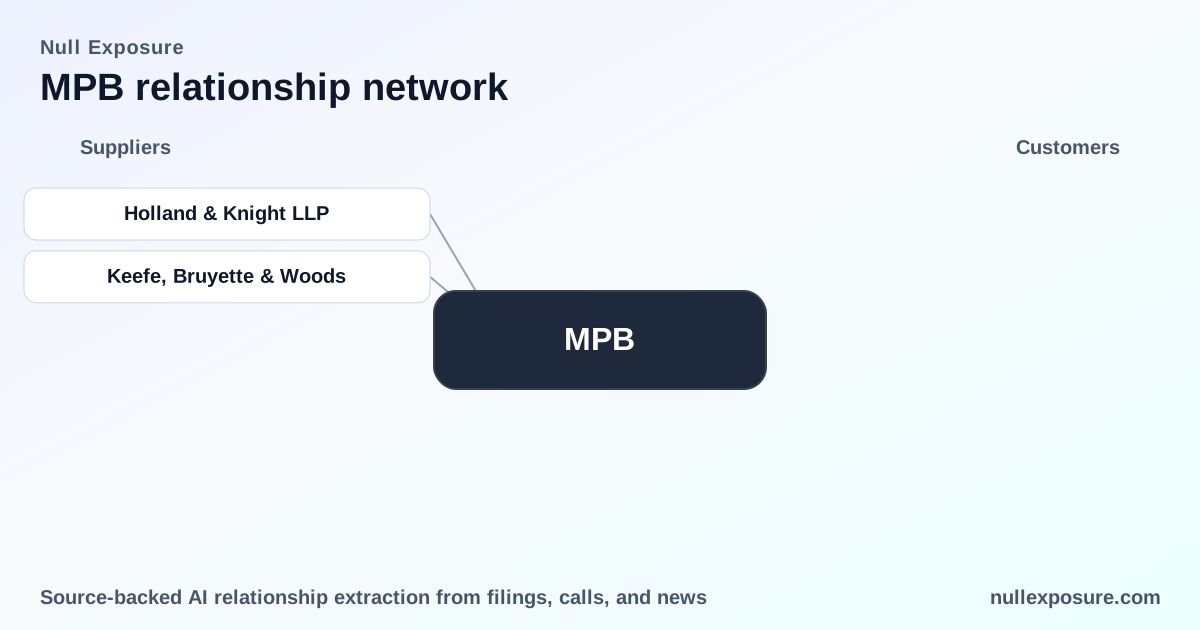
Mid Penn Bancorp (MPB): Advisor Relationships Signal M&A Discipline, Not Vendor Concentration
Mid Penn Bancorp operates as a regional bank holding company, generating earnings from interest margin on loans and securities plus non-interest fee income from deposits and commercial banking services. The company monetizes through traditional community banking economics — net interest income supported by lending and deposit spreads, supplemented by fee income and capital actions; FY2025-2026 metrics show Revenue TTM of $224.4M, a profit margin of 25.1%, and return on equity near 7.7%, consistent with a modestly profitable regional franchise. For investors evaluating supplier relationships, the most material vendor activity in public disclosure around FY2026 is deal-related advisory — legal and financial advisors engaged for the 1st Colonial acquisition — which signals episodic, transaction-driven supplier spend rather than ongoing operational dependency.
Explore deeper supplier profiles and sourcing intelligence at https://nullexposure.com/.
What the advisory roster reveals about Mid Penn’s operating model
Mid Penn’s disclosed supplier relationships in FY2026 are transactional professional services engaged to execute an acquisition. That pattern conveys several company-level signals relevant to investors and operators:
- Contracting posture: Mid Penn contracts external advisors on a deal-by-deal basis, indicating an in-house capability focused on banking operations rather than investment banking or complex legal closings. Engaging external specialists for M&A is standard for regional banks and preserves management bandwidth.
- Concentration and criticality: The disclosed vendors are not long-term system suppliers (core processors, cloud providers, or payment networks); they are critical for discrete strategic actions (regulatory approvals, fairness opinions, legal diligence) but not for daily operations.
- Maturity of sourcing: Using established advisors such as national law firms and well-known investment banks suggests mature procurement standards for strategic transactions — the company selects recognized firms to reduce execution risk and regulatory scrutiny.
- Cost and governance implications: External advisors raise one-time transaction costs but also fortify governance (independent fairness opinions, external counsel) — a positive signal for minority investors focused on deal quality and fiduciary oversight.
No supplier-specific contractual constraints or long-term exclusivity clauses are present in the public records reviewed; this absence is a company-level signal that supplier commitments tied to the acquisition were structured as professional services engagements rather than multi-year vendor contracts.
Advisors tied to the 1st Colonial acquisition (what each relationship means)
Holland & Knight LLP
Holland & Knight acted as legal counsel to Mid Penn in connection with the 1st Colonial acquisition, providing the specialized regulatory and transactional legal work required for bank M&A. This engagement signals the bank’s preference for established national law firms when managing regulatory review and closing documentation. According to a March 10, 2026 Intellectia news report covering the transaction, Holland & Knight LLP served as legal advisor to Mid Penn for the deal (FY2026).
Keefe, Bruyette & Woods
Keefe, Bruyette & Woods served as Mid Penn’s financial advisor on the 1st Colonial transaction, responsible for valuation support, deal structuring, and negotiation assistance. Employing Keefe, a long-standing investment bank for community and regional banks, indicates Mid Penn’s commitment to proven industry expertise for M&A execution. An Intellectia article dated March 10, 2026 lists Keefe, Bruyette & Woods as the financial advisor to Mid Penn for the transaction (FY2026).
How these supplier relationships change the risk profile for investors
The advisory engagements alter the investment thesis in specific, measurable ways:
- Execution risk is lowered. Using recognized legal and financial advisers reduces regulatory and valuation execution risk tied to the acquisition, which preserves expected accretion and integration timelines.
- Costs are concentrated and episodic. Advisory fees will pressure near-term earnings around the deal close but are non-recurring and should not alter normalized margins over time.
- Operational vendor concentration remains low. The lack of disclosed reliance on single-source operational vendors in the supplier disclosures means operational continuity risk tied to day-to-day suppliers is not illuminated by this data; investors should pursue deeper due diligence on core banking platform, payments, and IT suppliers separately.
- Governance quality is reinforced. The presence of an independent fairness opinion for the target (reported in the same coverage) and the use of external counsel signal stronger transactional governance that benefits minority shareholders during M&A.
If you evaluate M&A-driven supplier costs or the governance surrounding deal execution, compare advisor selection and engagement terms across peers; more information is available at https://nullexposure.com/ for investors seeking vendor-level insight.
Practical investor checklist and next steps
For buy-side analysts and corporate operators, treat these supplier disclosures as a starting point, not the full picture. Recommended actions:
- Confirm transaction economics and expected pro forma metrics with the company’s proxy or 8-K filings to quantify advisory fee impact.
- Request vendor roll-forward or deliverable schedules for deal-related suppliers to verify scope and termination terms.
- Cross-check whether similar advisor firms are used repeatedly across deals to detect any preferential or repeat-supplier concentrations that could imply negotiated fee advantages or conflicts.
For a consolidated view of supplier intelligence and comparative sourcing across regional banks, visit our research portal at https://nullexposure.com/.
Bottom line: Transactional advisors imply disciplined deal execution, not vendor dependency
The FY2026 disclosures show Mid Penn engaging established legal and financial advisers for the 1st Colonial acquisition — a normal, constructive posture for a regional bank scaling via M&A. These supplier relationships are transactional and governance-enhancing, reduce execution risk for the deal, and create temporary cost pressure rather than long-term operational dependence. Investors should incorporate the one-time cost and governance implications into near-term EPS and integration risk models, while conducting separate diligence on operational suppliers that are not captured in the current disclosure set.
To benchmark Mid Penn’s supplier strategy across peers or to commission a targeted supplier risk report, start here: https://nullexposure.com/.