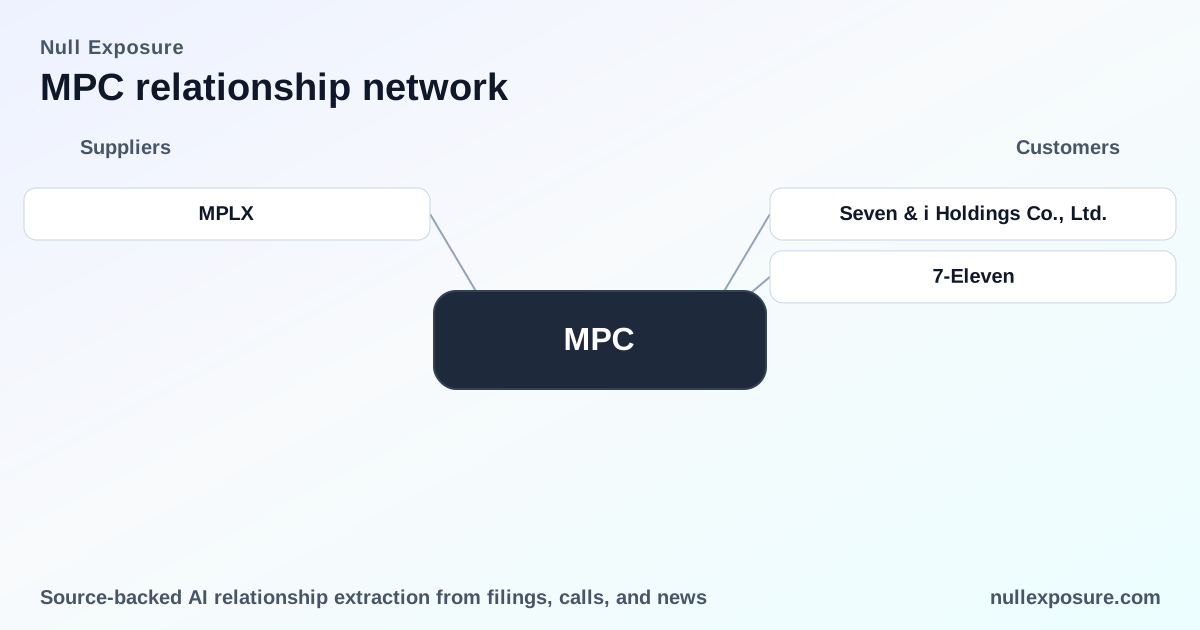
Marathon Petroleum (MPC): supplier posture and the MPLX midstream nexus
Marathon Petroleum monetizes scale through integrated refining, marketing, and transportation: it captures refining margins on roughly $133 billion of annual throughput, sells fuels at retail and wholesale, and internalizes logistics via majority-held midstream assets. The company's economics depend on tight coordination between refinery feedstock sourcing, long-term midstream contracts, and spot market flexibility — a supplier model that delivers margin capture but concentrates operational risk around a few critical partners. Explore supplier intelligence and relationship mapping at https://nullexposure.com/.
How Marathon sources feedstock and why supplier contracts matter to investors
Marathon operates with a dual contracting posture: a substantive base of long-term, fee‑based commercial agreements for transportation and terminal services combined with active spot-market purchases of crude, NGLs and renewable feedstocks. This hybrid model preserves margin optionality while locking in logistics capacity essential to refinery utilization. According to Marathon’s disclosures, purchase obligations for crude, NGLs and renewable feedstocks totaled roughly $17.18 billion, with $14.5 billion payable within 12 months, and crude transportation obligations of $7.98 billion (with $892 million due in the next 12 months), signaling material recurring cash commitments that drive procurement and capital planning decisions.
- Contracting posture: long-term, fee-based midstream contracts stabilize throughput and provide predictable capacity; spot purchases supply swing flexibility to exploit market arbitrage.
- Concentration and criticality: large obligations and internal midstream ownership concentrate exposure to a few partners and assets, making counterparty performance and volume commitments economically critical.
- Spend scale and maturity: multi-billion dollar short-term payables and longstanding commercial arrangements indicate a mature, capital‑intensive procurement program.
The MPLX LP relationship — a strategic, majority-owned midstream partner
MPLX LP is Marathon’s primary midstream partner and economic lever: MPC owned roughly 64% of MPLX’s outstanding common units and MPLX accounted for about 48% of MPLX’s revenues as of year‑end 2025, establishing a dominant ownership and revenue linkage between the two companies. According to MPLX’s SEC disclosure summarized through market coverage, MPLX provides 58% of crude pipeline volumes and 69% of terminal throughput to Marathon under long‑term minimum volume commitments, making MPLX both a supplier and a captive logistics platform. (Sources: TradingView summary of MPLX SEC 10‑K (FY2026); TradingView analysis, FY2026.)
A series of market reports highlights commercial dynamics: MPLX recently lifted its quarterly distribution by 12.5%, pushing forward yield to 7.71% and underscoring a fee‑based midstream cash flow model rooted in long-term contracts with Marathon that extend into the 2030s. Energies Media and investor commentary also emphasize that Marathon’s refining capacity combined with MPLX’s logistics gives MPC control over crude movement and refined product distribution across North America. (Sources: SimplyWallSt coverage (Mar 2026); EnergiesMedia reporting (Mar 2026).)
What the MPLX tie means for operators and investors
Operators should treat the MPLX relationship as a strategic dependency rather than a passive supplier contract. MPLX’s long‑term capacity commitments and Marathon’s majority ownership create a tight operational coupling: refinery uptime, crude slate optimization, and terminal throughput are interlinked with MPLX performance and capital allocation decisions. For investors, this implies:
- Upside: Consolidated cash generation and distribution support (MPC internalizes midstream economics and MPLX distributions support yield for unit holders).
- Risk: Concentration risk and counterparty exposure — a disruption at MPLX facilities or adversarial contract renegotiation would have outsized consequences for MPC refinery throughput and margin realization.
- Governance angle: Majority ownership gives MPC strategic control but also concentrates balance sheet exposure and governance responsibility for midstream capex and reliability.
Explore how supplier concentration affects valuation and operational risk on the Null Exposure platform: https://nullexposure.com/.
Constraints and company-level signals investors should price in
The relationship data and company filings generate several company‑level signals you must fold into valuation and stress scenarios:
- Long‑term vs. spot balance: Marathon runs a deliberate mix of long-term, fee‑based midstream agreements and spot purchases for feedstocks, allowing both capacity certainty and market capture when spreads favor spot sourcing.
- Service provider role is embedded: The midstream and logistics function operates as a core service provider to Marathon’s Refining & Marketing segment, implying contractual service levels and performance SLAs that materially affect refinery economics.
- Large committed spend: Company disclosures show multi‑billion dollar purchase and transportation obligations, indicating meaningful short-term cash outflows that influence liquidity, working capital cycles, and how procurement shocks transmit to margins.
- Maturity and integration: The combination of ownership, fee-based contracts, and long-tenor commitments reflects a mature, vertically integrated operating model where supplier relationships are both strategic assets and concentrated exposures.
Operational and valuation takeaways for investor decision-making
- Valuation drivers: Refining margin cycles, secured logistics capacity via MPLX, and distribution policies at MPLX will drive near-term cash flow realization for MPC. Analyst consensus (mid-2026) prices growth into forward multiples; investors must isolate how midstream volume commitments affect downside protection during weak crack spreads.
- Stress testing: Model scenarios where MPLX throughput declines by 10–20% or where contractual minimums are challenged; quantify impact on refinery utilization and procurement costs given the $17.18 billion of purchase obligations.
- Active monitoring: Track MPLX distribution guidance, SEC filings, and operational uptime metrics as leading indicators of logistics capacity risk and cash flow stability.
Final read: what to watch next and how we can help
MPLX is not just a supplier — it is Marathon’s logistics spine. That makes the MPLX–MPC relationship a primary driver of both operational resilience and investor returns. For investors and operators building exposure models or negotiating counterparty arrangements, focus on contract tenors, minimum volume commitments, and the near-term cadence of MPLX distributions and capex plans.
If you want structured supplier relationship intelligence, scenario analysis, or counterparty risk mapping for MPC and its midstream partners, visit Null Exposure to start a focused assessment: https://nullexposure.com/.
Key documents and reporting referenced in this note include MPLX’s SEC disclosures (summarized in TradingView’s FY2026 coverage), SimplyWallSt reporting on distribution and yield (Mar 2026), and EnergiesMedia commentary on shareholder communications (Mar 2026).