MapLight Therapeutics (MPLT): Strategic supplier map and what it means for investors
MapLight Therapeutics is a clinical-stage neurotherapeutics company that currently monetizes through a combination of collaboration agreements with technology partners, milestone-driven licensing economics, and capital markets activity. The firm reports no product revenue and negative operating cash flow, which places primary near-term value capture in partnership milestones and the successful execution of its capital markets strategy—most recently reflected by a managed IPO process with major investment banks. For investors and operators evaluating supplier and advisor relationships, the makeup of MapLight’s counterparties signals both go-to-market positioning and execution risk. Learn more at https://nullexposure.com/.
How MapLight makes money and why its relationships matter
MapLight develops therapeutics for neurological and psychiatric disorders using proprietary technology and early-stage discovery work. The company has zero revenue for the trailing twelve months and negative EBITDA, which forces reliance on partnership payments, milestone receipts, and equity financing to fund clinical development. Its supplier and advisor network therefore serves dual roles: technical acceleration (partners that deliver R&D capabilities) and capital formation (banks and underwriters that enable dilution or provide validation).
- Market capitalization stands at roughly $857.1 million, with no reported product revenue and an operating loss consistent with a pre-commercial biotech.
- Insider ownership is ~48.9% and institutional ownership is ~49.3%, demonstrating concentrated stakeholder alignment that influences contracting posture and governance.
Explore MapLight relationship signals in greater detail at https://nullexposure.com/.
Who MapLight is working with — what each relationship means
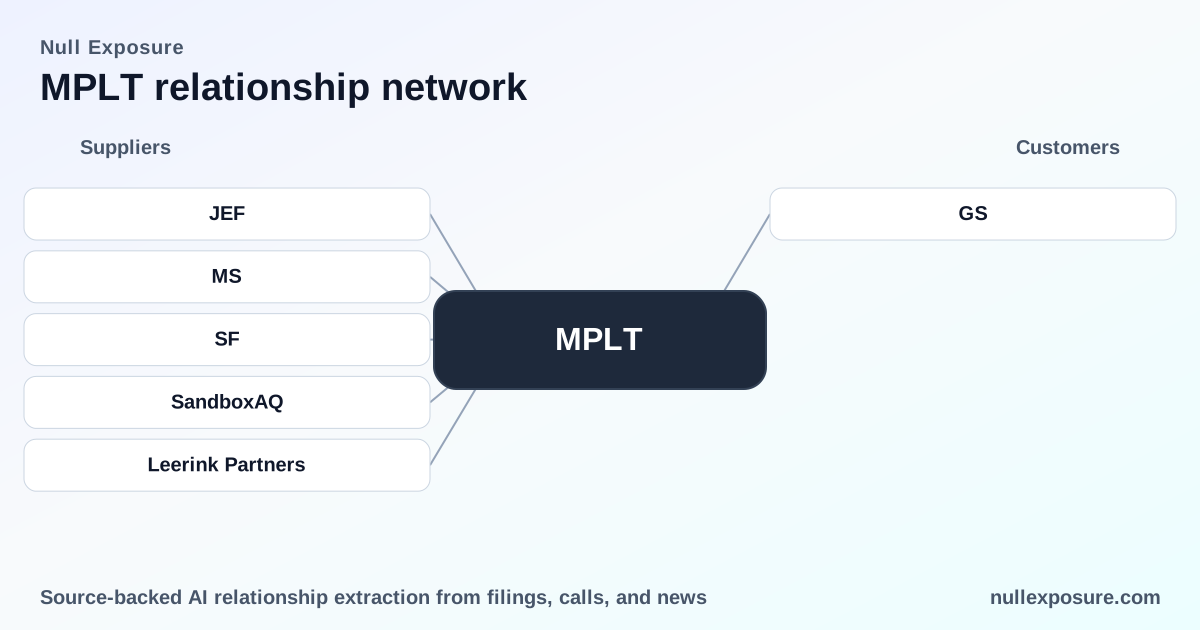
Below are the supplier and advisor relationships surfaced in public reporting and what they concretely imply for investors.
-
Jefferies — Jefferies is named as one of the joint book-running managers for MapLight’s initial public offering, indicating the firm’s role in underwriting and market placement of equity. This banking relationship demonstrates a standard capital markets engagement to support liquidity and distribution. According to a PR Newswire announcement regarding MapLight’s IPO process published March 10, 2026, Jefferies serves alongside other major banks as a joint book-runner.
-
Morgan Stanley — Morgan Stanley is also serving as a joint book-running manager on the IPO, providing institutional distribution and deal structuring support that enhances the credibility of MapLight’s capital raise. The PR Newswire filing on March 10, 2026 lists Morgan Stanley among the lead managers for the offering.
-
Stifel — Stifel appears as a joint book-running manager for the proposed offering, contributing middle‑market underwriting capacity and syndicate depth to MapLight’s equity issuance strategy. This was disclosed in MapLight’s PR Newswire announcement of the IPO on March 10, 2026.
-
Leerink Partners — Leerink Partners is included in the syndicate named in MapLight’s IPO announcement, reflecting a targeted healthcare-focused placement capability intended to reach specialist biotech investors. MapLight’s PR Newswire release dated March 10, 2026 names Leerink among the joint book-runners.
-
SandboxAQ — SandboxAQ is a technology collaborator with which MapLight entered a discovery and development deal that includes an undisclosed upfront payment and up to $200 million in preclinical, development, regulatory, and commercial milestones. This partnership signals that MapLight is outsourcing or augmenting technical discovery using external computational or AI-enabled platforms; FierceBiotech reported on the collaboration, referencing a December 16 release and covering the milestone structure in the context of MapLight’s pipeline acceleration.
What the relationships tell you about MapLight’s operating model
MapLight’s relationships indicate a milestone-driven commercialization approach and a capital formation posture that relies on boutique and bulge‑bracket bankers to underwrite dilution and validate valuation.
-
Contracting posture: Partnerships use upfront payments plus milestone tranches, typical of pre-revenue biotechs that de-risk programs by tying payments to technical and regulatory achievements. The SandboxAQ deal is a textbook example of this model with staged economics up to $200 million.
-
Concentration and criticality: A small set of powerful banks are running the IPO syndicate, concentrating execution risk in capital markets activities and making bank selection critical for pricing and aftermarket performance. On the technical side, a single named collaborator (SandboxAQ) is identified publicly—if that partner supplies unique computational capability, it becomes a critical supplier for discovery acceleration.
-
Maturity: MapLight is pre-commercial and pre-revenue, with negative EBITDA and no TTM revenues, which classifies it as an early-stage enterprise dependent on outside funding and milestone monetization.
-
Governance and stakeholder alignment: Insider and institutional stakes are both near 49%, indicating high-alignment but limited public float that can amplify share-price moves when financing or clinical news hits the tape.
Risk and upside — what to watch in diligence
-
Upside: The SandboxAQ collaboration creates a clear upside pathway via structured milestones; successful de-risking of programs could unlock large milestone payments and materially improve valuation. Major banks on the IPO syndicate reduce execution risk for near-term capital raises, improving runway if market conditions hold.
-
Risk: Zero reported revenues and negative EBITDA mean execution risk is binary—clinical or regulatory failures curtail value quickly. Concentrated reliance on a small number of financing banks introduces execution and pricing risk in an IPO or follow‑on, while a single named tech partner elevates supplier concentration risk.
-
Operational implications: Contracts should be reviewed for milestone definitions, payment timing, data ownership, and exclusivity; capital agreements should be evaluated for greenshoe, lockups, and overall dilution scenarios.
How investors and operators should act
For buy-side research and corporate diligence teams, focus on three actions: validate the terms and timing of milestone payments with SandboxAQ, assess the syndicate commitments and offering structure disclosed in the IPO documentation from March 2026, and model multiple dilution scenarios based on current cash, burn, and potential milestone inflows. If you need a centralized gateway for supplier intelligence and relationship verification, visit https://nullexposure.com/.
For operators negotiating with MapLight, insist on clear deliverables, payment triggers, and IP provisions tied to milestones to avoid open-ended obligations that can complicate downstream commercialization.
Final take
MapLight operates as a pre-revenue clinical-stage biotech using milestone‑based partner economics and capital markets underwriting to fund development. The presence of top-tier banks on the IPO syndicate and a technology collaboration with SandboxAQ are the two most consequential supplier relationships for near‑term value creation. Monitor milestone realization and the IPO execution timetable closely—the next 6–12 months will determine whether MapLight converts its partnerships into non-dilutive value or remains reliant on additional equity issuance.
For ongoing supplier-level intelligence, transaction context, and investment-grade relationship mapping, start your diligence at https://nullexposure.com/.