How Medical Properties Trust (MPT) monetizes healthcare real estate and why its supplier web matters
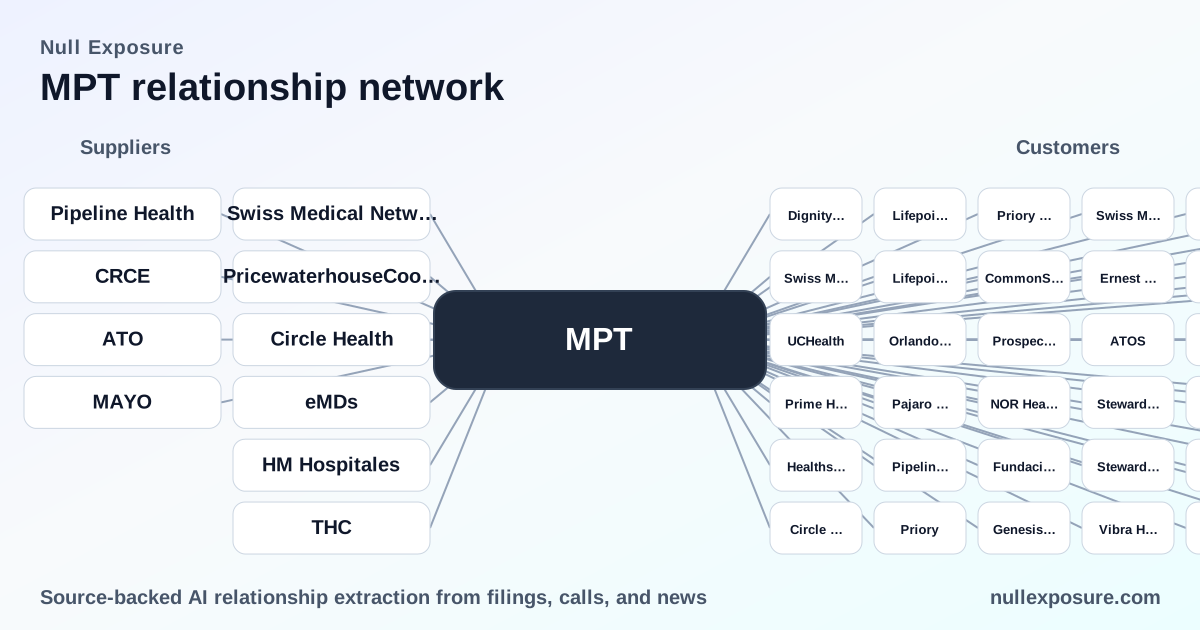
Medical Properties Trust operates as a capital-intensive owner and financier of hospital real estate, generating revenue primarily through long-term lease and mortgage arrangements with hospital operators, and by structuring secured financing around portfolios of properties. Investors should value MPT as a play on predictable, rent-like cash flows backed by tangible healthcare assets and enhanced by targeted financing transactions that extract value from operator balance sheets. For a practitioner-level view of counterparties that drive that cash flow, review the relationship map below and the operational constraints that shape risk and upside.
Explore deeper supplier intelligence at https://nullexposure.com/.
What the company signals about contracts and capital exposure
MPT’s public disclosures and earnings commentary establish a contracting posture that favors long-tenor, secured commitments and asset-level financing. The firm’s filings include references to “Long-term first mortgage loan,” indicating a preference for security and enforceable creditor positions rather than short-dated, unsecured exposure. Separately, balance-line evidence consistent with a >$100 million exposure band signals material single-counterparty or facility-level commitments that are large enough to influence portfolio risk and financing strategy. These are company-level characteristics: long-term secured contracts, sizable individual exposures, and capital-heavy arrangements that make tenant credit and collateral enforcement central to valuation.
How each counterparty fits into MPT’s operating picture
Below are the relationships surfaced in MPT’s supplier scope, each summarized in plain English with a concise source reference.
Swiss Medical Network — strong continental European operator
MPT referenced Swiss Medical Network as reporting solid year-over-year growth in hospital EBITDARM, indicating that this operator is delivering improved underlying cash generation for MPT’s leased assets in Continental Europe. Source: MPT 2025 Q4 earnings call commentary (2025Q4).
PricewaterhouseCoopers LLP — external auditor of internal controls
PricewaterhouseCoopers LLP audited the effectiveness of MPT’s internal control over financial reporting as of December 31, 2024, providing independent attestation to the reliability of financial statements and controls. Source: MPT FY2024 10‑K (filed December 31, 2024).
Circle Health — U.K. anchor operator with secured financing link
MPT highlighted Circle Health as a UK general acute operator sustaining strong performance; Circle is also connected to a secured loan facility collateralized by 27 properties leased to Circle affiliates, underscoring a blend of operational tenancy and structured financing. Source: MPT 2025 Q4 earnings call (2025Q4) and MPT FY2024 10‑K describing the secured loan facility for the Circle portfolio (FY2024).
eMDs — steady-performing operator partner
The company cited eMDs among operators that continue to deliver steady performance trends, positioning eMDs as a stable tenant group within MPT’s portfolio. Source: MPT 2025 Q4 earnings call (2025Q4).
HM Hospitales — consistent European operator
HM Hospitales was mentioned alongside other operators for producing steady performance trends, reinforcing diversification across continental European hospital operators. Source: MPT 2025 Q4 earnings call (2025Q4).
Tenet Healthcare — buyer/seller in prior portfolio transactions
Records show MPT acquired Palmetto General Hospital from an affiliate of Tenet Healthcare as part of South Florida portfolio expansion in 2021, illustrating MPT’s use of large, market transactions to scale regional exposure. Additional 2021 transactions involved Tenet-affiliated sellers in portfolio deals. Source: The Real Deal reporting on MPT purchases in 2021 (FY2021).
Pipeline Health — former operator that declared bankruptcy
Pipeline Health—an operator that MPT acquired hospitals from in prior transactions—declared bankruptcy after MPT purchased Los Angeles hospitals, highlighting counterparty distress that can crystallize asset- and reputational risk for MPT. Source: Mother Jones coverage of the Pipeline Health situation (FY2025 coverage of events originating in 2022).
Circle (CRCE) — borrower-linked secured facility for UK properties
MPT’s FY2024 filing discloses it closed a secured loan facility of approximately £631 million (about $800 million) secured by a portfolio of 27 properties leased to affiliates of Circle, reflecting large-scale, structured finance anchored by operator leases. Source: MPT FY2024 10‑K (FY2024).
Atos — additional operator showing steady trends
Atos was grouped by management as another operator producing steady performance trends, a signal that MPT’s exposure includes operators across different geographies and service models. Source: MPT 2025 Q4 earnings call (2025Q4).
Mayo Clinic — strategic clinical collaboration partner
MPT noted a new clinical collaboration with the Mayo Clinic, described as enhancing MPT’s long-term capabilities and international reputation—this positions Mayo as a strategic partner that can improve operator quality and asset marketability. Source: MPT 2025 Q4 earnings call (2025Q4).
What this pattern means for investors — risk and return mechanics
- Concentration of large, secured exposures: The presence of >$100M-scale facilities and a disclosed “long-term first mortgage loan” emphasize that MPT’s balance sheet is structured around large, asset-backed commitments; this supports stable cash flows but raises single-name exposure risk if an operator deteriorates.
- Operational criticality and counterparty credit: MPT’s economics are directly tied to operator EBITDARM and occupancy dynamics; operator bankruptcies like Pipeline crystallize downside on both cash flow and repositioning costs. Tenant credit is therefore a first-order risk driver.
- Maturity and enforceability: The company’s preference for long-term secured arrangements increases enforceability of creditor rights but also requires active asset management to realize value when operators fail.
- Diversification across geographies and operator types: References to U.K., Continental Europe, and U.S. operators (Circle, Swiss Medical Network, HM Hospitales, Tenet) show geographic diversification that cushions localized shocks but creates exposure to multiple regulatory and reimbursement regimes.
For a disciplined review of counterparties and contract structures across healthcare real estate portfolios, visit https://nullexposure.com/ to see how supplier relationships translate into balance-sheet risk and value.
Practical investor takeaways
- Underwrite tenant credit, not just bricks-and-mortar: MPT’s return profile is driven by operator earnings and lease durability. Treat large mortgage-like facilities as de facto credit lines tied to specific operators.
- Bankruptcy history is an active risk: Pipeline Health’s experience demonstrates that even post-transaction operator distress can impose asset repositioning costs and reputational complexity.
- Structured financing is core to the model: The Circle secured facility and similar transactions show MPT uses financing to extract liquidity from leased portfolios while retaining landlord upside.
If you evaluate healthcare REIT exposures or run counterparty stress tests, MPT’s supplier map is essential context. Dive into curated relationship intelligence at https://nullexposure.com/ for comparative analytics and source-level references.
Concluding view: MPT’s model delivers rent-like, secured cash flows but concentrates performance risk in tenant operations and a handful of large financings; investors should balance yield expectations against counterparty credit and workout complexity. For more granular supplier analysis and portfolio-level scenario planning, return to https://nullexposure.com/.