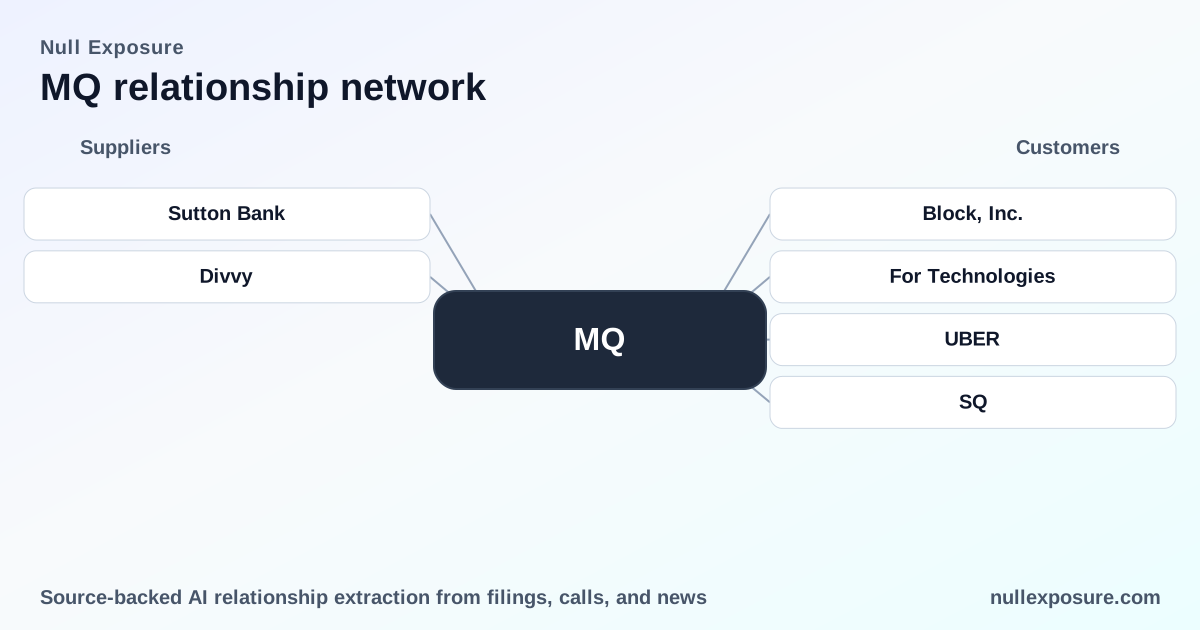
MQ Supplier Landscape: Sutton Bank, Divvy, and the issuer dependency investors must price
Marqeta operates as a card issuing and modern payments processing platform that monetizes through per-transaction processing fees, program management charges, and value-added integrations with corporate card partners. Its go-to-market depends on a two-tier supplier model: Issuing Banks that provide regulatory sponsorship and settlement rails, and commercial partners (card program clients) that drive transaction volume and product distribution. Investors should evaluate Marqeta’s supplier concentration and contractual posture as core inputs to revenue durability and operational risk. For deeper supplier intelligence, visit the NullExposure homepage: https://nullexposure.com/.
How Marqeta’s supplier model turns into revenue
Marqeta’s platform is fee-driven: it extracts revenue from processing volume and program services while outsourcing certain regulatory and settlement functions to issuing banks and card networks. Issuing Banks perform card issuance, Card Network sponsorship, settlement, and often provide the deposit accounts used to settle transactions, while Marqeta provides the orchestration, tokenization, and authorization infrastructure that clients buy. This division of labor lets Marqeta scale client-facing product features while relying on third parties for regulated banking capabilities.
- Contracting posture: Public disclosures indicate Marqeta operates with multi-year supplier arrangements that include auto-renewal provisions and defined notice periods, signaling an embedded operational posture rather than ad-hoc short-term contracts.
- Concentration and criticality: Company filings show a high concentration of settlement flow through a single issuing bank across multiple years, creating a single-point dependency that is material to TPV (total payment volume).
- Service provider role: Marqeta treats issuing banks as service providers whose fees are tied to processing volume or per-transaction schedules, so margin and unit economics are sensitive to provider fee schedules and routing mixes.
- Maturity: At least one core bank relationship traces back years, reflecting an entrenched programmatic relationship rather than a nascent vendor tie.
These characteristics collectively mean that Marqeta’s top-line growth is scalable through product adoption but sits on the operational backbone provided by a small number of critical suppliers.
What the public record lists (every relationship in the results)
Sutton Bank
Sutton Bank is Marqeta’s largest issuing bank partner by processing volume; Marqeta reports that a single issuing bank accounted for 70% of TPV in 2024 (down from 76% in 2023 and 82% in 2022), and notes an ongoing prepaid card program manager agreement with Sutton Bank initiated on April 1, 2016. This relationship is explicitly documented in Marqeta’s FY2024 10-K. (Source: MQ FY2024 10-K filing)
Divvy
Marqeta enables Divvy to offer integrated physical and virtual corporate cards with enhanced spend controls and data insights, reflecting a commercial partnership that surfaces Marqeta’s issuance and processing capabilities into enterprise card products. The arrangement is described on Marqeta’s own blog as supporting Divvy’s corporate card functionality (noted in Marqeta’s public communications covering FY2023). (Source: Marqeta blog post on the Divvy partnership)
The key supplier risks investors need on their radar
Single-bank settlement concentration is the principal operational risk. Marqeta’s public filing shows that a single issuing bank handled the bulk of settlement volume for three consecutive years, with the concentration easing but still dominant in 2024. That level of concentration creates vulnerability to sponsor-bank commercial renegotiation, regulatory changes, or operational disruptions that could interrupt settlement flows or compress margins.
Contracts are embedded and multi-year, reducing churn but increasing switching frictions. Company disclosures describe supplier agreements with multi-year terms and automatic renewal mechanics that lock in commercial terms and routing relationships through at least 2028 unless terminated with long notice periods. That structure is a double-edged sword: it supports revenue predictability and customer experience continuity, but it also concentrates negotiation leverage over renewal windows.
Issuing banks are service providers with volume-linked fee mechanics: the compensation model for issuing banks and card networks is tied to processing volume or fixed per-transaction fees, so margin dynamics depend on the routing mix and any changes in fee schedules the bank or networks institute. Marqeta’s margin and net revenue retention are therefore coupled to supplier economics as well as client growth.
Operational implications for valuation and diligence
For investors and operating partners, focus due diligence on three areas:
- Counterparty stability: verify the regulatory and capital profile of Marqeta’s issuing banks and the practical ability to transfer sponsorship if needed. The FY2024 filing establishes an entrenched operational relationship that dates back to 2016 for at least one program manager agreement (Sutton Bank), which affects portability.
- Contract detail: confirm renewal triggers, termination notice windows, and fee escalation clauses—public language shows an agreement term extending to 2028 with automatic two-year renewals unless notice is given 180 days prior, which shapes timing of any renegotiation risk.
- Contingency readiness: assess Marqeta’s technical and commercial ability to repartition settlement flows to alternative sponsors without material customer friction—this is the core mitigation to single-bank concentration.
If you want a consolidated supplier mapping and a checklist to support diligence, visit the NullExposure homepage for targeted supplier intelligence: https://nullexposure.com/.
Relationship-level takeaways for asset managers
- Sutton Bank: core issuance partner and the dominant settlement counterparty; historical TPV concentration through a single bank implies high criticality and operational dependence. The partnership includes a long-standing prepaid card program manager relationship dating to 2016, underscoring maturity and embeddedness. (Source: MQ FY2024 10-K)
- Divvy: strategic commercial integration that showcases Marqeta’s value to enterprise card clients through integrated physical/virtual cards and spend controls; this partnership exemplifies product-market fit on the merchant/client side rather than banking sponsorship. (Source: Marqeta blog covering the Divvy partnership, FY2023 discussion)
Bottom line and next steps
Marqeta’s platform economics are structurally attractive: fee-for-volume monetization with product-led client engagement. However, investors must price in meaningful supplier concentration and a supplier-driven margin lever. Contracts are long enough to provide near-term predictability, but concentration means operational disruptions or unfavorable renewals could have outsized P&L and go-to-market consequences.
For a focused supplier risk brief and ongoing monitoring tools tailored to payments and issuing ecosystems, explore practical intelligence at NullExposure: https://nullexposure.com/.