MRAM supplier relationships: what investors need to know about Everspin’s foundry and IR links
Everspin Technologies (ticker: MRAM) designs and sells MRAM memory products while outsourcing most fabrication and assembly to external foundries and service providers; the company monetizes through device sales, development partnerships and investor-facing communications that support capital markets visibility. For investors and operators, the core investment question is whether Everspin’s external manufacturing posture delivers scale and roadmap progression without creating single-source operational risk.
Explore full supplier map on NullExposure
How the supplier map frames the business model
Everspin’s public disclosures and press activity show a clear outsourced manufacturing model and an active supplier engagement posture. Company-level text specifies that Everspin “relies on third-party suppliers for most phases of the manufacturing process, including initial fabrication, final test, and assembly,” which is a direct signal that the firm acts as fabless for MRAM production. That operating posture drives three practical characteristics for investors:
- Contracting posture: Everspin is dependent on contractual relationships with leading foundries and service providers; intellectual property resides with Everspin while process execution sits with partners.
- Concentration risk: Relying on a small set of advanced foundries concentrates operational risk if capacity, yield, or capacity allocation issues arise.
- Maturity and criticality: Long-running joint development agreements and public tape-out milestones indicate a multi-year development cadence where foundry milestones are critical to time-to-market.
These company-level signals set the frame for the supplier relationships listed below and for how investors should monitor operational progress.
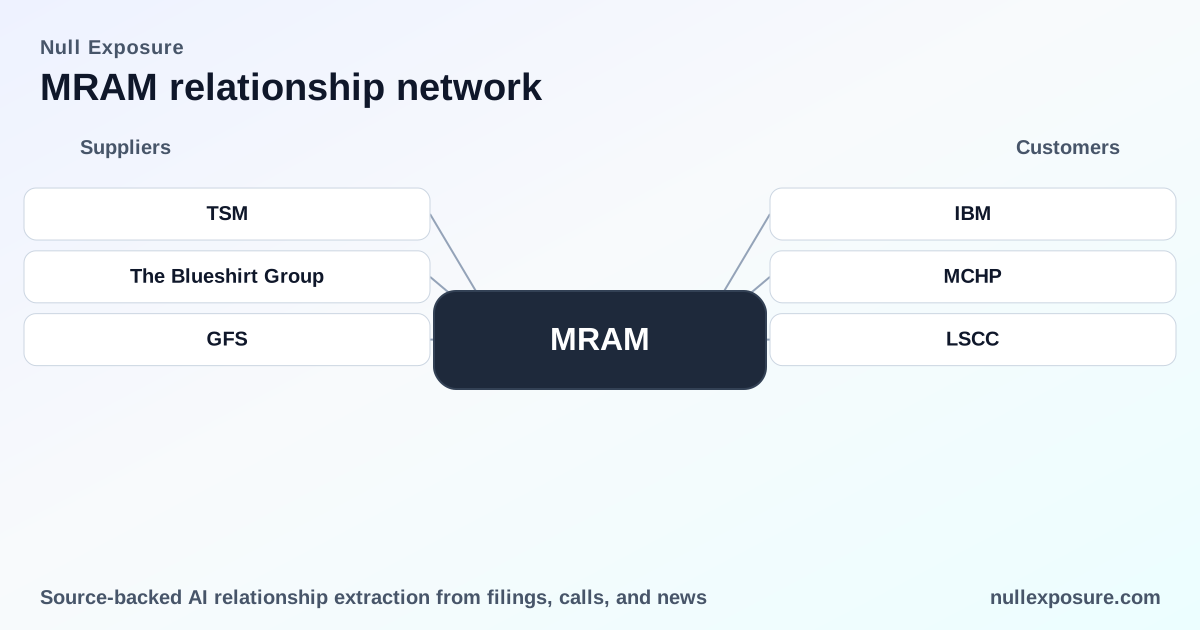
TSMC — advanced node tape-out underway
Everspin reported that it is “on track to tape out a monolithic 256‑megabit xSPI STT‑MRAM device on a 16‑nanometer FinFET node at TSMC in the second half of this year.” This is a near-term, high‑visibility product milestone tied directly to TSMC’s process capability, and it represents a step toward higher-density MRAM on mainstream logic nodes. According to Q4 2025 earnings call transcripts reported on March 10, 2026, by The Globe and Mail and InsiderMonkey, management publicly tied that tape‑out schedule to TSMC’s 16 nm FinFET node. (Sources: Q4 2025 earnings call transcript coverage, The Globe and Mail, March 10, 2026; InsiderMonkey, March 10, 2026.)
GLOBALFOUNDRIES — long-running joint development for scaled nodes
Everspin extended its Spin‑transfer Torque (STT‑MRAM) joint development agreement with GLOBALFOUNDRIES to work toward a 12 nm capability, reflecting an established development relationship dating back to at least FY2020. This JDA extension demonstrates a multi-year engineering collaboration that supports Everspin’s roadmap for MRAM scaling on specialty foundry processes. (Source: TechPowerUp coverage of the JDA amendment, 2020.)
The Blueshirt Group — outsourced investor relations on record
Everspin’s investor relations contact information lists The Blueshirt Group and Monica Gould as the IR point of contact in press releases covering FY2024 and FY2026 events, indicating that investor communications are handled through an external PR/IR firm. This is an operational choice that supports consistent market engagement and conference participation scheduling. (Sources: BizWire / FinancialContent press release, FY2024; BizWire / WorldNow press release about the Needham Growth Conference, FY2026.)
How the relationships translate into operational risk and opportunity
Everspin’s supplier map is coherent: product R&D and IP are internal; process execution, scale and supply continuity are external. That dynamic creates both leverage and vulnerability.
- Strategic upside: The TSMC tape‑out on 16 nm and the long-standing GLOBALFOUNDRIES JDA provide access to leading and specialty process nodes without the capital burden of owning a wafer fab. Successful tape‑outs convert directly into product launches and revenue expansion, accelerating addressable market capture for MRAM in embedded and discrete applications.
- Operational risk: Outsourcing to a small number of foundries concentrates execution risk. If either TSMC or GLOBALFOUNDRIES encounters capacity constraints, prioritization decisions, or yield issues, Everspin’s shipments and roadmap timing are the first casualty. The company-level disclosure that it “relies on third-party suppliers for most phases of the manufacturing process” underlines that vulnerability.
- Contractual levers and maturity: The GLOBALFOUNDRIES JDA extension to 12 nm is evidence of mature collaboration; such agreements typically include co‑development terms, IP protections, and prioritized process support, which mitigates some—but not all—supply risk. The presence of a dedicated IR firm (The Blueshirt Group) is a separate operational choice that improves investor access and message discipline but does not affect manufacturing execution.
Key takeaway: Everspin’s revenue growth is contingent on partner-delivered process milestones; the TSMC tape-out is the immediate operational event to watch, while the GLOBALFOUNDRIES JDA signals longer-term scaling capability.
Monitor supplier risk and roadmap exposure on NullExposure
Practical monitoring checklist for investors and operators
Active monitoring should focus on near-term foundry milestones and contractual protections:
- Track public confirmations of wafer tape‑outs, yield ramp cadence, and characterization results tied to the TSMC 16 nm program.
- Watch for production allocation notices or capacity commentary from TSMC and GLOBALFOUNDRIES that could affect wafer supply windows.
- Review Everspin’s filings and press releases for updated language on “third-party suppliers” to detect any shifts toward captive capacity or new foundry partners.
- Confirm that development agreements include priority access, IP carve-outs, and testing/assembly SLAs to limit downstream supply disruptions.
Investors should treat the TSMC tape‑out as a binary near-term catalyst and the GLOBALFOUNDRIES JDA as a structural support for future node scaling.
Final thoughts and next steps
Everspin’s model is classic fabless: internal design, external execution. That model enables capital-efficient scaling but concentrates operational risk in a small number of foundry partners. For investors, the immediate focus is execution evidence—yields, sample availability, and early customer qualification tied to the TSMC 16 nm tape‑out—while longer-term diligence should assess contractual protections embedded in the GLOBALFOUNDRIES JDA. Externalized IR via The Blueshirt Group supports market transparency but does not substitute for technical progress.
If you want a consolidated view of supplier exposures and development milestones to inform due diligence, start with the supplier map on NullExposure. Explore full supplier map on NullExposure
For direct operational benchmarking or investor‑facing materials that reference supplier timelines, use these signals to prioritize engagement areas and conference questions for management. Explore full supplier map on NullExposure