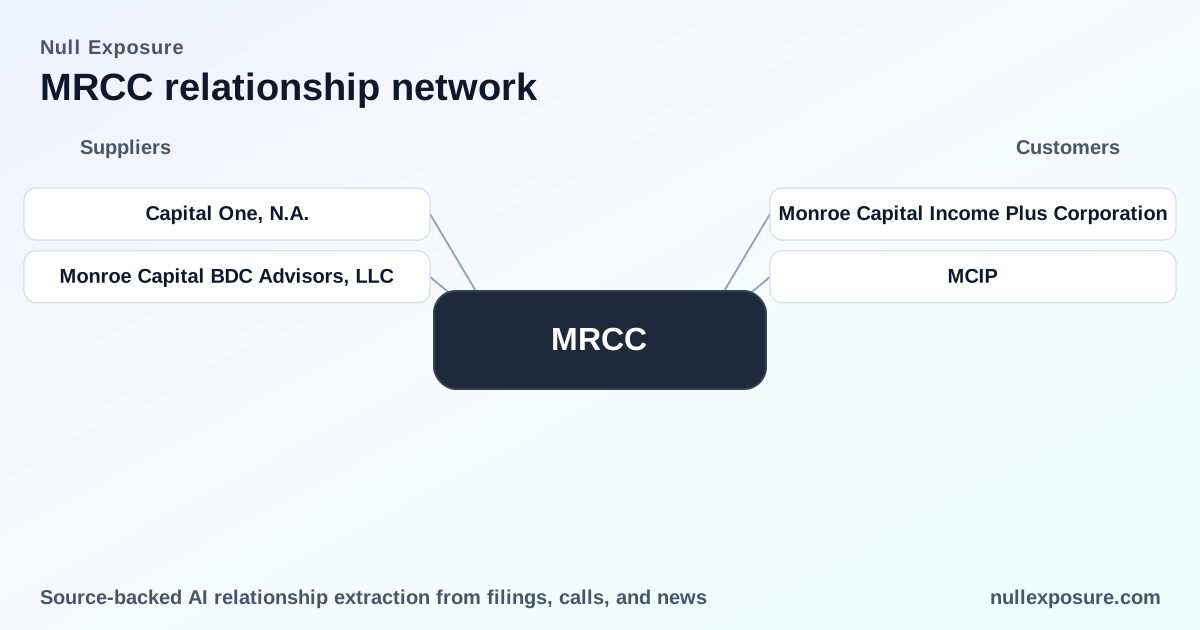
Monroe Capital Corporation (MRCC): Supplier relationships that define operations and risk
Thesis — Monroe Capital Corporation (ticker MRCC) operates as a closed‑end business development company that earns yield by originating and acquiring private credit assets while outsourcing investment management and administration. The company monetizes through portfolio interest and fee income and delegates day‑to‑day investing and back‑office functions to Monroe Capital affiliates under fee agreements; financing relationships such as a senior secured revolver provide working capital and leverage. Investors should focus on the contractual terms, counterparty concentration, and the practical ability of those suppliers to resign or be replaced without operational disruption.
For a concise gateway into our supplier mappings and signal analysis, visit https://nullexposure.com/.
Why supplier mapping matters for MRCC investors
Monroe’s economics are straightforward: portfolio returns feed distributions, while an external adviser and administrator collect management and incentive fees. That outsourcing model concentrates operational dependence on a small set of counterparties and creates convertible operational risk into investment risk — if the adviser or administrator changes, asset sourcing, portfolio monitoring, and even cybersecurity posture change with it. The supplier footprint is therefore a first‑order driver of MRCC’s execution risk and cost structure.
What the record shows — each named relationship
Capital One, N.A.
Capital One provides a senior secured revolving credit facility used by MRCC’s financing SPV (SLF SPV). According to MRCC’s FY2024 10‑K filing, SLF has a senior secured revolving credit facility with Capital One, N.A., which underpins short‑term liquidity and leverage for the SLF vehicle (10‑K, FY2024).
Takeaway: Capital One is MRCC’s bank lender for the SLF financing vehicle and is a core funding counterparty for the SLF structure.
Monroe Capital BDC Advisors, LLC
Monroe Capital BDC Advisors, LLC is the SEC‑registered investment adviser that manages MRCC’s investment activities; multiple company press releases and filings reiterate that the company’s investing activities are managed by this adviser, an affiliate of Monroe Capital LLC (GlobeNewswire, Dec 2025 and Mar 2026; The Globe and Mail, Dec 2025). Takeaway: MC Advisors is the primary investment decision‑maker and earns base management and incentive fees, making it the operational center of MRCC’s investing engine.
Contractual posture and operational constraints that matter
MRCC’s supplier profile reveals several binding operational characteristics that investors must internalize when evaluating the company.
-
Service provider concentration and active stage. The relationship evidence identifies MC Advisors and MC Management as the active service providers for investment advisory and administration, respectively, and MRCC is currently operating under those agreements (company filings and press releases, FY2025–FY2026). This concentration concentrates sourcing, diligence, and portfolio management functions in a small supplier set.
-
Resignation rights drive replacement risk. The investment advisory and administration agreements explicitly grant MC Advisors and MC Management the unilateral right to resign with 60 days’ written notice without penalty; MRCC recognizes the risk of not finding equivalent replacement expertise within that window (10‑K excerpts). This creates a short replacement runway and meaningful continuity risk.
-
Fee alignment and monetization mechanics. MC Advisors is paid a two‑part fee (a base management fee and an incentive fee) under the Investment Advisory and Management Agreement, which aligns the adviser’s cash receipts to both assets under management and performance (10‑K excerpt). Fees materially affect net yield to equity holders and should be tracked relative to portfolio yields.
-
Administration scope and cost pass‑throughs. An Administration Agreement has MC Management furnishing office facilities, clerical, bookkeeping and recordkeeping services and potentially reallocating overhead costs to SLF and the Company, indicating that administrative costs are partly recovered via reimbursements (10‑K excerpts). Operational cost volatility can therefore flow through via reimbursable expense mechanics.
-
Cybersecurity dependency. MRCC formally relies on cybersecurity strategy and policies implemented by Monroe Capital, the parent of both MC Advisors and MC Management, which centralizes security oversight but also centralizes cyber risk (10‑K excerpt). A supplier breach at the parent or adviser could have immediate operational consequences for MRCC.
-
Geography and business segment signals. Company‑level signals show a U.S. regional footprint (midwest tagging) and a services segment orientation; treat these as firm‑level characteristics rather than relationship‑specific attributes (company metadata).
For a consolidated view of supplier contract language and operational signals, see https://nullexposure.com/.
Operational and investment implications — what investors should watch
Hedge and monitoring priorities flow directly from the supplier picture:
-
Monitor any public notice or corporate filing that the adviser or administrator has initiated resignation or contract renegotiation; a 60‑day runway to replace the adviser is short and materially heightens execution risk.
-
Track fee pressure vs. portfolio yield; rising advisor fees or expense pass‑throughs compress distributable earnings and can force distribution cuts even if portfolio cashflow is stable.
-
Watch liquidity metrics and debt covenants tied to the Capital One revolver; bank funding availability underpins SLF leverage and distribution sustainability.
-
Maintain cyber and ops due diligence: because MRCC depends on Monroe Capital’s centralized cybersecurity program, any adverse security event at the parent or adviser is directly relevant to business continuity.
Practical checklist for relationship diligence
- Confirm the effective dates and renewal mechanics in the Investment Advisory and Administration Agreements (filings).
- Review recent press releases and shareholder communications for disclosures about adviser performance and fee calculations (GlobeNewswire, Globe and Mail, FY2025–FY2026).
- Validate the terms of the Capital One credit facility in the 10‑K for availability, covenants, and maturity profile (10‑K, FY2024).
If you want an executive summary or a tailored supplier risk brief for MRCC, request an analyst note at https://nullexposure.com/ — we map contractual signals to valuation scenarios.
Conclusion — tradeoffs are clear and actionable
Monroe’s outsourced model gives investors a concentrated operational counterparty exposure to MC Advisors/MC Management and a material lender relationship with Capital One. That concentration creates both operational efficiency and replaceability risk: the adviser and administrator control deal sourcing, monitoring, and cybersecurity, while a bank facility supplies leverage. Investors who underwrite MRCC’s yield must underwrite the stability of those supplier relationships and the fee mechanics that reduce distributable cashflow. For ongoing monitoring and supplier stress indicators, visit https://nullexposure.com/ where we maintain mapped relationship timelines and contract‑level signal alerts.