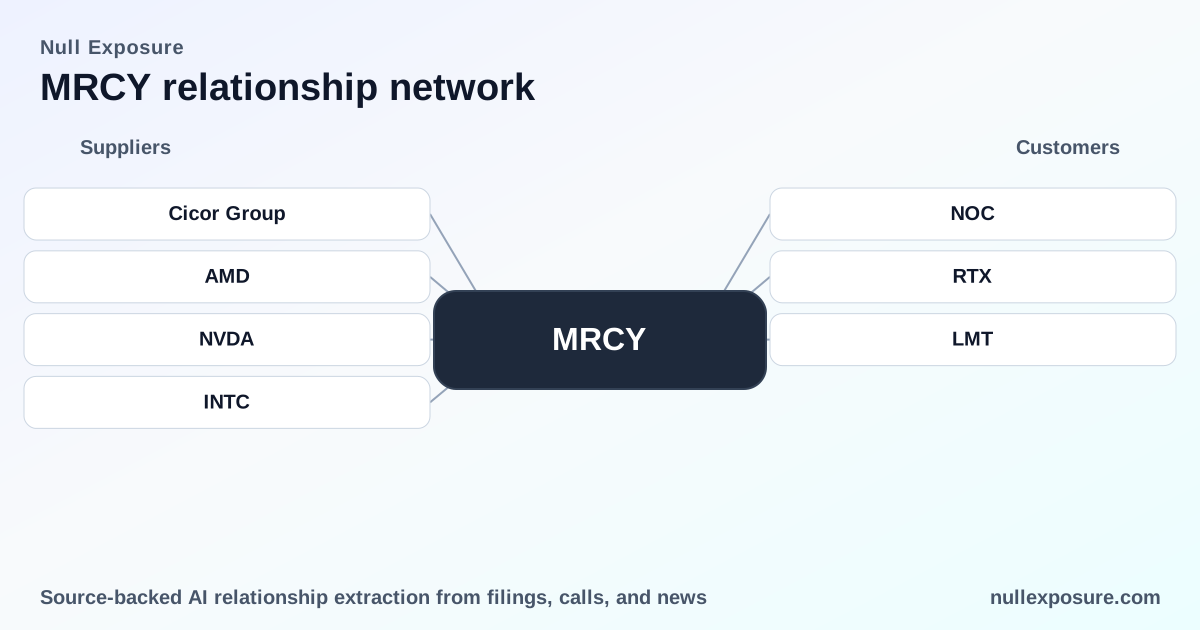
Mercury Systems (MRCY) — Supplier Relationships and Operational Constraints
Mercury Systems monetizes by taking commercial semiconductor and compute technology and converting it into mission‑qualified, ruggedized subsystems for defense and space customers. The company captures value through engineering integration, systems-level productization, and long-cycle government contracts and program wins that embed Mercury as a systems supplier rather than a simple component reseller. For investors, the core revenue levers are subsystem margins, program awards, and the firm’s ability to source advanced chips and turn them into dependable, fielded systems.
Explore deeper supplier intelligence and relationship analytics at https://nullexposure.com/.
Why suppliers define MRCY’s economics
Mercury’s business model is an integrator’s model: the company depends on advanced commercial silicon (FPGAs, AI accelerators, storage drives) and converts those inputs into certified subsystems for mission‑critical applications. That operating posture combines internal manufacturing with subcontracting to meet volume and qualification requirements, and it places supplier selection and supply‑chain timing at the center of program economics.
- Contracting posture: Purchase commitments are concentrated in the near term, implying a working‑capital and procurement focus around program delivery.
- Manufacturing mix: Mercury balances vertical integration with outsourced contract manufacturing in the U.S., which controls quality while providing capacity flexibility.
- Criticality: Suppliers that provide high‑performance FPGAs and AI compute are functionally critical — their availability directly affects Mercury’s ability to meet program milestones and revenue recognition.
If you want continuous monitoring of supplier exposures and program signals, visit https://nullexposure.com/ for more actionable intelligence.
What the record shows about individual suppliers
Below are all supplier relationships surfaced in public filings and coverage; each entry gives a plain‑English summary and the source used to document it.
Cicor Group
Mercury disclosed that it outsourced its former Swiss manufacturing operations to Cicor Group during fiscal 2025, a move flagged in its Form 10‑K as a factor that could enhance international operational risks. Source: Mercury Systems Form 10‑K, fiscal year ended June 27, 2025.
AMD (Advanced Micro Devices)
Mercury is shipping radiation‑tolerant storage and processing subsystems built around AMD Versal™ AI Core FPGAs, and press releases indicate multiple U.S. satellite programs and space/strategic weapons awards have adopted these AMD‑based subsystems. Source: Mercury press release reported by The Globe and Mail and corroborated by industry coverage in March 2026.
NVIDIA
Industry commentary positions Mercury at the intersection of AI compute and defense, ruggedizing NVIDIA GPUs and other advanced accelerators so they operate reliably in space and extreme military environments, which expands Mercury’s addressable content per subsystem. Source: Finviz market note, March 10, 2026.
Intel
Market analysis and coverage highlight Mercury’s role converting high‑end commercial silicon from Intel into mission‑qualified systems, with Intel counted among the commercial technology families the company adapts for defense customers. Source: FinancialContent / Finterra analysis, February–March 2026.
Operational constraints and company‑level signals investors must weigh
The public record supplies a compact set of company‑level constraints that shape supplier risk and procurement strategy:
- Short‑term purchase obligations: Mercury reported purchase commitments totaling $206.4 million at June 27, 2025, with a material portion scheduled in the near term (the filing lists “Less Than 1 Year $181,186” in the commitments schedule). This points to meaningful near‑term cash and supply commitments that demand active procurement management.
- Geographic manufacturing posture: The company subcontracts assembly and testing to contract manufacturers in the U.S. to build to Mercury’s specifications, signaling a deliberate onshore manufacturing footprint for critical subsystems.
- Manufacturer and subcontracting mix: Mercury explicitly relies on both vertical integration and subcontracting to meet manufacturing needs, a hybrid model that balances control over quality with capacity flexibility.
Collectively, these constraints describe a supplier ecosystem with near‑term payment timing pressure, onshore subcontracting preference, and a hybrid manufacturing posture — all of which determine how supplier disruptions or commercial silicon shortages affect delivery and margins.
How these relationships shape upside and risk
- Upside: Access to the latest commercial accelerators and FPGAs (AMD, NVIDIA, Intel) allows Mercury to deliver higher‑value, differentiated subsystems that command program awards and extend revenue visibility into long‑cycle defense programs. Public contract announcements tied to AMD Versal FPGAs illustrate how chip supplier selection converts into new program wins.
- Risk: Reliance on a small set of advanced commercial silicon families creates supply concentration risk and commercial‑cycle exposure; timing or allocation problems at chip suppliers translate quickly into program schedule risk for Mercury. The company’s sizable near‑term purchase commitments increase this sensitivity.
- Operational mitigation: The hybrid model of in‑house assembly plus U.S. contract manufacturing and the occasional outsourcing of non‑core factories (e.g., the Cicor arrangement) give Mercury tools to manage capacity, but they do not eliminate supplier concentration risk for mission‑critical components.
For ongoing supplier signal tracking and to benchmark Mercury’s procurement posture against peers, visit https://nullexposure.com/.
Bottom line for investors and operators
Mercury Systems captures margin by converting commercial chips into mission‑qualified subsystems, and its supplier map—centered on AMD, NVIDIA, Intel and complemented by contract manufacturers such as Cicor—directly determines program delivery and revenue trajectory. The company’s near‑term purchase commitments and its hybrid manufacturing posture are the practical levers investors should monitor: they are where supply risk converts into financial risk and where operational execution drives valuation outcomes.
For deeper supplier relationship intelligence and monitoring tailored to investor workflows, go to https://nullexposure.com/.