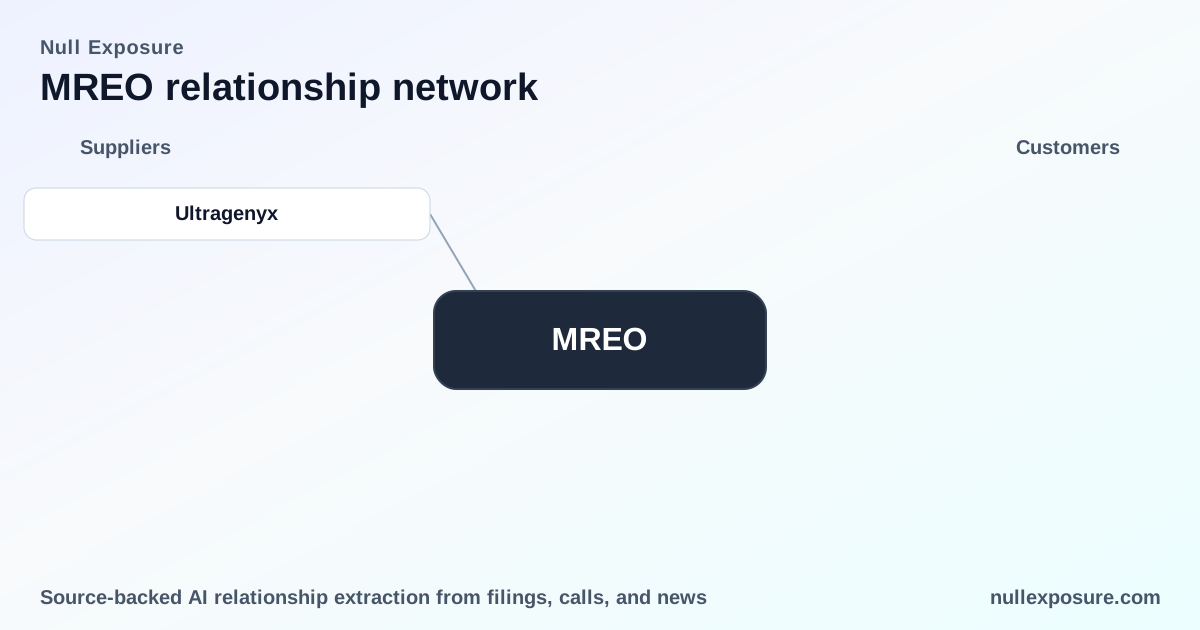
MREO supplier map: how manufacturing choices shape commercial optionality
MREO operates as a development-stage biopharma that outsources core R&D, clinical operations and manufacturing to third parties and monetizes by advancing assets toward commercialization and through partner-sourced manufacturing and supply arrangements. The company’s working model transforms fixed internal manufacturing capacity into contract relationships for clinical and commercial supply, with downstream monetization dependent on successful asset progression and third-party supply continuity—most materially evidenced by a December 2024 manufacturing and supply agreement for setrusumab. For a concise supply-risk checklist and supplier provenance, visit https://nullexposure.com/.
The single named supplier: Ultragenyx manufactures setrusumab
Mereo has an explicit manufacturing and supply agreement with Ultragenyx under which Ultragenyx is responsible for the manufacture and supply of Mereo’s therapeutic candidate, setrusumab, in Mereo’s territories. According to Mereo’s FY2024 10‑K filing (December 31, 2024), this manufacturing and supply agreement formalizes Ultragenyx’s role as the contract manufacturer for that asset and is presented under Material Agreements. (FY2024 10‑K, Item 1; reported December 2024.)
What that relationship means in plain English
- Ultragenyx is the named contract manufacturer for Mereo’s setrusumab program, taking responsibility for production and supply to Mereo’s territories under a December 2024 agreement. This makes Ultragenyx a critical execution partner for Mereo’s near-term manufacturing needs. (Mereo FY2024 10‑K, Material Agreements; Dec 2024.)
- The contract is framed as a typical third‑party manufacturing and supply arrangement rather than an internal manufacturing investment, underscoring Mereo’s reliance on external capacity and expertise to scale product supply if the program progresses. (Mereo FY2024 10‑K, Item 1; Dec 2024.)
The broader supplier posture: company-level operating constraints and implications
Mereo’s public disclosures establish a disciplined, outsourced operating model that has several predictable characteristics for investors and operators:
- Global supplier footprint. Mereo sources R&D, manufacturing, consulting and other services from providers across the U.S., EU, U.K., Switzerland, India and China. That geographic spread reduces single-country concentration but expands logistical and regulatory complexity across multiple jurisdictions. (Company disclosure on supplier geographies.)
- Outsourced manufacturing as the default strategy. Mereo explicitly relies on third‑party CMOs for clinical and potential commercial supply, and it contracts CMOs to develop processes and scale‑up for Phase 3 and commercialization. This is a deliberate contracting posture: low capital intensity for internal factories, higher dependency on supplier performance and contractual protections. (Company disclosures on reliance on CMOs for production and scale‑up.)
- Service-provider dependency for trials. The company depends on CROs and clinical sites to deliver trials on time and to standard, making trial delivery a function of third‑party operational quality as much as internal trial management. (Company disclosure regarding reliance on CROs and clinical trial sites.)
- Manufacturing supply chain responsibilities remain with CMOs. Mereo’s CMOs are expected to source raw materials to Mereo’s specifications, which places supply‑chain risk partly on suppliers’ vendor networks and procurement discipline. (Company statement on CMOs purchasing raw materials meeting Mereo specifications.)
- Modest near-term committed spend. Manufacturing commitments with CMOs were $0.5 million as of December 31, 2024 (versus $4.2 million in 2023), indicating relatively low committed cash outlays for manufacturing capacity at the reporting date; this influences counterparty leverage and the company’s flexibility in renegotiation or supplier transition. (Footnote on manufacturing commitments, FY2024 reporting.)
Collectively, these signals portray a company that is operationally lean on manufacturing assets but materially reliant on third‑party providers for execution and supply continuity.
Risk profile and strategic implications for investors and operators
- Single‑asset concentration risk: With Ultragenyx contractually responsible for setrusumab supply, disruptions to that partner could directly interrupt Mereo’s ability to supply the asset in its territories. Ultragenyx is a critical node for that program as of the December 2024 agreement. (Mereo FY2024 10‑K, Material Agreements; Dec 2024.)
- Contract leverage and spend dynamics: Low committed manufacturing spend ($0.5M at year‑end 2024) confers operational flexibility but also signals limited near‑term sunk cost in securing capacity, which can be double‑edged—useful for cost control but increasing supplier negotiation frequency around lead times and capacity hold. (FY2024 financial disclosures.)
- Geographic complexity, regulatory risk: A globally sourced supplier base supports redundancy but increases regulatory interfaces across multiple agencies and jurisdictional supply‑chain risk (import/export controls, local inspections, quality variances).
- Execution risk concentrated at CMOs/CROs: The company’s time to market is materially a function of third‑party manufacturing scale‑up and CRO trial performance, which elevates the importance of tight contract KPIs, quality audits, and contingency planning.
Tactical checklist for due diligence and operational oversight
- Demand visibility into the Ultragenyx manufacturing schedule, capacity reservations, and termination/force majeure clauses—contractual rights to supply continuity are the single most material operational lever for the setrusumab program. (See Mereo FY2024 10‑K summary of manufacturing and supply agreement with Ultragenyx; Dec 2024.)
- Validate CMOs’ raw‑material sourcing routes and redundancy given the company’s reliance on CMOs to procure materials to Mereo’s specifications.
- Track committed manufacturing spend trends quarter‑to‑quarter as a real‑time signal of production scale and commercial readiness; the drop from $4.2M to $0.5M in the latest year is a measurable change in near‑term commitments. (FY2024 reporting on manufacturing commitments.)
- Incorporate supplier geographic risk mapping into regulatory and logistics planning—diverse sourcing lowers country concentration but raises complexity in import/export compliance.
For a practical, investor-oriented supplier risk scorecard and supplier provenance map, consult https://nullexposure.com/ for templates and due diligence resources.
Final takeaways for investors
- Mereo runs a capital‑light, outsourced manufacturing model and has placed a critical manufacturing dependency with Ultragenyx for setrusumab under a December 2024 agreement. (Mereo FY2024 10‑K; Dec 2024.)
- Supplier risk is material but manageable with strong contractual protections, capacity transparency and contingency planning; current committed manufacturing spend is modest, which affects both flexibility and bargaining leverage.
- Active supplier oversight is essential. Investors should prioritize review of the Ultragenyx agreement, supplier performance KPIs, and CMOs’ supply‑chain resilience as the leading indicators of delivery risk and commercialization timing.
If you want a focused supplier-risk memo or a custom checklist tailored to Mereo’s Ultragenyx arrangement, start here: https://nullexposure.com/.