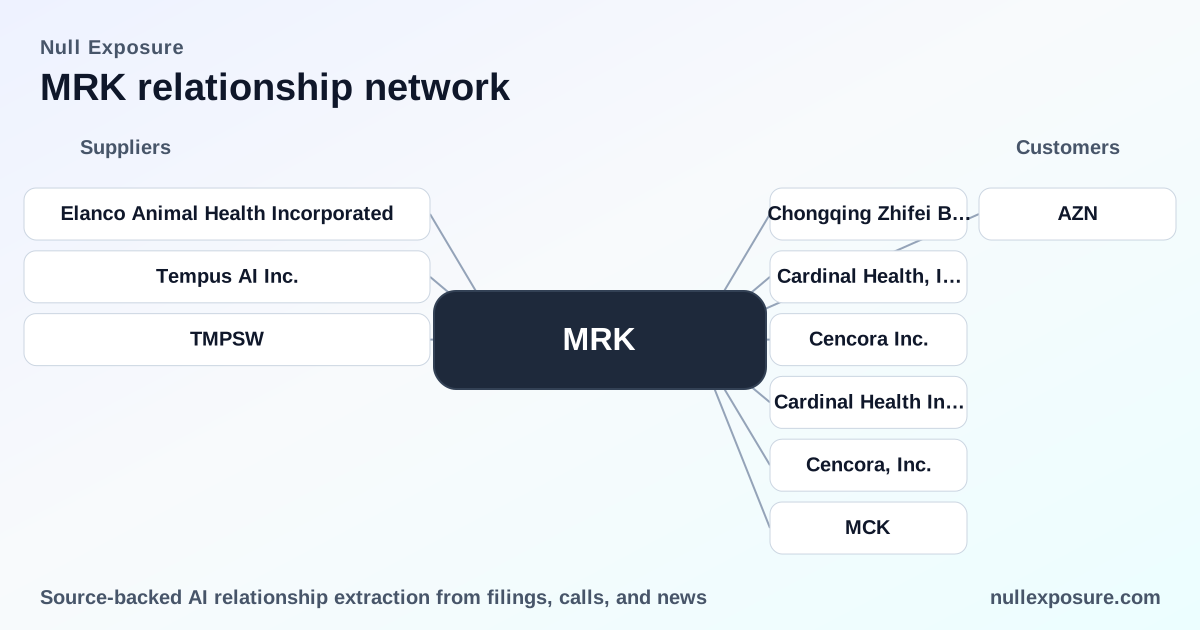
Merck & Co. (MRK) — Supplier Footprint, Strategic Partners, and What Investors Should Price In
Merck monetizes through global pharmaceuticals, vaccines, and strategic collaborations that extend its R&D and commercial reach; supplier relationships and downstream acquisitions feed product lines and clinical programs while strategic tech partnerships accelerate pipeline efficiency and precision medicine initiatives. Investors should treat MRK’s supplier map as both a revenue-support mechanism and an operational risk surface — supply integration drives topline continuity, while supplier engagement and strategic collaborations unlock R&D leverage. For a quicker read on supplier exposure and relationship intelligence, visit https://nullexposure.com/.
Why supplier relationships matter for Merck investors
Merck operates a capital- and knowledge-intensive business where upstream suppliers, contract manufacturers, and external collaborators are not interchangeable commodities but operational levers that affect product continuity, regulatory timelines, and margins. The available relationship signals emphasize two themes:
- Active supplier engagement on sustainability and Scope 3 emissions signals a contracting posture that demands collaboration rather than transactional sourcing.
- Strategic partnerships in AI and targeted acquisitions feed productivity and growth vectors outside pure chemistry/biology R&D.
These themes translate into practical investor considerations: supply-chain resilience and partner-driven innovation. Investors should price MRK with an understanding that supplier relationships are a source of both upside (faster clinical insights, extended addressable markets) and downside (concentration, integration risk).
All supplier relationships surfaced (with source notes)
Below are the exact relationships captured in the source set, each summarized in plain English with the original source cited.
-
Elanco Animal Health Incorporated
Merck’s FY2024 reporting attributes livestock product sales growth in part to the inclusion of sales from the July 2024 acquisition of the Elanco aqua business, indicating an operational linkage that contributed to livestock product revenue in FY2024. According to Merck’s FY2024 10‑K filing (filed for period ending 2024), the Elanco aqua business was folded into livestock product results for that fiscal year. -
Tempus AI Inc. (news report)
Tempus signed a strategic collaboration agreement with Merck aimed at accelerating AI-driven precision medicine initiatives, positioning Merck to incorporate Tempus’s AI capabilities into drug discovery and clinical decision support. A March 10, 2026 news release on SG.Finance/Yahoo reported the strategic collaboration between Tempus AI Inc. and Merck & Co., Inc. -
Tempus (Finviz coverage / TMPSW reference)
Financial media coverage noted a new multi‑year Merck deal with Tempus, framing the engagement as a multi-year AI partnership that supports Merck’s precision medicine ambitions. Finviz carried a March 10, 2026 item headlined “AI-Powered Tempus Inks New Multi-Year Merck Deal,” referencing the same strategic relationship and tagging Tempus with the TMPSW symbol in coverage.
What the constraint signal tells us about Merck’s operating model
Merck publicly states an active supplier engagement approach to reduce Scope 3 emissions, which is a company-level indicator of procurement and sustainability strategy rather than a relationship-specific note. This signal shows a contracting posture that emphasizes long-term collaboration, supplier accountability, and upstream value-chain influence.
Operational implications:
- Contracting posture: Collaborative and standards-driven — Merck is engaging suppliers to hit sustainability KPIs, implying contracts and supplier programs that embed performance metrics and longer-term commitments.
- Concentration: The data set does not show high supplier concentration numerically, but active engagement implies prioritization of critical partners and potential vendor concentration in strategic areas (e.g., biologics manufacturing, AI partners).
- Criticality: Supplier relationships are mission-critical where they touch CMC (chemistry, manufacturing and controls), specialty animal health, and data/AI assets that influence R&D timelines and product availability.
- Maturity: The presence of a formal supplier engagement program indicates organizational maturity in procurement and ESG integration, transitioning suppliers from transactional vendors to strategic partners.
Investment implications and risk-reward framing
- Revenue augmentation via inorganic and partner-driven channels. The Elanco-related sales inclusion is an example of how M&A and supplier/customer integrations can lift product-line revenue. Investors should treat M&A-driven top-line bumps as contingent on successful integration and sustained demand in those segments.
- R&D acceleration through AI partnerships. The Tempus collaboration is a strategic move to compress discovery and development timelines and to add precision capabilities; this reduces time-to-insight and can increase the probability-adjusted value of pipeline programs.
- ESG as an operational lever. Active Scope 3 engagement is a governance and operational control that reduces long-term supply disruption risk and supports reputational value — this is financially material over multi-year horizons.
- Integration and concentration risk remain real. Acquisitions and deep partnerships create dependency. Investors should monitor integration KPIs, supplier performance disclosures, and any concentration flags in subsequent filings.
Visit https://nullexposure.com/ for a structured view of supplier exposures and to track updates to MRK’s partner map.
Tactical takeaways for operators and portfolio managers
- Monitor Merck’s subsequent filings for integration metrics on the Elanco aqua business and for commercial cadence tied to livestock product categories.
- Track milestone announcements and scope of work from the Tempus collaboration to assess how quickly AI inputs translate into program de-risking or clinical acceleration.
- Watch supplier engagement disclosures for expanded Scope 3 targets or supplier scorecards that could influence procurement costs or capital allocation.
Conclusion — what to watch next
Merck’s supplier signals combine active sustainability engagement, acquisitive revenue support, and strategic tech partnerships. Each element shifts where risk and growth sit on the company’s balance sheet: acquisitions and supplier integrations feed near-term revenue and operational complexity, while AI partnerships target long-term productivity gains in R&D. Investors should prioritize monitoring integration outcomes for the Elanco linkage and the tangible outputs from the Tempus collaboration as the clearest near- to medium-term catalysts.
For continuing coverage and granular supplier intelligence on MRK and other large-cap suppliers, go to https://nullexposure.com/ — the resource for investors who need actionable supplier relationship insight.