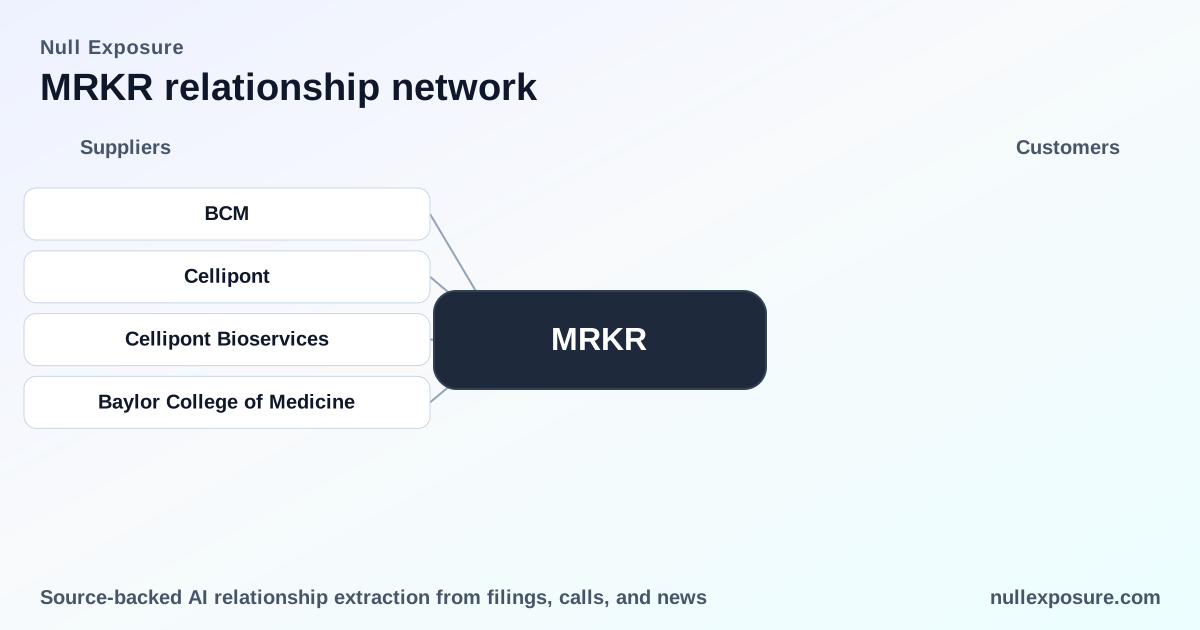
Marker Therapeutics (MRKR) — Supplier relationships and what they tell investors
Marker Therapeutics operates as a clinical-stage immuno‑oncology company that licenses MAR‑T cell technology from Baylor College of Medicine and outsources manufacturing of its cell therapies to third parties, monetizing through eventual product commercialization and licensing/partnership opportunities if clinical programs advance to approval and market entry. For investors, the supplier profile shows a transition from owning in‑house cGMP capacity to a outsourced manufacturing model that concentrates operational dependency on a small set of external partners and creates predictable multi‑year contracting dynamics. Explore MRKR supplier details on NullExposure
Key takeaway up front: Marker is a licensor of core IP (from BCM) and a client of CDMOs; manufacturing relationships are material to near‑term execution and have already driven capital flows and contract changes.
How the supplier map shapes the business model
- Contracting posture: Marker has shifted to framework, multi‑year master agreements for product supply rather than single‑batch deals, reflecting an intent to secure scalable manufacturing capacity for clinical and potential commercial supply.
- Concentration and criticality: Outsourced manufacturing is critical and somewhat concentrated — a small number of manufacturing partners handle cGMP supply after Marker disposed of its own facilities.
- Maturity and spend profile: The supplier relationships show active, mid‑level spend (in the $1M–$10M band in recent reporting), indicating meaningful operational expenditure but not yet large commercial‑scale procurement.
- Financial and execution risk: Terminations, settlements and materially stated risks in filings highlight execution and transition risk as the company integrates third‑party manufacturing into its clinical plans.
Relationships investors should know (each relationship in the results)
BCM (Baylor College of Medicine) Marker holds an exclusive worldwide license to MAR‑T cell intellectual property that underpins its pipeline; the license was executed in 2018 and remains the foundation of Marker’s product rights. According to Marker’s FY2024 10‑K, the company “entered into an exclusive license agreement with BCM under which the Company acquired a worldwide, exclusive license to BCM’s rights…to develop and commercialize MAR‑T cell product candidates.” (FY2024 10‑K)
Cellipont / Cellipont Bioservices Marker has entered strategic manufacturing collaborations with Cellipont to scale cGMP production of lead programs such as MT‑601; multiple news reports in 2025–2026 note this collaboration as a capability enhancement for Marker’s manufacturing. A Globe and Mail press release and related industry coverage reported that Marker “entered into a strategic manufacturing collaboration with Cellipont to scale up production of MT‑601,” and Intellectia noted an announcement dated June 17, 2025, describing the collaboration to advance cGMP manufacturing. (news coverage, FY2026)
Baylor College of Medicine (TACTOPS / media mention) Beyond the licensing arrangement, Baylor’s clinical work using MAR‑T technology is publicized and relevant to Marker’s clinical narrative; Marker announced Baylor’s TACTOPS study in pancreatic cancer was featured on Good Morning America in January 2026, reinforcing the visibility of the underlying academic work. (GlobeNewswire and SAHM Capital coverage, January 2026)
Operational and contractual context from company disclosures (constraints and what they imply)
- Marker transitioned away from owning cGMP manufacturing and now relies on CDMOs for clinical and potential commercial supply, a deliberate strategic choice to focus on clinical development. This is explicit in the company’s filings noting the disposal of manufacturing facilities and reliance on third parties.
- The company used a Master Services Agreement (MSA) structure for product supply; the initial term of an MSA cited in filings was three years and is extendable by mutual written agreement, indicating a framework/long‑term contracting posture rather than one‑off purchases.
- Spend and scale: Marker disclosed $5.8 million in services and manufacturing costs in 2024, with approximately $5.5 million paid on invoices, placing recent manufacturing spend in the $1M–$10M band — material for a clinical‑stage biopharma but not at commercial scale.
- Relationship disruptions have occurred: Marker entered into an MSA with a CDMO (Cell Ready) and later mutually terminated the agreement, settling for roughly $453,000 and exchanging mutual releases; such events demonstrate active vendor management and the operational friction that can accrue during transitions.
Cell Ready (explicitly named in constraint excerpts) Although not present in the news list above, company filings name Cell Ready as a former CDMO and counterparty to an MSA; Marker disclosed that Cell Ready is owned by a former director and that Marker mutually terminated the MSA with Cell Ready on March 27, 2025, settling for ~$453,000. These facts are addressed in MRKR’s filings and illustrate both governance and supplier‑concentration dynamics. (company filing disclosures, 2024–2025)
What these supplier signals mean for investors
- Execution risk is front and center. Outsourcing manufacturing accelerates Marker’s clinical focus but transfers manufacturing execution and scale risk to third parties; the terminated Cell Ready relationship and settlement are tangible evidence of that risk.
- IP ownership and licensing are strength. The exclusive BCM license is a strategic asset that differentiates Marker’s pipeline and supports long‑term value capture if clinical data validate efficacy.
- Spend is meaningful but not yet commercial. The $5.8M manufacturing/services charge in 2024 signals committed operational investment to advance trials, but not the sustained cost base of a commercial launch.
- Contract structure is defensive. Using master services agreements with multi‑year terms creates predictability, but contractual terminations and mutual settlements show that frameworks require active oversight.
Mid‑analysis action item If you are modeling MRKR’s operational runway and risk exposure, incorporate supplier concentration and the likelihood of repeat CDMO contracting into your cash‑flow and probability‑of‑success assumptions. For a deeper supplier risk breakdown, review MRKR supplier profiles on NullExposure.
Risks and watchpoints for the next 12–24 months
- Timelines tied to manufacturing scale‑up for MT‑601 and other candidates are critical; delays in CDMO ramp could push trial milestones.
- Financial sensitivity to manufacturing costs: further outsourcing could increase variable costs as trials scale.
- Governance: past relationships involving former directors (Cell Ready) require monitoring for governance optics and counterparty selection.
Conclusion and investor actions Marker’s supplier footprint shows a company that has outsourced critical manufacturing functions while retaining exclusive IP via its BCM license. This structure supports an asset‑light, clinical development focus but concentrates operational risk in a small set of CDMOs and contractual frameworks. Investors should track manufacturing collaborations (Cellipont, other CDMOs), filings that update spend and MSAs, and Baylor clinical readouts as near‑term value catalysts.
For a concise supplier risk matrix and continuous monitoring of MRKR counterparties, visit NullExposure to see our supplier‑level signals and curated relationship timelines. Explore MRKR supplier details on NullExposure