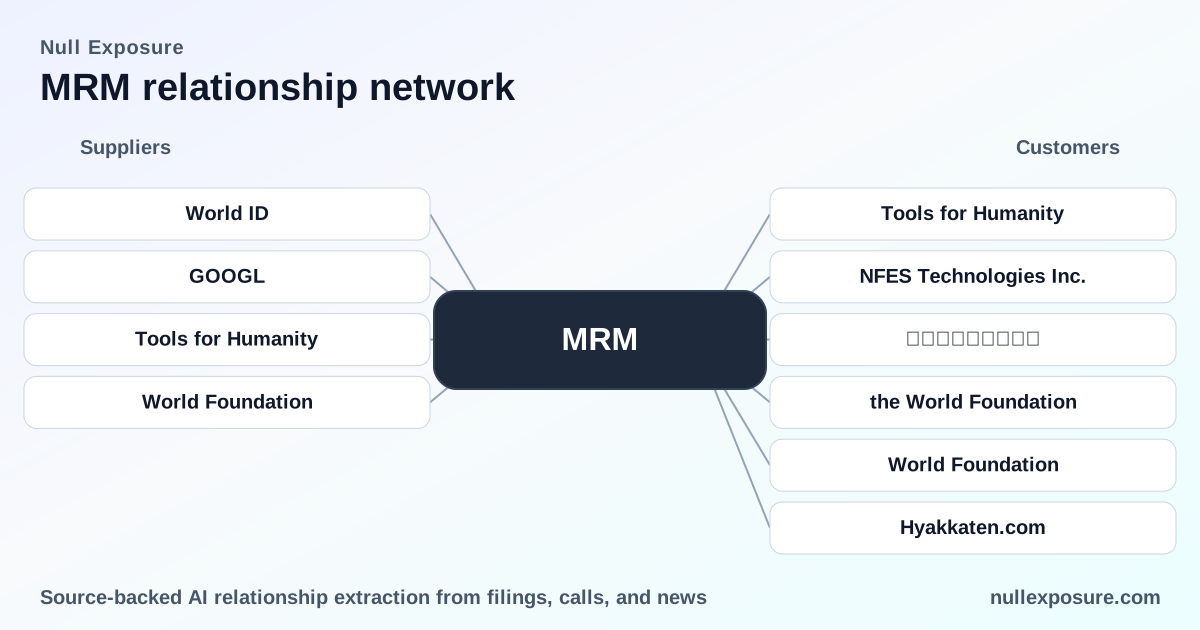
MEDIROM (MRM) — Supplier relationships sharpen a services-led revenue profile around World ID and device integrations
Thesis: MEDIROM Healthcare Technologies (MRM) operates as a services-and-hardware integrator in Japan that monetizes by selling device-software bundles and by signing Master Service Agreements (MSAs) to deploy identity and healthcare infrastructure at scale; recent MSAs and platform integrations convert its product roadmap into near-term project revenue and a recurring-services runway tied to World ID installations and device ecosystem partnerships. For investors, the critical question is execution — turning announced installations into contracted, recognized revenue while preserving margins and reputation. Learn more at https://nullexposure.com/.
How the deals fit together: MSA-driven rollouts, device integration, and service margins
MRM’s public disclosures show a two-track commercial model. First, it executes MSAs to install third-party identity infrastructure (World ID Orbs) across commercial locations, which generates project revenue and installation services income. Second, MRM builds a device-plus-app product (the MOTHER Bracelet and MOTHER app) that links into platform partners such as Google to extend device utility and stickiness.
The MSA posture is notable: signing a Master Service Agreement with Tools for Humanity and World Foundation standardizes commercial terms and creates the ability to scale installations quickly across a fragmented retail/service footprint in Japan. That contracting posture reduces per-location negotiation friction and positions MEDIROM to capture installation and operation margins as deployments move from pilot to scale.
According to company announcements, the MSA structure and planned rollouts convert into a clear revenue target: the company projects approximately $39 million in income before income taxes over two years tied to the World ID expansion, which is a material near-term revenue projection for a company focused on device and deployment services (GlobeNewswire, Feb 27, 2026). For hands-on analysis and supplier tracking, visit https://nullexposure.com/ to see how these relationships change supplier risk and revenue concentration.
Early traction and scale ambitions: 100 studios to 3,000 locations
MRM confirmed rapid phased deployment: an initial rollout will place World ID Orbs in 100 Re.Ra.Ku relaxation studios in Japan, followed by a nationwide plan to expand to 3,000 locations under the MSA with Tools for Humanity and World Foundation. That sequence converts a proof-of-concept into a broadened services contract and underwrites the aforementioned two-year income projection.
Operationally, this implies:
- Concentration in rollout partners during early phases (Re.Ra.Ku studios), so execution risk is front-loaded to a small set of locations.
- Scalability risk as the company moves to thousands of sites; logistics, installation labor, and local compliance will determine gross margins on the project pipeline.
- Revenue visibility provided the MSA is sufficiently prescriptive on pricing, timing, and acceptance criteria; the stated income projection signals contractual expectations rather than speculative upside.
Platform tie-ins matter: Google Health Connect and the MOTHER Bracelet
MRM also advances its device strategy through platform integrations. The company announced that the MOTHER Bracelet and the MOTHER app are integrated with Google’s Android platform Health Connect, broadening the bracelet’s interoperability with Android devices and third-party health services (PR Times, 2026). This strengthens the product's value proposition to consumers and increases potential app engagement revenue while making the device more attractive to enterprise or retail partners who want platform compatibility.
What investors should watch next
- Execution against the 3,000-location plan: conversions from MSA to signed installation orders and the pace of rollouts will directly drive the projected $39M revenue.
- Contract structure and margin disclosure: whether the MSA uses fixed-fee installations, revenue sharing, or service retainers will materially affect operating leverage.
- Customer concentration and operational scalability: early concentration in a single studio chain raises short-term risk; expanding to diverse site types will reduce that risk if executed smoothly.
- Regulatory and reputational exposure: identity infrastructure and biometrics carry public policy scrutiny; contractual clarity and data governance will be essential to preserve partner confidence.
Relationship-by-relationship: what the filings and press releases show
World ID — MEDIROM confirmed it will deploy World ID Orbs across 100 Re.Ra.Ku relaxation studios as an initial installation step, demonstrating early commercial adoption and field testing for the identity hardware in Japan. Source: news report on the Re.Ra.Ku rollout (Parameter.io, reported March 10, 2026).
Tools for Humanity — MEDIROM entered into a Master Service Agreement (MSA) with Tools for Humanity, the organization co-founded by Sam Altman and Alex Blania, to facilitate World ID adoption; the MSA became effective February 2, 2026, and company communications forecast approximately $39 million in income before income taxes over two years tied to expansion to 3,000 locations. Source: GlobeNewswire press release, Feb 27, 2026 (and related GlobeNewswire coverage Jan 23, 2026).
World Foundation — MEDIROM’s MSA names the World Foundation as a counterparty alongside Tools for Humanity, making the Foundation a contractual partner in the planned nationwide rollout and operational support for World ID Orbs deployments. Source: GlobeNewswire release announcing the MSA and the 3,000-location initiative (Jan–Feb 2026).
Google — MEDIROM announced integration of the MOTHER Bracelet and the MOTHER app with Google’s Android Health Connect platform, improving device interoperability with Android ecosystems and strengthening consumer and partner-facing features. Source: PR Times announcement regarding the MOTHER app and Health Connect integration (FY2024 reporting / press release published March 2026).
Constraints and company-level signals
There are no explicit constraint excerpts provided in the supplier relationship package. Company-level signals implied by the deal structure include: a services-heavy contracting posture (MSA-led), material near-term revenue concentration tied to a single major rollout program, and a product strategy combining hardware and app integrations to extend monetization. These are strategic characteristics investors should treat as operating-model facts until subsequent SEC filings or earnings releases provide more granular contract terms and revenue recognition details.
Bottom line for investors
MRM is converting a product strategy into contracted services revenue through MSAs and strategic platform integrations. The announced World ID rollout and the Google Health Connect tie-in create both opportunity and execution risk: successful scale would translate into meaningful near-term revenue, while delayed rollouts or contract disputes would disproportionately affect the company’s top line. Track MSA conversion rates, installation timelines, and margin disclosure in upcoming company filings.
For a concise supplier-risk briefing and ongoing tracking of how these commercial relationships evolve, visit https://nullexposure.com/. If you want to model sensitivity to rollout speed and contract margins, check our coverage at https://nullexposure.com/ for templates and updates.