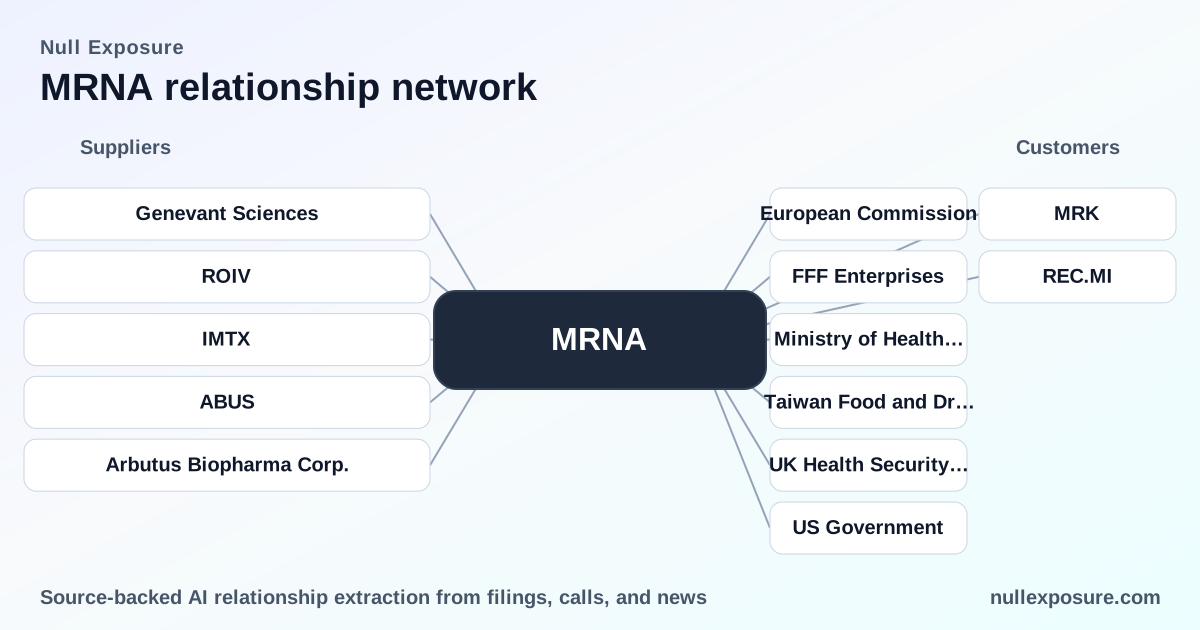
Moderna (MRNA) supplier relationships: what investors need to know
Moderna operates as an integrated developer and commercializer of mRNA medicines and vaccines, monetizing through product sales, partnerships, milestone receipts and, increasingly, licensing and settlement outcomes that resolve intellectual‑property disputes. Recent supplier and partner disclosures show a company balancing heavy, multi‑year supply commitments and CMO dependence with strategic legal settlements that convert litigation risk into cleared freedom‑to‑operate and non‑exclusive licenses.
Explore a consolidated view of these supplier dynamics and what they mean for portfolio risk and operational resilience: https://nullexposure.com/
Why the recent headlines matter to investors
Moderna’s supplier footprint is organized around two commercial realities: large non‑cancelable commitments for raw materials and manufacturing capacity, and strategic collaborations that carry milestone and reimbursement structures. The March 2026 settlement activity with Genevant and Arbutus is a capital deployment that simultaneously reduces long‑term IP risk and formalizes Moderna’s right to use third‑party LNP delivery technology for infectious‑disease vaccines.
- Capital for clearance: the settlement converts litigation exposure into a priced license and covenant not to sue.
- Operational continuity: disclosed non‑cancelable commitments and open purchase orders indicate ongoing, multi‑year supplier engagement and capacity booking.
- Collaboration economics: milestone payments and reimbursement terms are active levers in Moderna’s external R&D model.
For more structured insight into how this translates to supplier risk and contract posture, visit https://nullexposure.com/
The relationships you need to track (concise, sourced)
Genevant Sciences — Moderna will receive a global non‑exclusive license to Genevant’s LNP delivery technology for infectious‑disease mRNA vaccines, coupled with a covenant not to sue covering certain patents and products as part of a settlement; the deal is reported in multiple press releases and news coverage in March 2026. (Source: Proactive Investors and GlobeNewswire, March 2026)
Arbutus Biopharma — Moderna agreed to a settlement with Arbutus that includes a $950 million upfront payment due in July 2026 and an additional $1.3 billion contingent on the outcome of an appellate ruling concerning government‑contractor liability; the settlement grants Moderna a non‑exclusive license for infectious‑disease LNP applications with no future royalties. (Source: GlobeNewswire and 247wallst reporting, March 2026)
Roivant (including Genevant as a Roivant subsidiary) — market reaction reporting tied Roivant to the settlement dynamics; coverage noted Moderna stock gains linked to the $2.25 billion settlement involving Roivant’s subsidiary Genevant. (Source: 247wallst, March 2026)
Immatics N.V. — Moderna expanded a collaboration in late 2025 by advancing an mRNA‑based TCER® product into clinical development, triggering a $5 million milestone to Immatics in January 2026; Immatics will run the Phase 1 trial with costs fully reimbursed by Moderna. (Source: Immatics press release/InvestingNews, December 2025–January 2026)
How these relationships map to Moderna’s operating and contracting posture
The company disclosures and news coverage together paint a consistent operating model:
- Contracting posture is mixed but skewed to committed capacity. Moderna reported $809 million of non‑cancelable purchase commitments for raw materials and manufacturing (payable through 2027), which signals heavy forward booking for inputs and CMO capacity. This is a company‑level signal of long‑lead procurement and locked‑in spend.
- There are also significant cancelable obligations for near‑term operations. The company reported $2.9 billion of cancelable open purchase orders supporting clinical operations and contract manufacturing, indicating flexibility in short‑term operational spend while retaining substantial optionality.
- Supplier roles are both manufacturers and service providers. Moderna relies on CMOs for fill‑finish and raw‑material production and on CROs for trial execution; these third parties provide critical production, testing and logistics services rather than purely commodity inputs.
- Spend concentration is substantive. The non‑cancelable commitments and repeated references to material manufacturing agreements place aggregate supplier exposure in the >$100 million band at the company level.
- Relationship maturity and activity skew toward active, multi‑year engagements. Several agreements cannot be terminated for convenience, creating ongoing obligations and transition costs if Moderna resizes operations.
These operating signals are company‑level facts rather than relationship‑specific claims.
Strategic implications for investors and operators
The settlement with Genevant/Arbutus is the single most consequential supplier‑adjacent development in these results. It trades a headline litigation risk for a defined economic cost and an explicit license to LNP technology for infectious disease, materially reducing a source of legal uncertainty that had clouded Moderna’s vaccine platforms. The payment structure—$950 million upfront and $1.3 billion contingent on appellate outcomes—introduces both immediate cash impact and contingent liability that should be tracked as a contingent obligation on Moderna’s balance sheet (reported in March 2026 press coverage).
Operationally, large non‑cancelable commitments raise supplier concentration and continuity risk; they also secure critical feedstock and CMO capacity that supports commercialization and clinical scale‑up. For operators, the CMO and CRO reliance is a governance issue: contract terms, quality oversight and dual‑sourcing strategies will determine execution risk. For investors, focus on cash flow timing, contingent payment triggers, and the interaction of long‑term purchase commitments with revenue cadence.
The Immatics expansion highlights another axis: collaboration economics that combine milestone transfers with full cost reimbursement. That structure preserves Moderna’s control of clinical development while keeping external expertise on the execution path and shifting near‑term cash outlays to recognized, contracted reimbursements.
If you want a deeper supplier risk profile and contract‑level mapping for portfolio diligence, review the full tracker at https://nullexposure.com/
Bottom line and next steps
- Settlement reduces IP overhang and secures license rights, at a defined headline cost. That outcome materially improves Moderna’s freedom‑to‑operate for infectious‑disease LNP use.
- Large non‑cancelable supplier commitments lock in capacity but concentrate spend; cancelable orders provide short‑term flexibility. Monitor cash flows, contingent liabilities and the timeline of the $950M upfront payment.
- Collaborations continue to be a funding lever—milestones plus reimbursement is the dominant pattern. This preserves internal development capacity while outsourcing specialized execution.
For clients evaluating supplier exposures or constructing counterparty‑level diligence for biotech investments, our platform offers consolidated supplier intelligence and contract signals—start your research at https://nullexposure.com/
Contact Null Exposure for bespoke supplier mapping and scenario analysis to quantify counterparty risk across payment timing, contingent liabilities and CMO concentration.