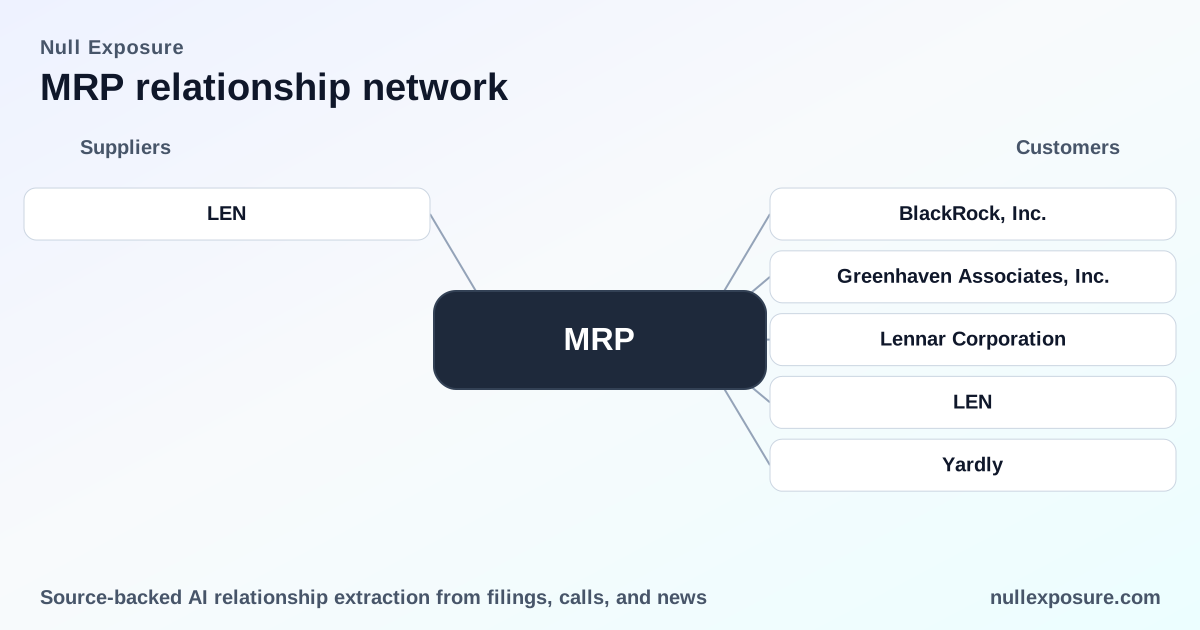
MRP and Lennar: How a single relationship drives operations and risk
MRP operates as a real estate operating company whose near-term economics are substantially driven by contractual relationships with Lennar and affiliated entities; it monetizes through ownership and management of residential development assets, license rights tied to Lennar’s homes and construction flow, and fee or reimbursement arrangements that arise as projects are developed or transferred. The company’s operating cash flow and growth trajectory are concentrated, contractually bound, and tied to long-duration arrangements that lock in roles and rights between the parties. For investor diligence, the counterparty mechanics and contract terms are the core drivers of valuation and downside.
Discover more supplier analysis and counterparty intelligence at https://nullexposure.com/.
Why this single relationship matters to MRP’s P&L and valuation
MRP’s filings make a plain operational claim: Lennar is not just a customer—Lennar is integral to MRP’s ability to generate revenue and complete development work. The relationship combines a perpetual licensing element, multi-year management arrangements, and a master construction agreement that assigns construction responsibility and coordination to Lennar. Together, these contractual features create both revenue predictability when volumes are sustained and acute concentration risk if Lennar’s activity slows or contractual options are not exercised.
- Contracting posture: The Management Agreement has a multi-year initial term with automatic one-year renewals, and the HOPP’R Rights license is perpetual subject to limited terminations. This indicates a long-term contracting posture that favors continuity and operational lock-in.
- Concentration and criticality: The company explicitly describes the Lennar agreements as “critical to our business,” and notes that Millrose’s financial results are “entirely dependent” on Lennar exercising Purchase Options and performing under the Lennar Agreements; this is concentration at the counterparty level.
- Role dynamics: MRP functions both as a licensee (holding perpetual, non-transferable licensing rights granted by a Lennar subsidiary) and as an operator whose day-to-day asset management is governed by a Manager under the Management Agreement.
- Maturity and spend signals: Reported audit fees in FY2024 are a mid-single-million dollar line, which is consistent with a company in active operational scale but not at the very largest enterprise scale.
These structural characteristics should be front and center when assessing upside, downside, and required governance protections.
Counterparty snapshot — Lennar
Lennar: MRP’s operating and construction counterparty. According to MRP’s FY2024 Form 10‑K, MRP entered into a HOPP’R License Agreement with a wholly‑owned subsidiary of Lennar, under which Millrose received a non‑exclusive, royalty‑free, non‑transferable license to use HOPP’R Rights solely for Millrose’s benefit; the filing also details a Master Construction Agreement assigning construction responsibilities to Lennar and a Management Agreement that delegates day‑to‑day management to the Manager (KL) under Millrose supervision (FY2024 10‑K). The filing explicitly states the relationship is critical and that Millrose’s financial results are currently dependent on Lennar exercising its Purchase Options and performing under the Lennar Agreements (FY2024 10‑K).
Source: FY2024 Form 10‑K for MRP (reported in the 2024 fiscal period; excerpts cited in the company’s filings).
Relationship mechanics, in plain English
- Lennar supplies construction services and controls construction methods on the homesites that form the assets MRP manages or holds; Lennar is contractually obligated to complete work on transferred homesites and to engage and pay for labor, materials, permits, and third‑party engineers as necessary (FY2024 10‑K).
- MRP has the right to use HOPP’R intellectual property for its benefit under a license from a Lennar subsidiary; that license is perpetual except in limited termination scenarios, giving MRP an enduring operational lever tied to Lennar’s platform (FY2024 10‑K).
- The Management Agreement ties a Manager (KL) to the day‑to‑day operations of Millrose and its subsidiaries, creating an outsourced operating model with Board supervision and contractual renewal mechanics (FY2024 10‑K).
These are not superficial vendor relationships; they are embedded contractual structures that determine how assets are delivered, owned, and monetized.
What the constraints tell investors about operating risk and optionality
The extracted constraints from MRP’s filings provide high‑signal read‑throughs:
- Long‑term contracting (high confidence): The Management Agreement’s multi‑year initial term and automatic renewals, plus the perpetual licensing element, indicate an operational model built on durable contracts rather than short ad‑hoc engagements. That reduces churn risk but creates lock‑in and path dependency.
- Licensing posture (high confidence): The non‑exclusive, royalty‑free license is favorable on cost but limits exclusivity and transferability; it is a company‑level indication that intellectual property access is structured to support operations but not to generate recurring licensing income from third parties.
- Critical counterparty dependence (high confidence): Filings label the Lennar agreements as critical; company revenues and the exercise of Purchase Options by Lennar are primary determinants of near‑term cash flow.
- Dual relationship roles (high confidence): MRP sits both as licensee and as a recipient of construction and management services, which concentrates execution risk tied to a single partner ecosystem.
- Active stage and spend signal (moderate confidence): The relationship is active and operational, and corporate spend lines (for example, audit fees of roughly $2.85 million in FY2024) suggest a firm of meaningful but not top‑tier scale.
Collectively, these constraints show a business model that trades market diversification for operational integration with a strategic counterparty.
Explore supplier risk profiles and contract read‑throughs at https://nullexposure.com/.
Investment implications and watchlist
- Upside driver: If Lennar continues to exercise Purchase Options and sustain homebuilding volumes, MRP benefits from steady asset transfers, management fees, and license utility—creating predictable cash flows under long‑dated contracts.
- Downside risk: Heavy counterparty concentration means a slowdown at Lennar or renegotiation of Purchase Options creates immediate earnings pressure; the perpetual license does not offset the operational dependency.
- Governance focus: Investors should press for transparency on Purchase Option schedules, performance covenants in the Master Construction Agreement, and the Manager’s incentive alignment with board oversight.
- Liquidity and covenant posture: Scrutinize how the Management Agreement and license termination clauses interact with solvency triggers or event‑of‑default provisions, as those terms can convert operational headwinds into balance‑sheet stress.
Actionable checklist for investors
- Request the schedule of Purchase Options and the historical exercise rate by Lennar over the last 12–24 months.
- Confirm termination mechanics in the HOPP’R license and Management Agreement and map scenario outcomes (e.g., non‑renewal, breach, force majeure).
- Monitor Lennar’s homebuilding guidance and orders as leading indicators for MRP’s near‑term revenues.
For deeper supplier relationship analysis and documented contract read‑throughs, visit https://nullexposure.com/.
MRP’s model is clear: contractual embeddedness with Lennar creates operational certainty when volumes hold, and acute concentration risk when they do not. Investors should treat the Lennar relationship as the primary valuation lever and require commensurate disclosure and contingency planning from management.