Marvell Technology (MRVL): How supplier ties shape product roadmaps and capital allocation
Marvell is a fabless semiconductor designer that monetizes by designing bespoke silicon for cloud and edge customers, licensing architectures, and selling differentiated system-on-chip products into data center, AI, and networking markets. The company captures value through design-led differentiation and volume-driven hardware sales while outsourcing wafer fabrication, packaging and testing to external partners; its supplier relationships therefore drive production capacity, time-to-market and margin volatility. Investors should evaluate Marvell’s supplier map for supply concentration, contract tenor and component criticality because these elements directly affect revenue delivery and capital planning. For a deeper supplier-risk view, visit https://nullexposure.com/.
How Marvell’s operating model turns suppliers into strategic levers
Marvell’s core operating characteristic is the classic fabless model: product and IP development in-house, manufacturing and assembly outsourced. According to a research feature published in March 2026, Marvell “operates as a fabless semiconductor company, meaning it designs and markets hardware while outsourcing the actual manufacturing to foundries like TSMC.” This structure converts supplier relationships from procurement line items into strategic levers for capacity, cost and roadmap execution. The company also discloses that it enters into capacity reservation arrangements to secure long-term manufacturing capacity and relies on assembly/test subcontractors largely located in APAC markets. That combination — design control + outsourced manufacturing with long-term capacity reservations — defines both Marvell’s leverage and its supply-side risk profile.
Visit https://nullexposure.com/ for continued monitoring of supplier dynamics and material disclosures.
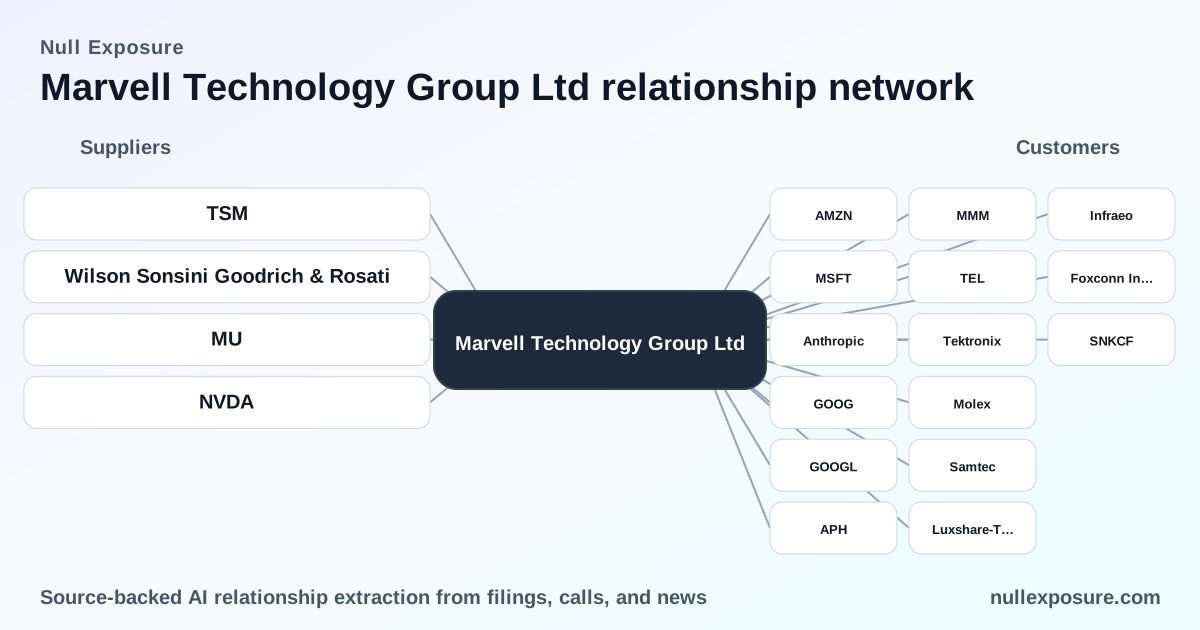
Who Marvell works with — relationship-by-relationship rundown
TSMC: the primary outsourced foundry partner
Marvell uses external foundries for wafer fabrication as a fabless designer, and industry reporting lists TSMC as a leading manufacturing partner for Marvell’s silicon. According to a FinancialContent research feature (March 9–10, 2026), Marvell outsources manufacturing to foundries like TSMC. (Source: FinancialContent research feature on Marvell, March 2026.)
Wilson Sonsini Goodrich & Rosati: legal counsel for securities filings
Marvell filed an 8‑K to include a legal opinion from Wilson Sonsini Goodrich & Rosati in connection with a shelf prospectus supplement, reflecting use of outside counsel for securities transactions and regulatory compliance. TradingView and other market reports referenced the filing and the legal opinion in March 2026. (Source: TradingView coverage of Marvell 8‑K filing, March 10, 2026; ts2.tech reporting on the same filing, March 2026.)
Micron Technology (MU): HBM memory co‑engineering for AI platforms
Marvell has collaborated with Micron on HBM design and integration to build custom high-bandwidth memory architectures optimized for AI compute platforms, indicating close engineering ties for critical memory subsystems. The Globe and Mail press release on Marvell’s FY2026 activity cites this collaboration. (Source: The Globe and Mail press release quoting Marvell’s HBM work with Micron, March 2026.)
NVIDIA (NVDA): NVLink Fusion interconnect integration
Marvell partnered with NVIDIA to integrate NVLink Fusion technology into custom cloud-platform silicon, signaling interoperability efforts with NVIDIA’s interconnect stack for higher-performance AI systems. This integration was described in the same Globe and Mail release covering Marvell’s FY2026 announcements. (Source: The Globe and Mail press release describing Marvell’s NVLink Fusion partnership with NVIDIA, March 2026.)
What these relationships imply for investors and operators
The relationships above expose several key, company-level operational constraints and strategic characteristics:
-
Contracting posture: Marvell discloses long-term capacity reservation arrangements with foundries and partners as part of its standard operating posture, which signals proactive capacity management rather than opportunistic spot buys. This reduces short‑term wafer-constrained risk but increases fixed commitment exposure and requires disciplined demand forecasting. (Company disclosures in FY2026 notes to consolidated financial statements.)
-
Geographic concentration and operational footprint: Packaging and testing are outsourced primarily to subcontractors in Taiwan, Canada, Korea, Singapore and China, concentrating downstream operations in APAC hubs and exposing supply chains to regional risks such as logistics, labor and geopolitical friction. (Marvell’s FY2026 operational notes.)
-
Role and criticality of partners: Foundries and memory/interconnect partners function as manufacturers and co‑engineers for Marvell’s silicon; these supplier roles are critical to product performance and delivery timelines. Close engineering partnerships with Micron and NVIDIA elevate supplier criticality beyond simple procurement relationships.
-
Maturity of supplier strategy: The combination of long-term capacity reservations and high-profile engineering collaborations indicates a mature supplier program focused on securing scale and product differentiation rather than transactional sourcing.
Key investment implications
- Positive: Long-term capacity commitments and tight engineering integration with memory and interconnect leaders support product performance leadership and smoother scaling into AI workloads, which can sustain higher ASPs and sticky customer relationships.
- Negative: Concentration in APAC assembly/test facilities, long-term capacity obligations and dependence on third-party foundries create downside exposure to regional disruptions, contract renegotiation risk and capital commitment cycles.
Practical risk checklist for due diligence
- Confirm the length, flexibility and counterparty mix of Marvell’s capacity reservation agreements and whether they include volume tiers or escape clauses.
- Track changes in APAC logistics, trade policy, and foundry capacity projections that would affect wafer and assembly throughput.
- Monitor the progress and productization timelines for Micron HBM and NVIDIA NVLink Fusion integrations, as delays would directly impact revenue recognition for key cloud-platform wins.
If your analysis requires continuous supplier monitoring or you need curated alerts on material disclosure changes, check the monitoring resources at https://nullexposure.com/ to stay ahead of supplier-driven inflection points.
Final perspective and recommended actions
Marvell’s supplier relationships are integral to its business model: outsourced manufacturing + long-term capacity commitments + strategic co‑engineering with memory and interconnect leaders. For investors, the upside is sustained product differentiation and scale economics; the downside is concentration and contractual rigidity. Operators should prioritize visibility into capacity contracts and cross‑company engineering milestones to reduce execution risk.
For a tailored supplier-risk briefing or to subscribe to ongoing supplier-disclosure tracking, visit https://nullexposure.com/ — the most direct route to monitor how supplier developments will move Marvell’s P&L and roadmap.