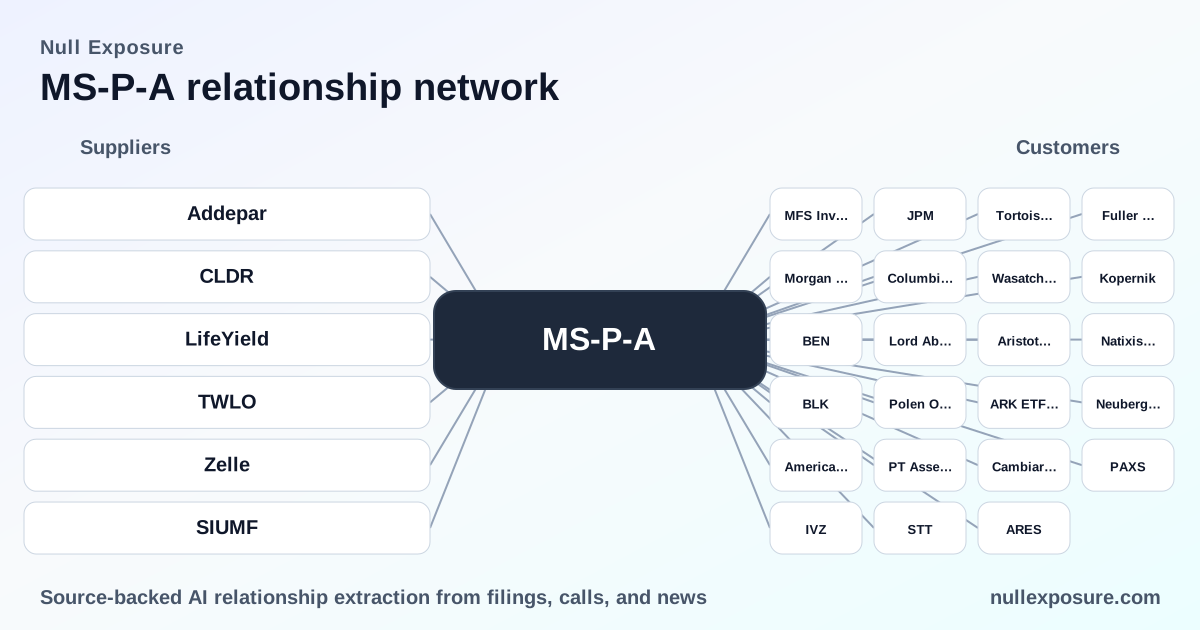
MS-P-A (Morgan Stanley Preferred Series A): Supplier Relationships and Strategic Implications
Morgan Stanley operates as a global investment bank and wealth manager that monetizes through advisory fees, trading and underwriting spreads, asset-management fees, and client-servicing fees generated by its wealth-management franchise; the MS‑P‑A preferred shares represent a capital instrument tied to that diversified fee base. The supplier relationships detailed below focus on technology and services that support Morgan Stanley’s push to digitize advisor workflows, deepen private-markets capabilities, and modernize client-facing channels—factors that influence revenue durability and operational risk for investors evaluating the preferred issue. For a consolidated view of supplier exposures and more supplier intelligence, visit https://nullexposure.com/.
Why supplier ties matter for MS‑P‑A holders
Morgan Stanley’s franchise value rests on client retention and fee stability in wealth management and capital markets. Technology partnerships and targeted acquisitions affect distribution efficiency, client engagement, and private-asset capability, which in turn influence fee generation and downside resiliency for capital holders. Investors should therefore read vendor linkages as operational levers: some strengthen competitive differentiation (directly supporting revenue), others reduce cost or operational friction.
- Contracting posture: The firm uses a mix of strategic partnerships and acquisitions to secure capability rather than short-term vendor relationships, consistent with a long-term integration approach in wealth-management operations.
- Concentration and criticality: Suppliers tied to advisor-facing platforms and private-market administration are higher criticality because they directly support fee-generating activity and client experience.
- Maturity: Several partnerships date back multiple years and one relationship reflects acquisition-led ownership, indicating varying integration timelines and operational control.
No supplier constraint excerpts were provided in the available records; as a company-level signal, that absence indicates the public records supplied here do not disclose detailed contract terms, termination clauses, or concentration thresholds.
For a deeper supplier-risk read on Morgan Stanley, visit https://nullexposure.com/.
Relationship-by-relationship: what investors should know
-
Addepar
Morgan Stanley deployed Addepar’s investment-tracking software to 20 of its top adviser teams to consolidate wealthy clients’ assets across accounts and improve relationship management; this is a direct digital-enablement play within the wealth channel. According to Fortune (FY2017), 20 top adviser teams were selected to use Addepar’s platform (https://fortune.com/2017/01/17/morgan-stanley-tech-wealth-management/). -
Cloudera
Cloudera appears on a list of data-analytics and cloud partners Morgan Stanley levered to modernize branches and support client targeting and communications, signaling reliance on third-party data tooling for analytics-driven distribution. Fortune identified Cloudera among technology firms Morgan Stanley used for branch modernization and customer targeting (FY2017) (https://fortune.com/2017/01/17/morgan-stanley-tech-wealth-management/). -
LifeYield
LifeYield’s tax-optimization software is cited as part of Morgan Stanley’s technology mix for advisor tools and client servicing, aligning with the firm’s effort to provide differentiated, tax-aware portfolio advice to retain high-net-worth clients. Fortune listed LifeYield among partners deployed to modernize client-facing capabilities (FY2017) (https://fortune.com/2017/01/17/morgan-stanley-tech-wealth-management/). -
Twilio
Morgan Stanley lists Twilio as a communications platform partner used to modernize branch communications and support digital client interactions—an operational investment to enhance advisor-client touchpoints. Fortune referenced Twilio alongside other cloud and messaging partners in the firm’s modernization effort (FY2017) (https://fortune.com/2017/01/17/morgan-stanley-tech-wealth-management/). -
Zelle
Zelle was adopted as a digital payments network partner to expand client-facing payment options, part of a broader push to upgrade mobile and digital services that affect client convenience and retention. Fortune reported Zelle as one of the new partners for Morgan Stanley’s initiative to modernize client services (FY2017) (https://fortune.com/2017/01/17/morgan-stanley-tech-wealth-management/). -
Solium Capital (Shareworks)
Morgan Stanley acquired Solium Capital in 2019 to bolster its stock-plan administration and private-markets capabilities; management has used that asset to scale private-wealth and employee-equity services as a strategic extension of wealth management. A WealthManagement report notes that the firm has been building that business since purchasing Solium Capital (reported FY2025 context) (https://www.wealthmanagement.com/wirehouse-news/morgan-stanley-is-seeking-to-capture-more-private-market-wealth).
How these relationships translate to business risk and opportunity
These supplier relationships reveal a deliberate strategy: build advisor productivity and private-markets administration through a combination of best-of-breed vendors and acquisitions. That strategy creates both upside and focal points for monitoring:
- Opportunity: Digital and data partnerships increase wallet share per client by enabling cross-account views, tax optimization, and more frequent advisor engagement—direct drivers of fee income resilience.
- Operational risk: Third-party platforms introduce vendor-dependency risk for client servicing and payments; acquisitions (Solium) reduce that dependency but increase integration and execution risk.
- Disclosure signal: The absence of contract constraints in the supplied records is a company-level indicator that investors should seek contract- and concentration-level disclosures through filings and vendor-risk reporting.
For a high-level supplier exposure scan and additional supplier relationship context, see https://nullexposure.com/.
Investment implications for holders of MS‑P‑A
Preferred-holders prioritize income stability and capital protection in downside scenarios. These supplier relationships strengthen Morgan Stanley’s wealth-management revenue engine—an important support for preferred claims—while creating vendor-concentration and integration vectors that deserve active monitoring. Investors should watch:
- Progress on integrating acquired services (Solium) into fee-bearing workflows that support recurring revenues.
- Any signs of operational disruption tied to critical vendor platforms used by advisor teams.
- Public disclosures on vendor concentration, costs, and strategic outcomes in wealth-management reporting.
Key takeaways
- Morgan Stanley leverages technology partners and targeted acquisition to modernize wealth management and private-market services, supporting fee resilience.
- Addepar, Cloudera, LifeYield, Twilio, Zelle, and Solium are material operational partners that influence client experience and revenue generation; Solium represents an acquisition rather than a pure vendor relationship.
- No supplier constraint excerpts were provided in the data set; investors should obtain contract-level disclosure and vendor-concentration metrics from filings and direct corporate reporting.
For ongoing monitoring of Morgan Stanley supplier exposures and to access supplier-level signals across financials, visit https://nullexposure.com/.