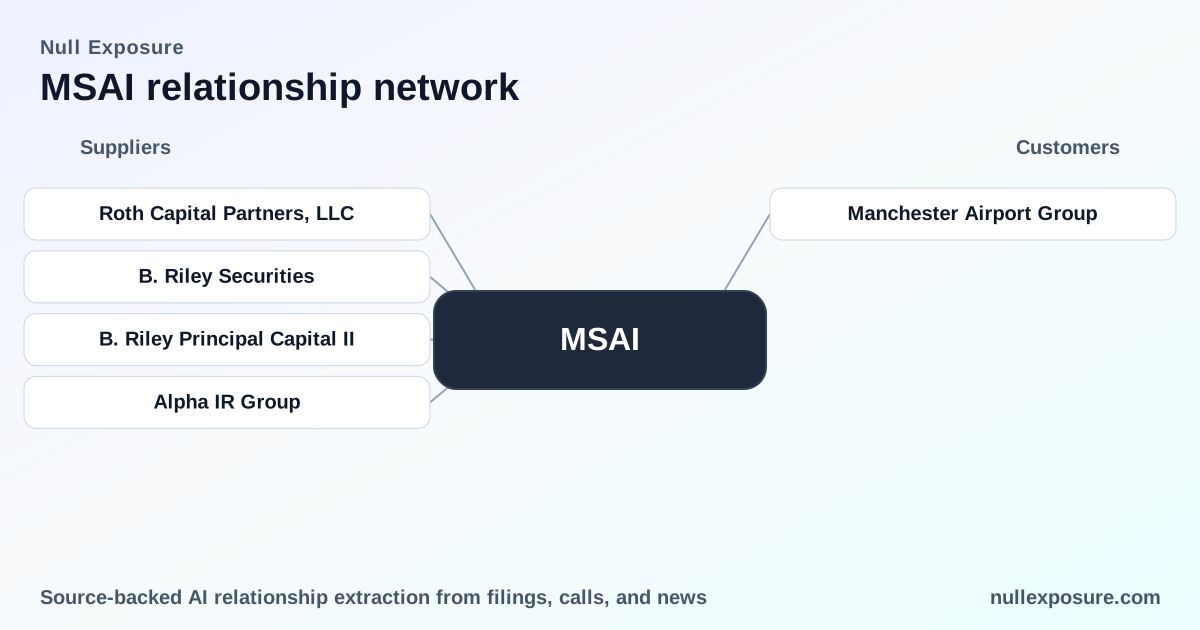
MultiSensor AI Holdings (MSAI) — supplier relationships and financing counterparties investors should track
MultiSensor AI Holdings develops and manufactures high-performance infrared imaging systems and monetizes through product sales to industrial, scientific and defense customers, complemented by recurring services and targeted capital raises when balance-sheet liquidity is required. Revenue comes from hardware sales and related services, while equity financings and placement agreements are a persistent tool to fund R&D and working capital. For direct access to ongoing counterparty intelligence and issuer signals visit https://nullexposure.com/.
Quick investor thesis
MSAI is a small-cap technology manufacturer with a capital-intensive product roadmap and a financing posture that is reliant on external placement agents and equity facilities to sustain operations. Its competitive edge is engineering-led thermal imaging IP, but negative EBITDA and modest revenue scale force the company into regular capital markets activity; that financing behavior is a material element of counterparty risk and liquidity planning for investors.
Counterparties and placement agents — the relationship roll call
Below I list every relationship surfaced in public reporting and summarize what each counterpart does for MSAI.
Roth Capital Partners, LLC
Roth Capital acted as sole placement agent for MSAI’s private and registered-direct offerings in FY2025, helping the company execute a roughly $14–14.4 million equity raise to shore up liquidity and support operations (Newsfile and TradingView/Reuters reporting, FY2025: https://www.newsfilecorp.com/release/271781/, https://www.tradingview.com/news/reuters.com,2025-11-04/).
B. Riley Securities
B. Riley Securities functioned as the sales agent for an at‑the‑market equity program (up to $8.6 million) and was the counterparty for at‑the‑market executions before those arrangements were terminated effective February 2, 2026 (TradingView/press releases, FY2026: https://www.tradingview.com/news/tradingview:a7914c0f2750d/).
B. Riley Principal Capital II
B. Riley Principal Capital II was the counterparty to a $25 million common stock purchase agreement that MSAI entered into previously and subsequently ended as part of the same February 2026 contract terminations (Globe and Mail / TradingView reporting, FY2026: https://www.theglobeandmail.com/investing/markets/stocks/MSAI/pressreleases/90914/).
Alpha IR Group
Alpha IR Group is listed as MSAI’s media and investor relations contact for quarterly and annual results disclosures, serving as the company’s external communications partner for investor outreach and press distribution (company press release, FY2025: https://www.accessnewswire.com/newsroom/en/computers-technology-and-internet/multisensor-ai-announces-fourth-quarter-and-full-year-2024-result-1007068).
What these relationships reveal about operating posture
The counterparties above are primarily capital markets intermediaries and investor-relations providers, not supply-chain vendors. That structure signals a business where financing counterparties are operationally material:
- Contracting posture: The company conducts frequent equity raises via placement agents and at‑the‑market facilities, demonstrating a proactive, market-driven financing strategy rather than long-term bank debt or self-funded growth.
- Concentration and criticality: Capital relationships are concentrated among a small set of boutique and middle‑market underwriters (Roth, B. Riley). For a small issuer, loss or termination of a placement relationship translates into materially higher execution risk for future raises.
- Maturity: MSAI’s use of short‑term equity programs and external IR firms is consistent with an early commercial-stage manufacturer still proving scale and margin durability.
If you want ongoing coverage of comparable counterparty movements and financing signals for small-cap suppliers, subscribe at https://nullexposure.com/.
Supplier constraints and manufacturing signals investors must price
Company disclosures provide direct supplier risk signals that are separate from financing counterparties:
- Geographic exposure: MSAI depends on suppliers in China for critical components and raw materials such as gallium and germanium, which are integral to infrared sensor production and represent a concentration risk in APAC supply chains (company disclosures).
- Global supply footprint: Suppliers are otherwise located worldwide and can be subject to constraints beyond the company’s control, indicating global supply fragility when demand or geopolitical pressure spikes.
- Manufacturing model: MSAI uses a hybrid manufacturing strategy — contract manufacturing for high-volume products and in-house production for specialized, lower-volume items — which delivers flexibility but creates multiple vendor interfaces and quality-control touchpoints.
These constraints translate into real operational risk: raw-material concentration elevates price and availability sensitivity, while reliance on contract manufacturers creates scope for capacity bottlenecks during demand surges.
Investment implications — what investors and operators should focus on
- Cash runway and financing cadence: Given negative EBITDA and recurring equity raises, investors must track placement-agent availability and the terms of any new facilities; termination of B. Riley arrangements in Feb 2026 materially changed MSAI’s execution options.
- Supply-chain single points of failure: Dependence on China‑sourced gallium and germanium is a strategic vulnerability that affects production continuity and gross margins.
- Counterparty concentration: A small roster of placement agents and an outsourced IR firm centralize execution risk; a loss of access to these counterparties would force more expensive or dilutive capital routes.
- Operational leverage: The hybrid manufacturing model gives MSAI product flexibility but requires rigorous supplier management to convert engineering prowess into consistent gross-margin improvements.
Key operational and market signals to watch: future placement-agent appointments, any recurring or expanded at‑the‑market programs, supplier diversification moves, and material changes to gross margin or inventory disclosures.
Actionable next steps for analysts and operators
- Review upcoming SEC filings and press releases for replacement placement agents or new financing commitments; counterparty changes will directly affect dilution trajectories.
- Validate supplier contracts and alternate sources for gallium/germanium to assess outage and price shock scenarios.
- Monitor revenue mix and order book disclosures to judge whether in‑house manufacturing scale can improve margins as volume grows.
For a curated feed of capital-market counterparties and supplier constraints across small-cap manufacturers, visit https://nullexposure.com/ and evaluate subscription options.
Bottom line
MSAI is an engineering-centric infrared manufacturer that relies on a small set of capital-market intermediaries for liquidity and on China-sourced raw materials for production. Both dimensions — financing counterparties and supplier geography — are first-order investment risks that drive dilution, production continuity, and ultimately valuation. For ongoing tracking of these relationships and signals, see https://nullexposure.com/.