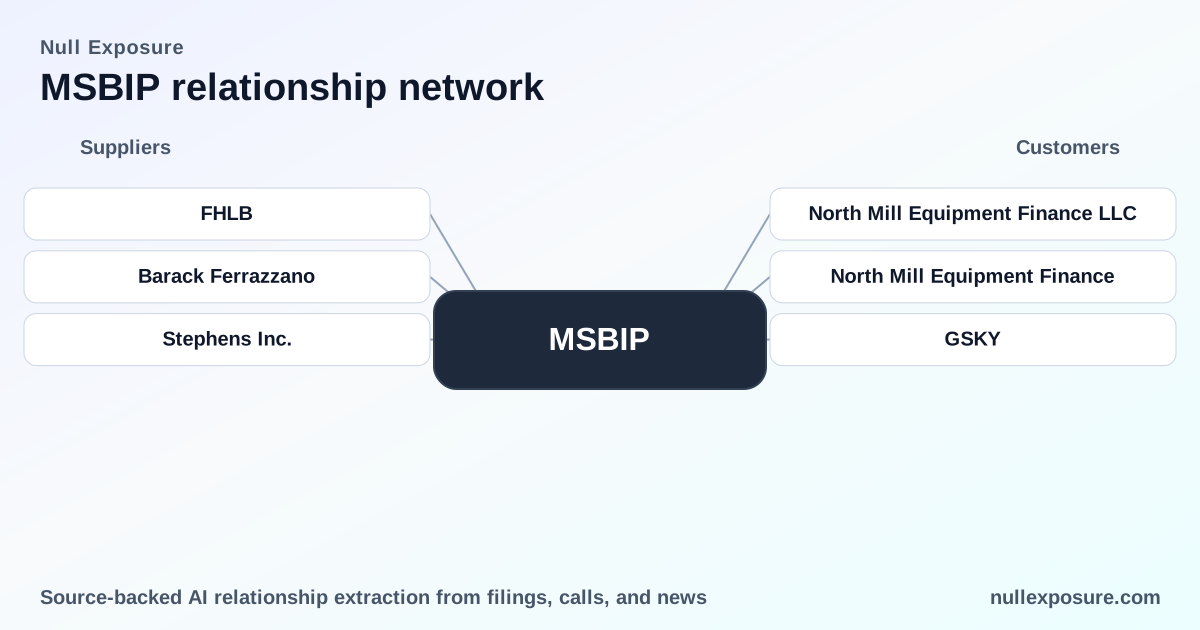
Midland States Bancorp (MSBIP): Supplier map and what it means for investors
Midland States Bancorp is the financial holding company for Midland States Bank, monetizing through traditional banking spreads, service fees and dividends paid up from the bank to the holding company. The firm’s revenue profile is banking-centric — loan origination, servicing and deposit management drive cash flow — and the holding company’s financial flexibility is tightly linked to dividend flows from the bank and access to wholesale funding. For investors and vendor managers, the relevant lens is operational dependency: third‑party servicers and funding counterparties are functionally critical to Midland’s ability to generate and transfer cash to the parent. Learn more about supplier exposure and monitoring at https://nullexposure.com/.
Why supplier relationships are a strategic lens for a regional bank
Midland operates like a regional banking franchise that outsources discrete but core functions — loan origination and servicing among them — while relying on external funding sources for liquidity. The company-level signals in public filings and disclosures show a contracting posture that is service-oriented and active: Midland uses third parties to originate and service consumer and commercial loans, and those third parties sit squarely inside the control and liquidity equation.
- Contracting posture: Active service-provider relationships for loan functions, as described in the company’s consolidated financial statement notes.
- Concentration and criticality: The primary source of funds for the holding company is dividends from the bank, which elevates the criticality of funding lines and service continuity.
- Maturity and spend: Documented credit-enhancement assets and disclosed balances place these vendor arrangements in a mid-size spend band (roughly $10m–$100m in economic footprint for the arrangements referenced), not immaterial from an operational or audit perspective.
- Control signal: Management disclosed a failure to design and maintain effective internal controls over loan data where third-party service organizations perform core lending functions — a clear governance risk for counterparties and investors.
These are company-level characteristics rather than properties of any single supplier.
Operational control risk is an investor-level risk
The firm explicitly identified weaknesses in internal controls over loan data that involve third‑party servicers. That is not a reputational footnote; it is a tangible operational risk that can compress earnings, increase compliance costs, and interrupt cash flow if remediation is not accomplished promptly. Investors should treat third‑party servicer oversight as a direct component of credit and dividend sustainability analysis.
The current supplier relationships you should know about
Below are the supplier and adviser relationships disclosed in recent public material. Each relationship is summarized plainly with source context.
-
FHLB — Midland discloses FHLB advances and other borrowings on its balance sheet with reported ledger line items showing amounts such as 293,000; 373,000; 345,000; 498,000; and 258,000 in the published schedule of borrowings, reflecting recurring use of Federal Home Loan Bank credit facilities as a funding tool. According to the company’s 2025 fourth‑quarter results press release on GlobeNewswire (filed Jan. 22, 2026) these advances are a recorded component of Midland’s funding mix; the same borrowings are reflected in coverage of the 4Q25 results on QuiverQuant (published March 10, 2026).
Sources: GlobeNewswire (Jan. 22, 2026); QuiverQuant coverage of Midland’s 4Q25 results (Mar. 10, 2026). -
Barack Ferrazzano — The law firm served as legal counsel to Midland in the sale of substantially all of its equipment finance portfolio to North Mill Equipment Finance, a corporate disposal completed in late 2025. The engagement indicates reliance on external legal advisors for major divestitures. A transaction notice published by Sahm Capital (Dec. 1, 2025) identified the firm’s role.
Source: Sahm Capital transaction notice (Dec. 1, 2025). -
Stephens Inc. — Served as exclusive financial adviser to Midland for the same equipment finance portfolio sale. The engagement shows Midland leaned on an investment bank to execute a strategically significant asset sale in FY2025. The advisory role was documented in the same Sahm Capital release announcing the transaction (Dec. 1, 2025).
Source: Sahm Capital transaction notice (Dec. 1, 2025).
What these relationships imply for risk and opportunity
The mix of counterparties — a wholesale funding relationship with FHLB and discrete transactional engagements for legal and financial advisory services — produces a clear set of investor implications:
- Liquidity and dividend sensitivity: Regular draws on FHLB advances mean Midland’s short-term liquidity and interest expense profile are sensitive to funding market conditions; because the holding company depends on bank dividends, any funding stress filters directly to parent-level cash flow.
- Service continuity risk: Third‑party servicers are embedded in loan origination and servicing workflows; the disclosed internal control deficiencies elevate operational and regulatory risk until remediation is complete.
- Transaction dependence on boutique advisers: The reliance on outside legal and advisory firms for portfolio sales demonstrates that Midland outsources high‑complexity transactions rather than building permanent internal capacity for large asset dispositions.
For operational and vendor-risk teams, the combination of active service relationships and documented control gaps is the priority. Review provider SLAs, audit rights, and remediation plans before committing incremental exposure.
If you want a vendor‑level risk scorecard tailored to these relationships, start the process at https://nullexposure.com/.
Practical next steps for investors and supplier managers
To move from observation to action, follow a short, prioritized agenda:
- Conduct targeted due diligence on loan servicers’ control environment and remediation timetables, asking for SOC reports and evidence of corrective action.
- Quantify FHLB exposure and its maturity profile in company liquidity analysis; stress test dividend distributions under higher borrowing costs.
- Confirm contractual protections and transition plans for the outsourced loan functions (termination rights, data access, escrowed documentation).
- Monitor the implementation plan for the equipment finance portfolio sale to understand residual operational dependencies and cost savings.
These steps are not theoretical — they are necessary to translate disclosure into investment posture and vendor negotiation strategy. For a vendor monitoring framework built for financial institutions, visit https://nullexposure.com/.
Bottom line: supplier relationships are core credit drivers
Midland States Bancorp’s supplier map is not ancillary; it is central to the company’s ability to earn, distribute and protect capital. FHLB borrowings are a visible funding lever, while third‑party servicers are a persistent operational dependency with documented internal control implications. Legal and advisory firms were used for a material portfolio sale, underscoring Midland’s reliance on external expertise for strategic transactions.
Investors and operational partners should treat supplier oversight as a first‑order input into credit and governance assessments. If you want ongoing, structured intelligence on counterparties and remediation progress, begin that research at https://nullexposure.com/.