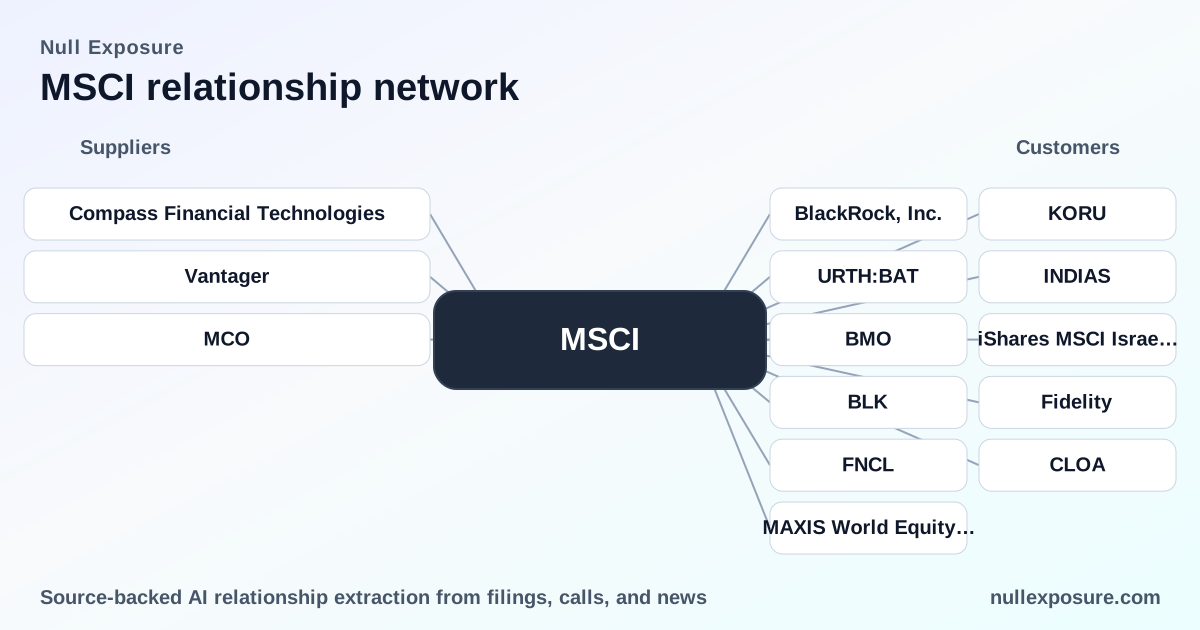
MSCI's supplier relationships: strategic buys and what they mean for investors
MSCI monetizes a high-margin, subscription-led franchise by licensing indexes, analytics, ESG scores and portfolio tools to asset managers, asset owners and financial intermediaries worldwide. The company combines recurring index licensing and data subscriptions with professional services and bespoke analytics to generate roughly $3.13 billion in trailing revenue and a ~38% net profit margin (TTM), making it a cash-rich vendor with strong pricing power and durable customer relationships. Investors should evaluate supplier and partner links through the lens of strategic capability acquisition, model reliance, and third‑party risk control because MSCI’s product set is built on licensed models and integrated data flows that feed its index and analytics engines.
Discover more supplier intelligence at https://nullexposure.com/ for follow-up due diligence.
Recent supplier interactions that change the operational map
MSCI’s 2025–2026 activity shows a mix of acquisitions and licensed model use that strengthen product breadth while introducing integration and dependency vectors. The relationships below are the public record for FY2026 and are consequential to how MSCI packages multi‑asset, private markets, and AI-enabled diligence products.
Compass Financial Technologies
MSCI completed an acquisition of Compass Financial Technologies to expand multi‑asset index and portfolio construction capabilities. According to CityBiz (March 10, 2026), Compass had been a trusted partner for MSCI prior to the deal, and the acquisition accelerates MSCI’s product roadmap for custom and institutional index solutions. (Source: CityBiz, 2026 — https://www.citybiz.co/article/813260/msci-acquires-compass-financial-technologies/)
Vantager
MSCI purchased Vantager, an AI‑native platform founded in 2024 that provides limited partners enhanced investment diligence tools in GP data rooms, positioning MSCI to integrate AI-driven private markets diligence into its product suite. AlternativesWatch reported the acquisition in early March 2026 and characterizes Vantager as built specifically to support LP due diligence workflows. (Source: AlternativesWatch, March 2026 — https://www.alternativeswatch.com/2026/03/05/msci-vantager-ai-platform-lp-due-diligence/)
Moody’s (licensed credit models)
MSCI licensed Moody’s credit risk models in Q3 2025 for use within MSCI’s private credit database, embedding third‑party credit analytics into MSCI’s own product offering and increasing the firm’s dependence on external model intellectual property. TradingView/Zacks noted the licensing arrangement and its application to MSCI’s private credit products in FY2026 disclosures. (Source: TradingView / Zacks summary, 2026 — https://www.tradingview.com/news/zacks:f76805de6094b:0-msci-acquires-compass-financial-to-expand-multi-asset-indexes/)
What these supplier ties reveal about MSCI’s operating model
MSCI’s supplier relationships reflect a purposeful operating posture: aggressive capability acquisition plus selective licensing of third‑party models to fill product gaps quickly. Several company‑level signals flow from the disclosed activity and governance excerpts.
- Contracting posture: MSCI uses acquisitions to internalize adjacent capabilities (Compass, Vantager) while continuing to license specialist intellectual property (Moody’s models). This hybrid approach balances speed to market with control over core analytic workflows.
- Concentration and criticality: Licensing of Moody’s credit models indicates critical dependence on best‑in‑class external models for specific product lines (private credit). Those models are high‑value inputs to monetized subscription offerings and therefore operationally and commercially critical.
- Maturity and integration risk: Acquisitions of small, specialist platforms (Compass, Vantager) accelerate product breadth but introduce integration risk—both technical and go‑to‑market—until those capabilities are fully folded into MSCI’s commercial channels.
- Company‑level risk controls: MSCI’s disclosures emphasize that cybersecurity incidents tied to third‑party providers have been immaterial over the last three fiscal years, framing third‑party risk as monitored and historically contained. This is a company‑level signal about risk management rather than a relationship‑specific claim. (Source: MSCI filings, FY2025 disclosures.)
For deeper supplier coverage and diligence workflows, visit https://nullexposure.com/ to see how these signals are tracked across vendors.
Investment implications and risk framing
These supplier relationships alter MSCI’s risk/return profile in identifiable ways:
- Revenue diversification and product upsell: Compass and Vantager extend MSCI’s addressable market into multi‑asset construction and AI‑assisted private markets diligence, expanding cross‑sell opportunities to existing index and analytics customers.
- Model dependency creates operational leverage—and vulnerability: Licensing Moody’s models enhances product credibility and speed to market, but it leaves MSCI exposed to third‑party contract terms, re‑pricing risks, and potential model replacement costs if licensing terms change.
- Integration execution determines value capture: The pace and effectiveness of integrating Compass and Vantager into MSCI’s sales motion will determine whether the acquisitions are accretive beyond stated cost synergies.
- Third‑party risk is visible but historically contained: Public filings say cybersecurity incidents tied to suppliers have been immaterial over recent years, which supports confidence in MSCI’s vendor governance. Treat this as a positive signal, not a guarantee.
Key takeaway: MSCI continues to buy targeted capabilities while selectively licensing domain expertise; the strategy boosts product depth and monetization potential but increases reliance on vendor models and raises integration execution risk.
What investors should watch next
- Contract renewals and licensing terms with Moody’s or other model vendors—any change in terms would influence cost structure and product margins.
- Product release cadence and commercial adoption for Compass‑derived multi‑asset indexes and Vantager‑powered AI diligence tools.
- Any further disclosures on third‑party incidents or material supplier disputes that would alter the company’s previously described immaterial impact profile.
For a practical next step in supplier due diligence and to monitor these relationships as they evolve, start with a vendor intelligence run at https://nullexposure.com/.
Bottom line
MSCI is deploying a blended supplier strategy—acquire to own strategic capabilities, license to augment specialized functionality—that strengthens monetization paths while introducing model‑dependency and integration execution risk. Investors should value MSCI’s high margins and recurring revenue, but underwrite future cash flows with explicit scenario analysis for licensing cost changes and acquisition integration outcomes. Explore supplier visibility tools and ongoing monitoring at https://nullexposure.com/ to convert these signals into actionable investment views.