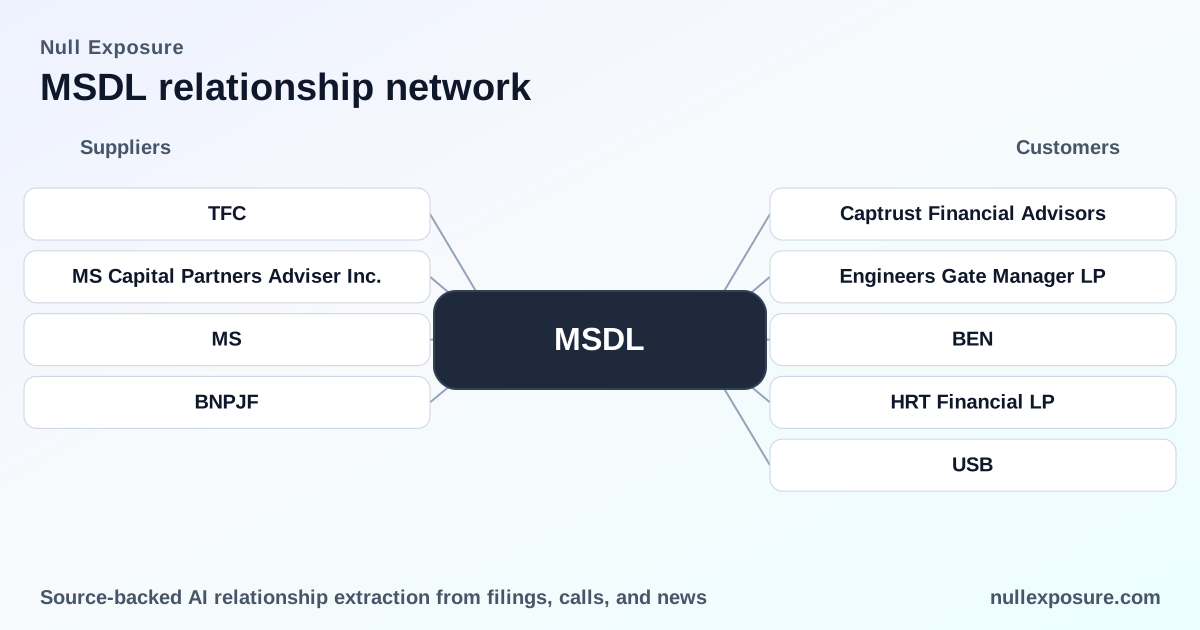
Morgan Stanley Direct Lending Fund (MSDL): supplier map and what it means for investors
Morgan Stanley Direct Lending Fund is a closed-end business development company that originates and holds middle‑market private debt—senior secured loans, subordinated debt and co‑investments—and monetizes through coupon income, management and incentive fees paid to its adviser, and selective capital-management actions. The fund is externally managed and levered, relying on committed credit facilities to provision liquidity and on Morgan Stanley’s platform for deal flow; its supplier relationships therefore sit at the core of both operations and capital structure. For investors evaluating counterparties, the relevant conclusion is straightforward: service relationships (adviser/administrator) and funding counterparties (banks) are active, material, and structurally long‑dated. Learn more about supplier exposures and operational risk at https://nullexposure.com/.
Why the supplier map matters to returns and downside
MSDL's returns derive from net interest spread on private loans less fees and financing costs, meaning counterparty terms and continuity of service directly affect distributable cash flow. The company’s public filings and press release language point to a contracting posture characterized by long‑term notes and renewable administration agreements, and to concentration of critical services with large, enterprise counterparties. Those characteristics produce two investor realities: (1) fund performance is exposed to funding-cost and covenant shifts at bank counterparties, and (2) operational continuity hinges on the Adviser/Administrator relationship—an active, service‑provider dependency that is explicitly described as material in regulatory disclosures.
Key operating signals:
- Long‑term contractual posture: notes and administration agreements are described as multi‑year in the fund’s reports, indicating durable obligations and recurring service arrangements.
- Large‑enterprise counterparties: the adviser is an indirect, wholly owned Morgan Stanley subsidiary, anchoring the fund to a global institution for sourcing and governance.
- Critical service providers: regulatory language flags Adviser/Administrator continuity as essential to operations and distributions.
- Active, ongoing relationships: fee arrangements and administration renewals are current and operational.
If you want a concise briefing and supplier scorecard for portfolio risk, visit https://nullexposure.com/ for a deeper supplier-risk view.
The supplier roster, relationship by relationship
Truist (TFC)
The fund reports an outstanding balance with Truist’s credit facility—$293.1 million outstanding was disclosed in the company’s November 6, 2025 financial release—and the company’s SEC filing explains it amended and restated the senior secured revolving credit agreement to increase the facility size, reflecting an effort to secure favorable financing and enhance liquidity. The press release and 10‑K language together mark Truist as a material funding counterparty for MSDL (Business Wire / FinancialContent, Nov. 6, 2025; SEC 10‑K cited via TradingView).
Truist Bank (separate filing reference)
The SEC 10‑K filing notes the amendment and restatement of the senior secured revolving credit agreement specifically with Truist Bank, increasing the facility and extending its maturity—this is the operational documentation underpinning the fund’s working capital and leverage capacity (SEC 10‑K summary reported on TradingView, FY2025).
MS Capital Partners Adviser Inc.
MSDL is externally managed by MS Capital Partners Adviser Inc., which functions as the investment adviser under a fee structure of base management and incentive fees; press releases and filings repeatedly identify this corporate entity as the adviser responsible for portfolio management (Business Wire / FinancialContent, Nov. 6, 2025). Marketscreener commentary also reiterates the adviser’s role in governance and capital actions such as buyback programs (Marketscreener, FY2026).
Morgan Stanley Investment Management / Morgan Stanley (MS)
The fund leverages Morgan Stanley’s broader platform and advisory relationships for deal flow into private credit and middle‑market financings, enhancing origination and underwriting capacity; that affiliation is a strategic distribution and sourcing advantage cited in public communications (Globe and Mail press release, FY2025). The 10‑K narrative also frames Morgan Stanley’s corporate network as a pipeline differentiator for MSDL’s investment activity (TradingView summary, FY2025).
BNP (BNPJF)
MSDL discloses $351.0 million outstanding in its BNP funding facility as part of its overall bank funding mix, which positions BNP as another material lender supporting the fund’s leverage and liquidity profile (Business Wire / FinancialContent, Nov. 6, 2025).
Constraints and what they tell investors about business model risk
The fund’s public disclosures and regulatory language provide explicit company‑level signals about how supplier relationships are structured and why they matter:
- Contracting posture — long‑term: the fund lists multi‑year notes and administration agreements with renewal features, establishing a durable liability base and recurring service commitments that affect leverage capacity and cost structure.
- Counterparty profile — large enterprise: the adviser is an indirect, wholly owned Morgan Stanley subsidiary, anchoring a key service relationship to a global financial institution and implying both stability and governance interdependence.
- Materiality — critical service providers: filings warn that loss or resignation of the Administrator or Adviser would disrupt operations and distributions, a direct statement that these suppliers are operationally critical.
- Relationship role — service provider: the Adviser and Administrator provide investment advisory, management and administrative services under formal agreements and fee structures—these are not peripheral vendors but central providers to the fund’s business model.
- Relationship stage — active: fee payments, administration renewals, and credit‑facility amendments are current and executed, indicating live counterparty exposure rather than legacy or dormant arrangements.
- Segment focus — services: the fund’s agreements contain indemnities and regulatory frameworks consistent with outsourced investment and administrative services, which elevates governance and operational oversight as active investor concerns.
Those constraints together mean counterparty negotiations, covenant language, and continuity planning should be primary items on an investor due‑diligence checklist.
Investment implications and next steps
For income‑oriented investors and allocators, the supplier map yields three practical conclusions: (1) funding‑counterparty risk is a first‑order return driver—monitor bank facility sizes, outstanding balances and maturity profiles; (2) Adviser/Administrator continuity is a governance risk that can affect distributions; (3) Morgan Stanley affiliation is a structural advantage for deal flow but also concentrates operational dependency.
Practical next steps:
- Review recent credit‑facility amendments and maturity schedules with a focus on covenant flexibility and pricing.
- Assess governance protections and contingency arrangements in the Adviser/Administrator contracts.
- Track funding concentration dynamics between Truist and BNP to understand refinancing and liquidity risk.
If you want a tailored counterparty risk brief or a supplier concentration analysis for MSDL, get a targeted report at https://nullexposure.com/. For ongoing coverage and alerts on supplier changes and filings, subscribe at https://nullexposure.com/—your quickest route to actionable supplier intelligence.
Bold takeaway: MSDL’s return profile is tightly coupled to bank funding terms and to the Adviser/Administrator relationships; investors should prioritize contract language and counterparty continuity when sizing exposure.