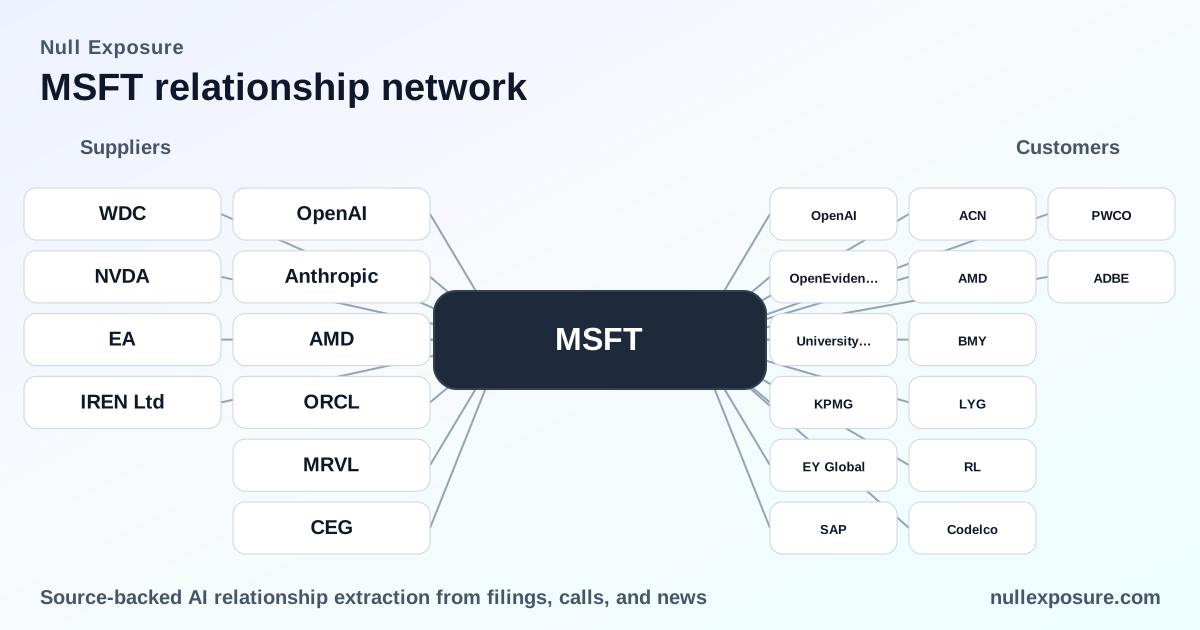
Microsoft (MSFT) supplier relationships — what investors need to know
Microsoft monetizes through a diversified portfolio: subscription software (Office/Microsoft 365), cloud infrastructure (Azure), enterprise AI services (Copilot and E7 bundles), and high-margin platform services tied to developer and enterprise spend. The company converts product leadership and ecosystem lock-in into recurring revenue while underwriting large-scale capital investment in data centers and AI infrastructure, creating durable demand for a set of specialist suppliers across semiconductors, storage, energy and AI model vendors. For a concise supplier exposure briefing and ongoing monitoring, visit https://nullexposure.com/.
The short take for investors
Microsoft’s supplier posture is deeply strategic and capital-intensive. Key characteristics investors should internalize:
- AI-first capex drives outsized dependency on chip and interconnect suppliers (Nvidia, Marvell, AMD) and specialized storage (Western Digital).
- Long-dated energy contracts reduce operational risk for hyperscale datacenters but concentrate counterparty exposure (Constellation Energy).
- AI model partnerships diversify software product roadmaps while creating regulatory and continuity considerations (OpenAI, Anthropic).
These structural dynamics underpin both revenue growth in cloud/AI and concentrated supplier risk that must be priced into valuations.
Supplier relationships, company-by-company
OpenAI
Microsoft continues to integrate OpenAI’s models into Copilot while broadening options for customers to choose other models; Microsoft now supports multi-vendor model selection for enterprise assistants. According to coverage in March 2026, Microsoft has shifted Copilot toward a flexible model architecture that still includes OpenAI models in its offerings (Fortune, March 9, 2026 — https://fortune.com/2026/03/09/microsoft-copilot-cowork-ai-agents-anthropic-e7-m365-saas/).
Anthropic
Anthropic is a primary partner for Microsoft’s new Copilot Cowork and is being embedded into enterprise product bundles such as the E7 suite and Copilot Chat for select customers. CNBC and CRN reported in March 2026 that Anthropic’s Claude powers Copilot Cowork and is integrated alongside Microsoft’s own AI capabilities (CNBC, March 9, 2026 — https://www.cnbc.com/2026/03/09/microsoft-office-365-e7-copilot-ai.html; CRN, March 2026 — https://www.crn.com/news/ai/2026/microsoft-unveils-e7-suite-copilot-cowork-in-enterprise-ai-offensive).
Nvidia
Nvidia is a core hardware supplier for Microsoft’s AI infrastructure, and Microsoft has invested heavily in data center buildout that relies on Nvidia accelerators. CNBC reported Microsoft committed more than $100 billion in data center infrastructure spending over the prior year, explicitly including Nvidia chips as a central component (CNBC, March 9, 2026 — https://www.cnbc.com/2026/03/09/microsoft-office-365-e7-copilot-ai.html).
Advanced Micro Devices (AMD)
Public reporting has suggested Microsoft is a potential large-scale customer for AMD as hyperscalers expand AI hardware footprints; analysts have speculated Microsoft could be an incremental gigawatt-scale purchaser. InsiderMonkey relayed analyst commentary in March 2026 that positions Microsoft as a plausible third large customer for AMD’s gigawatt-scale offerings (InsiderMonkey, March 2026 — https://www.insidermonkey.com/blog/heres-why-ubs-lowered-advanced-micro-devices-amd-price-target-1711427/).
Marvell Technology
Marvell supplies high-speed SerDes and memory controllers that underpin custom AI hardware programs, including references to Microsoft’s Maia program in industry reporting. FinancialContent’s March 2026 analysis on AI interconnect technology notes Marvell’s role in enabling Microsoft’s specialized hardware builds (FinancialContent, March 9, 2026 — https://markets.financialcontent.com/stocks/article/finterra-2026-3-9-architecting-the-ai-interconnect-a-comprehensive-research-feature-on-marvell-technology-mrvl).
Western Digital
Western Digital is a key storage supplier to Microsoft’s hyperscale datacenters, with cloud and hyperscale customers like Microsoft accounting for a substantial portion of demand for high-capacity enterprise drives. Market coverage in March 2026 identified Microsoft as a Titan client buying Enterprise Helium drives for data centers (FinancialContent, March 9, 2026 — https://markets.financialcontent.com/stocks/article/finterra-2026-3-9-the-storage-renaissance-a-deep-dive-into-the-new-western-digital-wdc).
Constellation Energy
Microsoft has executed long-term power supply arrangements with Constellation Energy, including deals that span up to 20 years and supply datacenters with nuclear-generated power. Market reports in March 2026 describe these long-duration agreements as part of Microsoft’s strategy to secure reliable, low-carbon energy for its global datacenter footprint (Finviz/InsiderMonkey reporting, March 2026 — https://finviz.com/news/333128/constellation-energy-ceg-share-price-target-cut-by-multiple-analysts; https://www.insidermonkey.com/blog/constellation-energy-ceg-share-price-cut-by-multiple-analysts-1711817/?amp=1).
Electronic Arts (EA)
Microsoft’s relationship with Electronic Arts is commercially ambivalent: EA’s titles are integral to Xbox Game Pass while some EA franchises compete with Microsoft-owned gaming assets, creating a “frenemy” supplier/customer dynamic. Industry commentary in March 2026 frames EA as both a key content provider and competitor within gaming distribution (FinancialContent, March 9, 2026 — https://markets.financialcontent.com/stocks/article/finterra-2026-3-9-the-privatization-of-a-giant-a-deep-dive-into-electronic-arts-ea-in-2026).
IREN Ltd
Industrial and infrastructure customers like IREN are procuring AI cloud services from Microsoft at scale; a March 2026 report described a multi-year, multi-billion-dollar deal for AI cloud services between IREN and Microsoft. Blockmanity reported that IREN locked a $9.7 billion, five-year arrangement with Microsoft for AI cloud services (Blockmanity, March 2026 — https://blockmanity.com/news/why-the-bkch-etf-is-silently-evolving-into-a-top-ai-infrastructure-bet/).
What the constraints tell investors about Microsoft’s operating model
Microsoft’s supplier constraints read like a hyperscaler playbook: critical supplier concentration, strategic manufacturer relationships and high capital intensity. Company-level signals from filings and reporting indicate:
- Materiality: critical. Microsoft recognizes that "few qualified suppliers" exist for certain server and device components, and that supplier disruptions could affect datacenter operations and device manufacturing. This is a company-level flag signifying supply-chain sensitivity rather than an issue tied to any single supplier.
- Relationship role: manufacturer. Microsoft engages third-party manufacturers for device production and has processes to relocate production geographically, indicating mature contract management and contingency planning.
These constraints imply a contracting posture that is long-duration, bespoke and relationship-driven rather than purely transactional. Concentration in specialized suppliers increases counterparty risk but also gives Microsoft bargaining power through scale and pre-commitments. For investors, this combination drives predictable demand for certain suppliers while exposing Microsoft to vendor-specific disruptions and geopolitical execution risk.
For a deeper supplier risk score and continuous monitoring of these relationships, check https://nullexposure.com/.
Investor implications and key risks
- Upside: Microsoft’s multi-model Copilot strategy and heavy capex create sustained, high-margin Azure and productivity revenue growth and lock in suppliers that scale with demand. Anthropic and OpenAI partnerships broaden product differentiation for enterprise customers.
- Downside: Concentration in critical hardware and interconnect suppliers (Nvidia, Marvell, AMD, Western Digital) and long-term energy counterparties creates idiosyncratic supplier risk that can translate into operational constraints if one node fails. Long-term energy contracts reduce volatility in operating costs but increase counterparty exposure.
- Regulatory and continuity risk: Relationships with AI model vendors introduce policy and procurement complexities for government-facing customers; Microsoft has committed to continuity with certain partners even as classification and scrutiny evolve.
If you are modeling supply-side risk into MSFT’s valuation or vendor exposure, map capex phases and long-dated supplier contracts against demand curves for AI cloud consumption. For bespoke briefings and supplier-level analysis, visit https://nullexposure.com/.
Bottom line
Microsoft’s supplier map is the structural underpinning of its AI and cloud growth thesis: strategic, concentrated and capital-intensive. Investors should price in both the leverage that scale delivers and the vendor concentration that introduces idiosyncratic operational risk. For ongoing, investor-grade supplier intelligence and alerts, go to https://nullexposure.com/.