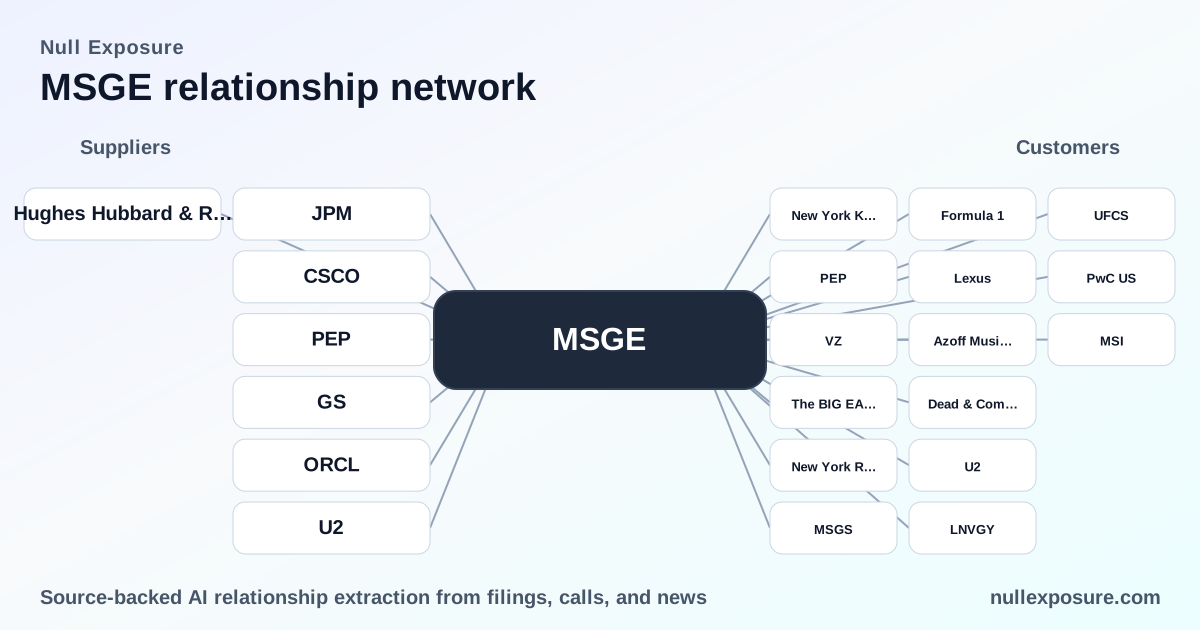
MSG Entertainment (MSGE) — supplier relationships that shape revenue, risk, and runway
Thesis: Madison Square Garden Entertainment Corp. operates a vertically integrated live-entertainment and venue-management business that monetizes through ticketing, venue operations, sponsorships and branded partnerships, and long-term venue leases. Supplier relationships span financial advisors, technology and infrastructure vendors, brand partners, legal counsel and artist deals — each relationship influences revenue capture, cost structure, and operational continuity in different ways. For an investor or operator, the imperative is to translate these supplier ties into a map of concentration, criticality, contract tenor and operational maturity. Learn more about our supplier intelligence at https://nullexposure.com/.
How MSGE runs the business and what suppliers control
MSG Entertainment runs arenas, concert residencies, and venue operations while licensing and partnering the MSG brand across assets. That operating model creates a set of supplier archetypes that matter more than others:
- Technology and infrastructure vendors (networking, ticketing platforms, enterprise suites) control event uptime, customer experience and data security — outages or vulnerabilities directly hit revenue and reputation.
- Brand and sponsorship partners provide recurring, often multi-year revenue that offsets event volatility and lifts gross margins through shared marketing and exclusivity.
- Financial and legal advisors shape capital transactions, M&A and monetization of non-core assets; their presence matters most around asset sales, capital raises and restructuring.
- Artist and promoter arrangements drive box-office economics and are often negotiated as high-impact, high-commitment deals (residencies, revenue splits).
Two company-level signals from recent disclosures are important for underwriting counterparty risk and runway: MSGE reports long-term real estate commitments (Radio City lease extended through 2038 with an additional optional renewal window), and active debt servicing under the National Properties Credit Agreement, indicating ongoing secured financing activity. These items point to capital intensity and long-duration fixed obligations in MSGE’s cost base, which increases the economic importance of stable sponsor and technology supplier relationships.
Explore supplier exposure maps and counterparty histories at https://nullexposure.com/.
What the public relationships tell investors — one-line takes, with sources
Below are each relationship surfaced in our feed with a concise plain-English takeaway and the cited source.
-
J.P. Morgan — acted as financial advisor to MSG in a FY2018 transaction, reflecting the bank’s advisory role on strategic asset deals and divestitures (Variety, 2018: https://variety.com/2018/biz/news/azoff-management-to-buy-out-msgs-interest-in-azoff-msg-entertainment-for-125-million-1202971912/).
-
Cisco — supplies networking, data center and wireless infrastructure across The World’s Most Famous Arena, positioning Cisco as a critical technology supplier for event operations and guest connectivity (Cisco newsroom release, Dec 2025: https://newsroom.cisco.com/c/r/newsroom/en/us/a/y2025/m12/madison-square-garden-entertainment-and-cisco-announce-multi-year-partnership-making-cisco-an-official-partner-of-the-world-most-famous-arena.html).
-
PepsiCo — is an expanded, multi-year official partner across the MSG Family of Companies, providing a branded sponsorship relationship that contributes recurring commercial revenue and marketing support across venues (MSG press release, FY2025: https://investor.msgsports.com/press-releases/news-details/2025/THE-MSG-FAMILY-OF-COMPANIES-AND-PEPSICO-EXPAND-MULTI-YEAR-PARTNERSHIP/default.aspx).
-
Goldman, Sachs & Co. — served as financial advisor to MSG in earlier partnership activity, indicating established investment-bank relationships used for strategic corporate transactions (GlobeNewswire, 2017: https://www.globenewswire.com/news-release/2017/02/01/912851/0/en/The-Madison-Square-Garden-Company-Partners-With-TAO-Group.html).
-
Oracle — was implicated as the vendor platform involved in a December 2025 application-data security vulnerability that allowed unauthorized access, an incident that flags third-party software risk and incident response exposure (PR Newswire alert, 2026: https://www.prnewswire.com/news-releases/data-breach-alert-edelson-lechtzin-llp-is-investigating-claims-on-behalf-of-persons-affected-by-the-madison-square-garden-entertainment-corp-data-breach-302700032.html).
-
U2 — entered a high-value residency arrangement with a substantial revenue split (reported 90% of ticket revenue for a 36-show residency), representing artist economics that can materially alter show-level profitability, and demonstrates the potential for large, concentrated payout structures to talent (New York Post, 2023: https://nypost.com/2023/11/21/business/london-mayor-blocks-msg-boss-james-dolans-plans-for-sphere/).
-
Hughes Hubbard & Reed LLP — served as legal counsel in a 2017 partnership transaction, showing reliance on established outside counsel for transactional structuring and approvals (GlobeNewswire, 2017: https://www.globenewswire.com/news-release/2017/02/01/912851/0/en/The-Madison-Square-Garden-Company-Partners-With-TAO-Group.html).
What to read into concentration, criticality and contracting posture
These relationships reveal three structural features of MSGE’s operating model that investors should prioritize:
-
Concentration of critical tech suppliers: Cisco and Oracle (infrastructure and enterprise applications) are single points that, if disrupted, degrade event operations and data integrity. The December 2025 vulnerability tied to Oracle highlights the operational risk of third-party software and the potential for litigation and remediation costs.
-
Sponsorships as margin stabilizers: Multi-year brand deals like the PepsiCo partnership deliver predictable non-ticket revenue, which underwrites capital-intensive venue leases and helps service debt; these relationships are therefore high-priority for cash-flow stability.
-
High-impact artist economics: Deals that allocate outsized shares of ticket revenue to talent (the reported U2 arrangement) can materially compress margins for marquee residencies; countersigning and structuring these agreements requires tight margin governance and forecasting.
Combine these structural features with the company-level constraints: material long-term lease obligations (Radio City through 2038) and active loan repayments — which together increase reliance on steady sponsorship and event throughput to meet fixed costs.
For a detailed supplier risk matrix and counterparty history, see https://nullexposure.com/.
Operator takeaways and red flags investors should monitor
- Monitor vendor patching and third-party security attestations for Oracle and other enterprise suppliers; a single exploit translates into regulatory, remediation and reputational costs.
- Track sponsorship renewal cadence and contractual exclusivity for partners like PepsiCo — renewals are the practical hedge against event revenue cyclicality.
- Assess deal-level economics for headline residencies (guarantees, revenue splits, duration) to ensure marquee shows are accretive rather than loss-leading.
Bottom line and next steps
MSG Entertainment’s supplier base reads like a blueprint of what drives live-entertainment economics: technology uptime, brand monetization, and artist contracts. The company’s long-term property commitments and active debt servicing raise the bar for predictable partner revenue and robust vendor governance. Investors and operators should prioritize monitoring security posture of enterprise suppliers, sponsorship renewal health, and the economics of headline talent.
If you want ongoing, transaction-level insight and supplier risk scoring for MSGE and peers, start here: https://nullexposure.com/.
Final action: review the supplier summaries above and use them to prioritize diligence questions in the next board or underwriting meeting. For ongoing supplier intelligence and alerts, visit https://nullexposure.com/.