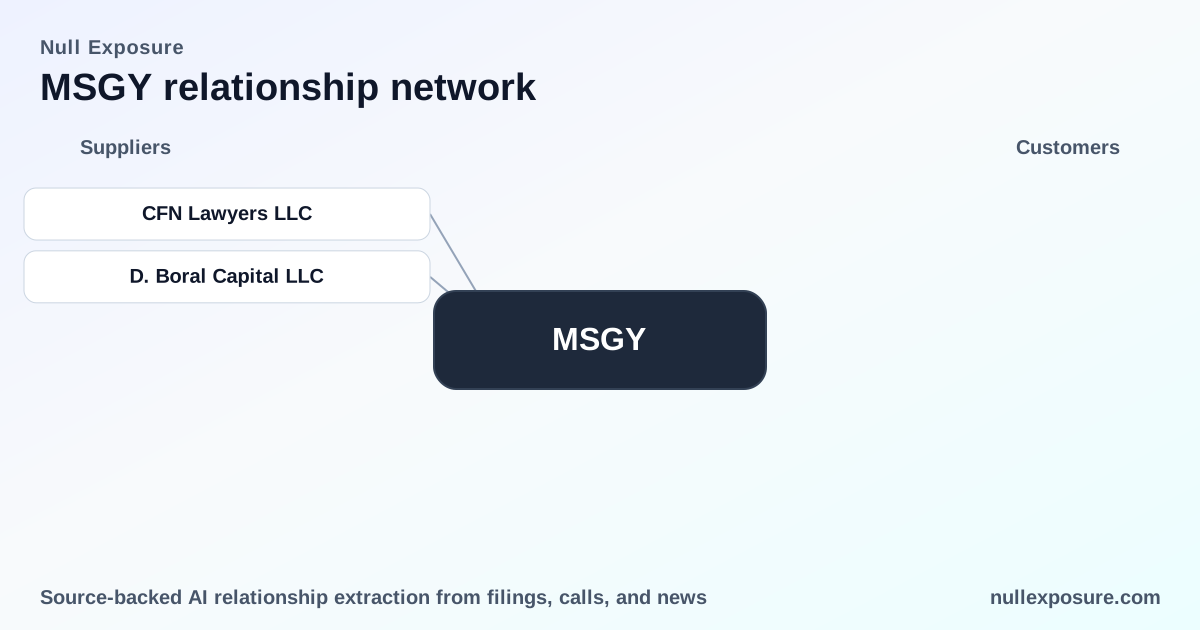
Masonglory Limited (MSGY) — Supplier relationships and capital-partner profile
Masonglory Limited operates wet trades and ancillary services in Hong Kong and monetizes through project revenue and service contracts tied to maritime and construction-related wet work. The company generates cash from contracting activity (TTM revenue $23.3M) and supplements operating margins with selective capital raises; its capital partners and legal advisors are therefore central to funding flexibility and transactional execution. For a marketplace view of supplier concentration and partner roles, visit https://nullexposure.com/.
One-page financial context that drives supplier posture
Masonglory is a small-cap industrial services issuer with TTM revenue of $23.3M, gross profit of $2.17M and net profit margin roughly 5.5%. Market capitalization sits at about $6.1M and the company reports high insider ownership (73.8%) and minimal institutional ownership (1.42%), signaling strong founder control and limited third-party investor depth. Valuation multiples are compressed—trailing P/E ~4.76, EV/Revenue ~0.255, EV/EBITDA ~3.94—which reflects both low market sentiment and potential leverage points for opportunistic suppliers and capital providers.
These metrics shape how suppliers and partners negotiate: shorter payment cycles, reliance on discrete financing events, and an emphasis on contractual protections are consistent with Masonglory’s profile as a compact but profitable operator.
Who Masonglory works with and why it matters
Below are the supplier/partner relationships surfaced in filings and news around the company's most recent offering activity. Each relationship is described in plain English and tied to the public disclosure.
-
CFN Lawyers LLC — U.S. counsel to Masonglory in the offering. According to an AccessNewswire release dated March 10, 2026, CFN Lawyers LLC acted as U.S. counsel to Masonglory in connection with the company’s offering, providing transactional legal services required for a U.S.-listed capital raise. (AccessNewswire, March 10, 2026)
-
D. Boral Capital LLC — sole underwriter / bookrunner for the offering. The same March 10, 2026 release states that D. Boral Capital LLC served as the sole underwriter and bookrunner, which means Masonglory partnered with a single underwriting firm to place the issuance and manage investor allocation. (AccessNewswire, March 10, 2026)
These partner choices reveal an approach to capital markets that uses boutique underwriting and retained legal counsel to execute discrete equity transactions rather than sustained syndication through large investment banks.
What these partner choices imply about contracting posture and supplier criticality
Masonglory’s limited roster of disclosed transaction partners yields several operating-model signals investors and suppliers should treat as structural facts:
-
Contracting posture — transactional and event-driven. The use of a single bookrunner for an offering implies capital sourcing on a deal-by-deal basis rather than ongoing syndicated coverage; suppliers should expect the company to favor tight, event-focused contracts and to negotiate terms that protect cash flow around financings.
-
Concentration — governance and decision control are centralized. With insiders holding nearly three-quarters of equity and institutions owning a fraction, counterparties face concentrated negotiating counterparts, which compresses bargaining power for external suppliers and amplifies the importance of legal counsel and underwriter credibility.
-
Criticality — legal and capital partners are mission-critical for growth. Counsel (CFN Lawyers) and the underwriter (D. Boral) are directly consequential to Masonglory’s ability to raise capital and execute cross-border transactions; continuity and relationship quality with these partners affect timing and cost of future financing.
-
Maturity — small cap, limited float, selective market access. A small public float (shares float ~3.27M) and sparse institutional ownership signal thin liquidity, which increases execution risk for equity raises and makes boutique underwriting a logical operational choice.
For a deeper supplier-risk lens and customized scoring, explore more at https://nullexposure.com/ — actionable insights are geared to investor and operator use.
Supplier and investor risk / opportunity checklist
Masonglory’s partner profile creates a clear set of practical trade-offs:
-
Opportunities:
- Positive return metrics: ROE ~46.6% and ROA ~13.2% indicate efficient asset use and strong profitability relative to size, creating scope for supplier relationship growth tied to profitable contracts.
- Low valuation multiples allow strategic suppliers or financial partners to negotiate favorable terms if they provide predictable execution.
-
Risks:
- Dilution and timing risk tied to event-driven capital raises using boutique underwriters can create payment pressure for suppliers if financing windows delay.
- Concentrated ownership increases governance risk for minority stakeholders and may limit transparency for counterparties evaluating long-term exposure.
Practical takeaways for buyers, operators, and institutional evaluators
- Treat legal and underwriting partners as strategic suppliers. The company’s capital access depends on counsel and a single bookrunner, so their continuity and reputation are de facto risk controls for vendors and financiers.
- Price for concentration and liquidity risk. Contract terms should reflect the company’s small float and concentrated insider base—shorter payment terms, stronger security interests, and defined remedies are prudent.
- Monitor subsequent filings and press around capital raises. Future choices of underwriters or counsel will signal shifts in Masonglory’s access to capital markets and bargaining posture.
If you evaluate suppliers or counterparty exposure to small-cap industrials, our platform provides targeted relationship scoring and supplier concentration intelligence at https://nullexposure.com/.
Bottom line and next steps
Masonglory is a small but profitable operator that relies on transactional capital-market relationships—notably CFN Lawyers as counsel and D. Boral Capital as sole underwriter—to fund growth and stabilize working capital. Suppliers and investors should treat these partners as operationally material and price contracts accordingly. For tailored diligence on supplier concentration, underwriting partners, or transactional risk profiles, visit https://nullexposure.com/ and request the relevant exposure report.