MSI Supplier Landscape: Strategic Partners, Operational Constraints, and Investor Implications
MSI operates as an integrated provider of public-safety and security hardware, software, and services, monetizing through product sales, recurring software and support contracts, and strategic acquisitions that extend its technology stack and addressable market. The company sources critical components and software capabilities from a mix of specialist suppliers and contract manufacturers while deploying capital to acquire capabilities that accelerate growth—creating a hybrid operating model that blends buyer leverage with acquisition-driven capability expansion. For investors evaluating supplier risk and strategic durability, the interplay of global manufacturing exposure, single-source disruption risk, and acquisition-driven integration demands tight operational oversight and disciplined capital allocation. For a deeper supplier-risk profile and monitoring tools, visit https://nullexposure.com/.
How MSI actually contracts and sources — the operating model in plain terms
MSI runs a two-track supply posture: it is both a buyer of third-party hardware/software and a manager of contract manufacturing relationships that produce the bulk of its physical products. MSI sources through a global network of contract manufacturers (including facilities in Mexico and Malaysia) while simultaneously purchasing specialized systems and software from boutique providers to complement its platform. This structure creates a mix of leverage and vulnerability: global sourcing provides scale and cost flexibility, but single-source vendors are explicitly identified as potentially material to operations.
- Global manufacturing footprint: MSI engages contract manufacturers across multiple geographies, which reduces single-location manufacturing risk but increases supply-chain complexity.
- Buyer and manufacturer roles: MSI acts as a large buyer negotiating components and as a coordinating party for contract manufacturers that assemble finished goods.
- Operational criticality: The company recognizes that a disruption at a single-source vendor can have a material adverse impact on results, making supplier continuity a board-level risk.
- Segment focus on manufacturing: The manufacturing segment is central to MSI’s go-to-market model and to its exposure to cost and logistics volatility.
These constraints are company-level signals drawn from MSI’s FY2025 disclosures and should inform any diligence on supplier concentration, contingency planning, and inventory strategy.
For supplier benchmarking and granular exposure analysis, see https://nullexposure.com/.
Supplier roll call — who MSI names in its filings and calls
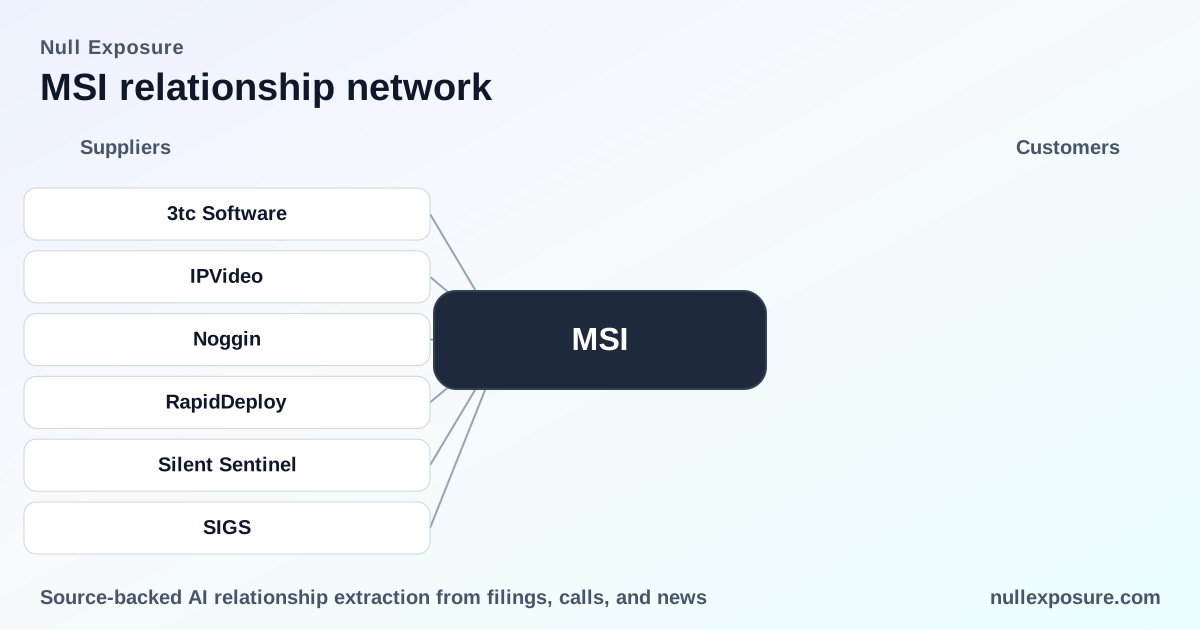
MSI’s FY2025 10-K and public remarks identify multiple specialist partners and an acquisition disclosed on an earnings call. Each relationship below is described with the discrete language MSI used.
3tc Software
3tc Software is described by MSI as a provider of control room software solutions, indicating a software partner that likely complements MSI’s public-safety command-and-control offerings. According to MSI’s FY2025 Form 10‑K, 3tc Software is listed among named software suppliers (FY2025 10‑K).
IPVideo
IPVideo is presented as the creator of a multifunctional safety and security device, suggesting a supplier of integrated hardware/sensor systems that feed MSI platforms. MSI names IPVideo in its FY2025 10‑K as a supplier of such devices (FY2025 10‑K).
Noggin
Noggin is identified as a provider of cloud-based business continuity planning, operational resilience and critical event management software, which signals its role as a SaaS partner for operational resilience capabilities within MSI’s portfolio. MSI references Noggin in its FY2025 10‑K (FY2025 10‑K).
RapidDeploy
RapidDeploy is noted as a provider of cloud-native 911 solutions, indicating a partnership or supplier relationship in mission-critical emergency response software that integrates with MSI systems. MSI includes RapidDeploy in its FY2025 10‑K filing (FY2025 10‑K).
Silent Sentinel
Silent Sentinel is called out as a provider of specialized, long-range cameras, suggesting a hardware-sensor supplier used in perimeter and area surveillance solutions. MSI lists Silent Sentinel among its named suppliers in the FY2025 10‑K (FY2025 10‑K).
Silvus
Silvus is referenced in MSI’s Q4 2025 earnings call where management stated that capital allocation for 2025 included $4.9 billion in acquisitions, including our acquisition of Silvus, indicating Silvus was acquired as part of MSI’s inorganic growth strategy to add specific communications capabilities (Q4 2025 earnings call).
What these relationships imply for investors: concentration, criticality, and integration risk
The supplier list reflects a deliberate combination of niche software and specialized hardware partners that augment MSI’s platform breadth while MSI’s acquisition of Silvus demonstrates a willingness to internalize capabilities rather than remain dependent on vendors. From an investor perspective, three themes matter:
- Concentration and single-source exposure: MSI’s own 10‑K explicitly warns that a single-source vendor disruption could be material. That elevates the importance of monitoring supplier concentration and contractual protections across these partners.
- Operational criticality of suppliers: Several suppliers deliver mission-critical, safety-of-life capabilities (cloud-native 911, control-room software, long-range cameras), increasing the consequences of supplier performance lapses.
- Acquisition as risk mitigation and integration challenge: The strategy to acquire capabilities like Silvus reduces dependency but introduces integration and capital-allocation risk; investors should track post-acquisition operational milestones and synergy realization.
Key takeaway: MSI balances buying specialized capabilities with selective acquisitions to reduce dependence, but the company retains material exposure to supplier continuity and global manufacturing complexity.
For operational diligence tools and more supplier-level intelligence, visit https://nullexposure.com/.
Practical risk checklist for diligence teams
To translate the above into actionable diligence, focus on:
- Contract terms and termination clauses with named suppliers and major contract manufacturers.
- Inventory buffers and dual-sourcing strategies for components tied to safety-critical products.
- Integration plans, milestones, and performance metrics for acquisitions (e.g., Silvus).
- Geographic supply-chain mapping to identify nodes in Mexico, Malaysia, and other production locations named by MSI.
Investors should view supplier relationships not as passive inputs but as operational levers that materially affect margins, product availability, and reputational risk.
Final assessment and investor action items
MSI’s supplier network combines specialized software/hardware vendors with large-scale contract manufacturing, creating an operating model that is effective for platform expansion but exposed to concentrated supplier disruption. The company’s explicit recognition of single-source risk and its global contract-manufacturing footprint are the principal constraints investors must monitor. Track contractual safeguards, integration outcomes for acquisitions like Silvus, and MSI’s actions to improve supplier redundancy.
To monitor MSI supplier exposure and to receive alerts on new supplier filings, go to https://nullexposure.com/ and sign up for supplier-risk coverage.