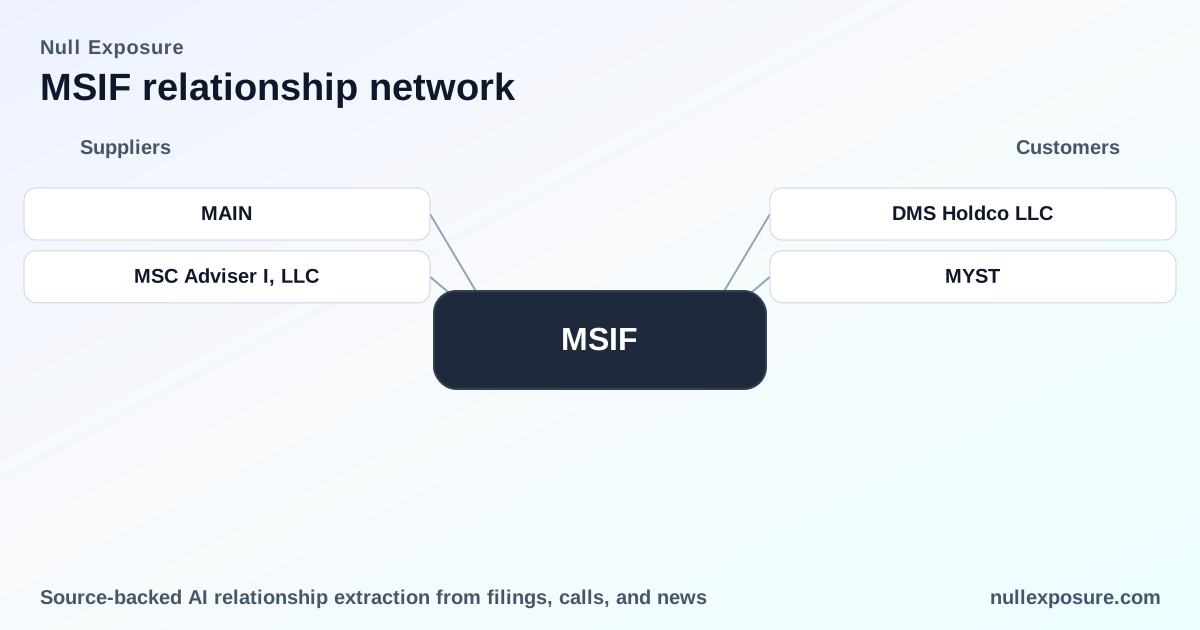
MSIF supplier relationships — who runs the fund, who co-invests, and what investors should price in
MSIF is an externally managed closed‑end income vehicle that monetizes by collecting investment returns while paying an external adviser for portfolio management, administrative services and certain distribution-related fees; it also leverages bank credit facilities to support liquidity and deal activity. Investors should evaluate the Adviser’s operational control, fee and reimbursement mechanics, and the co‑investment relationship with Main Street Capital as core drivers of net returns and governance oversight. For a concise hub of original supplier intelligence, visit https://nullexposure.com/.
The operating model in one paragraph: outsourced management, fee-bearing services, and credit leverage
MSIF runs an adviser‑centric operating model: day‑to‑day investment sourcing, underwriting and portfolio management are delegated to an external adviser that also handles administrative functions in exchange for management fees and reimbursements. The company funds investments with a mix of equity and multi‑year revolving credit facilities whose terms were recently extended, which increases the effective time horizon of its financing and shapes liquidity flexibility. This structure creates concentration and dependency on the Adviser for capital deployment and reporting, while also embedding contractual obligations to service providers that affect economic returns.
How the public signals map to contracting posture and business constraints
- Long‑term financing posture: The firm reports amendments to its Corporate Facility that extend revolving and maturity dates into 2028–2029 and adjusted pricing to SOFR+ spread levels, signaling multi‑year financing commitments that lengthen funding runway and lock in lender relationships.
- Material dependency on the Adviser: Company disclosures flag that financial condition and operating results depend on the Adviser’s ability to manage and deploy capital, indicating the Adviser is a material service provider to the business model.
- Service provider economics: Filings state the company pays fees, selling commissions and reimbursement for administrative services to its Adviser subject to a quarterly cap, which creates a predictable but fee‑bearing relationship that directly influences net distributable income.
- Active and governed relationship: The Adviser relationship is active with contractual mechanics (including resignation notice provisions), underscoring both operational continuity and the need for governance oversight by the board.
All of the above are company‑level operational signals; they shape how investors should value MSIF’s cashflows without assigning a constraint to any individual supplier unless explicitly identified in source text. For further supplier intelligence, review curated profiles at https://nullexposure.com/.
Main Street Capital Corporation — co-investor and strategic partner
Main Street Capital Corporation provides co‑investment support and deal flow alignment for MSIF, partnering on lower‑middle‑market debt and equity solutions that the Fund can access through joint transactions. According to MSIF materials and distribution announcements, the Fund has "partnered with entrepreneurs...in co‑investments with Main Street Capital Corporation" and management highlighted continued support from Main Street in a 2025 Q4 earnings call. (Source: corporate press release and MSIF 2025 Q4 earnings commentary.)
Takeaway: Main Street’s role is strategic and deal‑level; its participation can bolster sourcing and underwriting but also creates potential for shared conflicts of interest and concentration in co‑investment exposures.
MSC Adviser I, LLC — the Adviser and administrator running the fund
MSC Adviser I, LLC is identified repeatedly in public notices as MSIF’s investment adviser and administrator, performing the core duties of portfolio management and fund administration that drive performance and investor reporting. Multiple regulatory and press notices in FY2025–FY2026 reference MSC Adviser I, LLC as the company’s investment advisor and administrator, including announcements of operating results and governance updates. (Source: MarketScreener and Morningstar filings and press coverage, FY2025–FY2026.)
Takeaway: The Adviser is the operational engine for MSIF; its performance, turnover, fee arrangements and internal cost cap mechanics directly determine net returns and operational risk.
What these relationships imply for investors — risk, concentration and governance
The combined supplier picture is one of outsourced portfolio control with strategic co‑investment ties. Key investor implications:
- Concentration of operational risk: Dependence on a single Adviser for sourcing and operations is material; a change in adviser or deterioration in its execution would have immediate operational and earnings consequences.
- Fee‑and‑reimbursement mechanics matter: The Adviser receives management fees and is reimbursed for internal administrative services subject to a quarterly cap — a feature that limits but does not eliminate operating cost transfer to the Fund.
- Financing maturity reduces short‑term refinancing risk: Extended revolver terms through 2028–2029 lower the near‑term refinancing cliff, but leverage still amplifies asset performance variability.
- Co‑investment alignment creates both upside and conflict potential: Main Street co‑investments can improve deal access and economics, yet require active conflict management and transparent valuation practices.
For a deeper dive into how these supplier relationships affect valuation modeling and downside scenarios, explore MSIF supplier analysis at https://nullexposure.com/.
Practical checklist for investors evaluating MSIF exposure
- Confirm the Adviser’s track record on realized exits, defaults and NAV smoothing; fee drag matters.
- Review the credit facility terms and covenant language (maturities, amendment history, pricing floors) to assess liquidity sensitivity.
- Examine disclosures around co‑investment allocation and valuation with Main Street to identify related‑party flows and preferential deal routing.
- Scrutinize the quarterly cap on internal administrative expense reimbursements to understand fixed vs. variable expense transfer to the Fund.
Final assessment and next steps
MSIF runs a classic externally managed model where Adviser competency, fee mechanics and the Main Street co‑investment channel are the primary drivers of investor outcomes. The extended credit facility maturities reduce immediate refinancing risk, but the Adviser dependence and fee/reimbursement structure remain material to net returns. Investors should prioritize governance monitoring and disclosure quality when sizing positions.
For ongoing supplier intelligence and to track any changes in these relationships or contract terms, visit https://nullexposure.com/.