MSC Industrial Direct (MSM): supplier relationships that shape distribution economics
MSC Industrial Direct is a broadline distributor of metalworking and MRO products that monetizes through product sales, a high‑margin e-commerce channel, and a mix of third‑party and exclusive private‑label SKUs. The company sources inventory from a large supplier base, leverages a 2.4‑million+ product catalog on mscdirect.com, and captures recurring revenue from industrial customers through fast fulfillment and account management. For investors and operators, the supplier book is the operating lever that determines gross margin stability, fill‑rates, and the scalability of MSC’s digital channel.
Explore supplier relationship intelligence and portfolio signals at https://nullexposure.com/ to support diligence and monitoring.
Supplier entries reported in the FY2025 filing — names and immediate takeaways
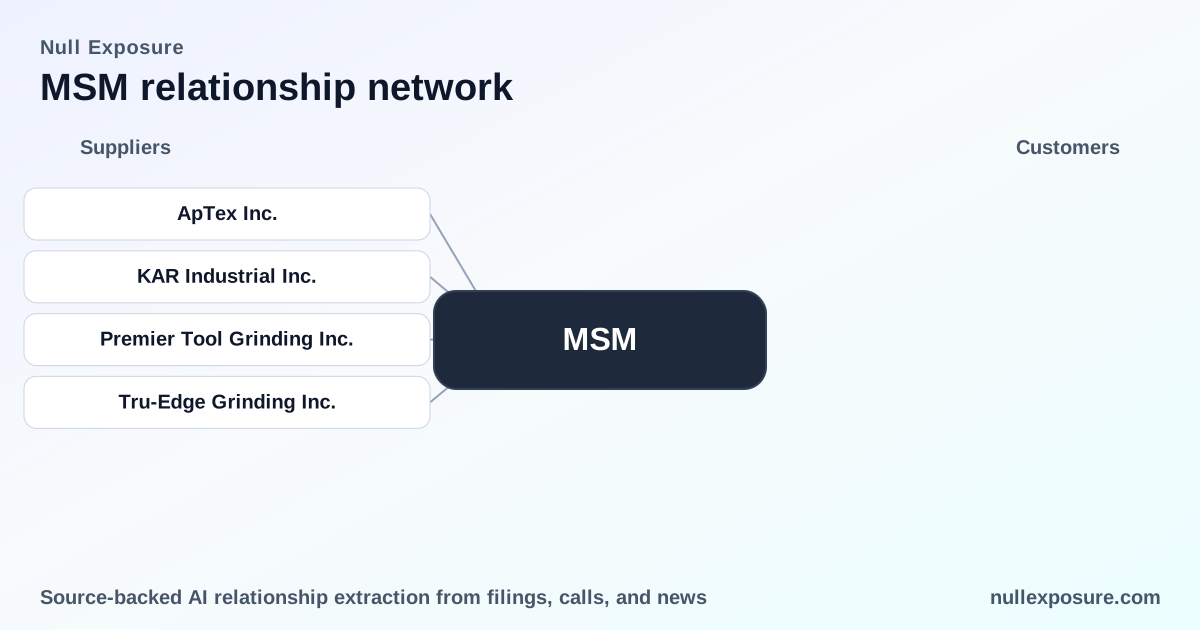
Below I list every supplier relationship called out in the available results, with a concise plain‑English description and source attribution.
ApTex Inc.
ApTex Inc. is listed in MSC’s FY2025 Form 10‑K as a named supplier relationship; the filing records ApTex as part of MSC’s broader supplier membership roster for the fiscal period. According to the FY2025 Form 10‑K (filed 2025‑08‑30), ApTex is included among third‑party product sources that underpin MSC’s catalog and distribution network.
KAR Industrial Inc.
KAR Industrial is recorded in the FY2025 Form 10‑K as a supplier/member; in addition, MSC publicly expanded its Canadian footprint through a KAR Industrial acquisition and integration into MSC’s distribution and e‑commerce channel. A SahmCapital news report (January 22, 2024) noted MSC’s intent to enhance KAR’s offerings with access to MSC’s 2.4 million‑plus product portfolio and mscdirect.com e‑commerce reach.
Premier Tool Grinding Inc.
Premier Tool Grinding Inc. appears in MSC’s FY2025 Form 10‑K supplier list as a supplier/member that supports MSC’s tooling and cutting‑tool assortments. The FY2025 Form 10‑K (msm‑2025‑08‑30) includes Premier Tool Grinding Inc. among the vendors contributing to MSC’s product depth in precision tooling.
Tru‑Edge Grinding, Inc.
Tru‑Edge Grinding, Inc. is documented in MSC’s FY2025 Form 10‑K as a named supplier, reflecting MSC’s reliance on specialty grinding and sharpening vendors to support its tooling SKUs. The FY2025 Form 10‑K lists Tru‑Edge Grinding, Inc. as part of the supplier membership group for the fiscal year.
What these supplier entries reveal about MSC’s operating model and constraints
The supplier list and MSC’s explicit disclosures yield several company‑level operating signals investors must weigh:
-
Contracting posture — direct procurement at scale. MSC states that it purchases substantially all products directly from more than 3,000 suppliers, which establishes a direct vendor management model rather than heavy reliance on intermediaries. This contracting posture favors margin control and inventory oversight, but it also increases operational complexity in procurement and compliance. (Source: FY2025 Form 10‑K.)
-
Private‑label exposure and manufacturer role. MSC sells third‑party manufactured products as the majority of SKUs, while SKUs sold under MSC exclusive brands represent approximately 15% of net sales. The relationship role dimension is flagged as “manufacturer” with moderate confidence, signaling MSC blends distribution with some vertically differentiated product offerings that support higher margins. (Source: FY2025 Form 10‑K constraints.)
-
Concentration and criticality. The supplier base is large and diversified by count, which reduces supplier concentration risk on paper, but MSC’s business is critically dependent on maintaining high fill‑rates across many SKUs and fast e‑commerce fulfillment — so individual supplier disruptions in key tooling lines or exclusive SKUs can have outsized commercial impact. (Source: FY2025 Form 10‑K.)
-
Maturity and integration posture. MSC’s public integration of KAR Industrial into its platform illustrates a strategic approach to bolt‑on expansion: acquire regional distributors or specialists, then fold them into MSC’s centralized e‑commerce and catalog infrastructure to scale sales and procurement synergies. The KAR example shows how MSC converts supplier acquisitions into channel and SKU leverage. (Source: FY2025 Form 10‑K; SahmCapital news, Jan 22, 2024.)
For directed supplier monitoring and competitive diligence, visit https://nullexposure.com/ for further supplier signal tools and reporting.
Risks, opportunities, and what operators should watch
MSC’s supplier relationships create discrete investment levers and operational risks:
-
Risk — supply disruption to specialized tooling SKUs. Many suppliers named (Premier Tool Grinding, Tru‑Edge) are niche providers; disruptions here translate directly to lost sales in tooling segments that command higher margins.
-
Risk — private‑label execution. With ~15% of net sales from MSC exclusive brands, execution on product development, quality control, and supplier manufacturing relationships directly affects gross margin expansion and brand trust.
-
Opportunity — e‑commerce scaling and cross‑sell. Integrating acquired suppliers (KAR) into MSC’s digital channel accelerates cross‑sell of the 2.4M product portfolio and raises lifetime value of acquired accounts.
-
Operational priority — supplier governance. Investors should watch metrics that reflect supplier performance: days to replenish critical SKUs, rate of backorders in specialty tooling, and the share of exclusive SKU revenue over time.
Actionable monitoring items for operator teams:
- Maintain supplier scorecards for high‑impact vendors such as Premier Tool Grinding and Tru‑Edge Grinding.
- Quantify revenue at risk in exclusive SKU categories and validate manufacturing oversight for private‑label items.
- Track integration KPIs for acquired suppliers (e.g., KAR) to ensure the e‑commerce uplift targets are realized.
Bottom line for investors and procurement leaders
MSC’s model is distribution plus selective manufacturing through exclusive brands; its supplier universe is large, direct, and operationally critical. The company mitigates supplier concentration by scale, but niche tooling suppliers and execution on private‑label manufacturing are principal operational risk vectors. The KAR acquisition example demonstrates MSC’s tactical use of M&A to expand regional reach and accelerate e‑commerce monetization.
If you need ongoing monitoring of MSC supplier relationships or a tailored briefing that links supplier disclosures to commercial and credit risk, start here: https://nullexposure.com/.
For portfolio teams and operators, the focal question is simple: can MSC sustain high fill‑rates and private‑label quality while scaling e‑commerce and integrating acquired supplier relationships? The answers will determine gross margin resilience and the durability of growth. Final recommended next steps: prioritize supplier performance metrics, validate exclusive‑brand manufacturing oversight, and monitor acquisition integration milestones. Learn more and get supplier intelligence at https://nullexposure.com/.