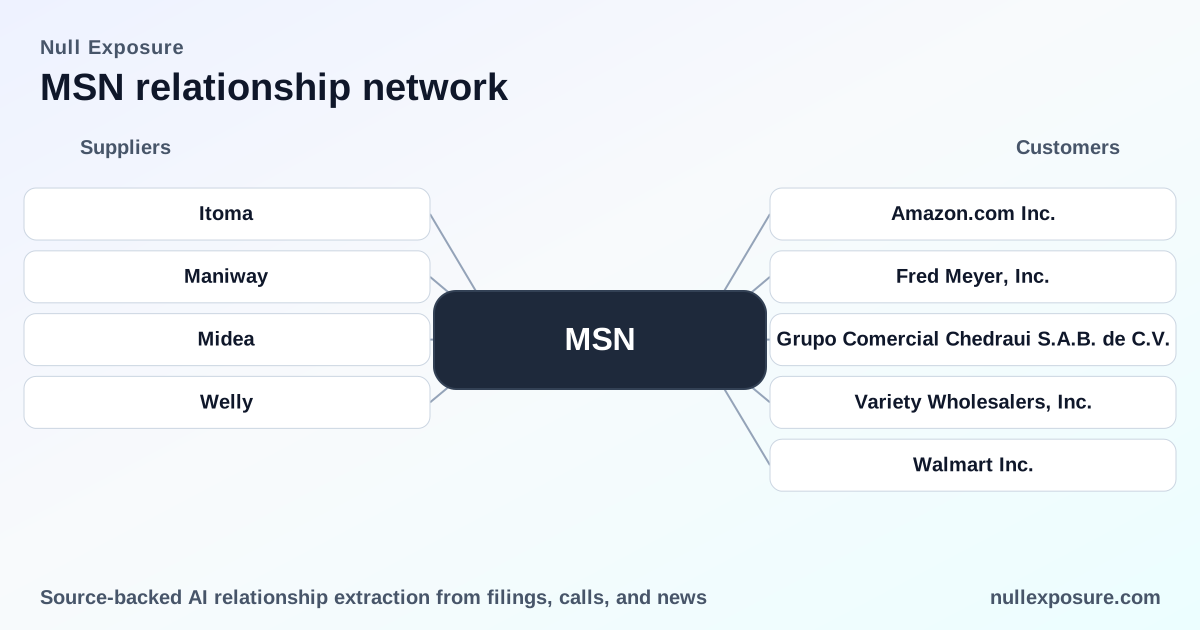
MSN’s supplier footprint: concentrated Chinese manufacturing, material operational leverage
MSN sources virtually all finished goods from a handful of APAC manufacturers and monetizes by reselling those products through its distribution channels; the business model rests on tight supplier relationships and margin capture between OEM production and downstream sales. For investors, MSN is a classic play on concentrated manufacturing supply — high operating leverage if procurement stays stable, but material downside if one of the top suppliers interrupts supply or re-prices.
Explore more supplier intelligence at https://nullexposure.com/.
The supply picture in plain English: concentration, location and contract posture
MSN’s FY2025 disclosure confirms a compact supplier ecosystem: four suppliers accounted for roughly 95% of product purchases in both FY2025 and FY2024, and 100% of purchases were finished goods sourced from manufacturers in the People’s Republic of China. The company also states it has no long‑term or exclusive purchase commitments with suppliers, even while maintaining lease and subscription commitments on the service/office side (office leases with remaining terms of 29–51 months and a subscription ERP contract with an annual commitment). Together these facts create an operating posture with three defining characteristics:
- High concentration and criticality: The top four suppliers provide nearly all purchasable volume, making supplier disruptions material to MSN’s results.
- Contractual flexibility but operational exposure: Absence of long‑term purchase commitments gives MSN negotiating flexibility but reduces guaranteed supply, increasing exposure if a supplier curtails shipments.
- Geographic supply clustering: Sourcing is geographically concentrated in China, concentrating geopolitical, logistics and input‑cost risk.
These points come directly from MSN’s FY2025 Form 10‑K and the supplier summary contained therein.
How each named supplier contributes to MSN’s purchase profile
Itoma
Itoma supplied 37% of MSN’s product purchases in FY2025, up from 24% in FY2024, making it the single largest supplier by share in FY2025. According to MSN’s FY2025 Form 10‑K, this shift elevates Itoma into a position of operational importance for the company.
Welly (formerly Weili)
Welly provided 37% of purchases in FY2025 and 38% in FY2024, remaining a consistently large supplier across both years as reported in MSN’s FY2025 10‑K, and underscoring persistent reliance on a small set of manufacturers.
Midea
Midea accounted for 12% of purchases in FY2025, down from 16% in FY2024, per MSN’s FY2025 Form 10‑K, representing a meaningful but secondary supplier position relative to the two largest partners.
Maniway
Maniway’s share declined to 9% in FY2025 from 17% in FY2024, according to the FY2025 10‑K, reflecting shifting sourcing mixes across the reporting periods.
(Each supplier share is drawn from MSN’s FY2025 Form 10‑K supplier summary.)
What the constraints tell investors about MSN’s operating model
MSN’s public disclosures reveal a set of company-level constraints that shape how risk translates into financial outcomes:
- Contract types are mixed: The company carries multi‑year real estate leases (29–51 months) and a subscription‑based ERP commitment (annual payments disclosed for FY2026), indicating fixed operating costs on the corporate side. These are explicit line items in the FY2025 filing.
- Purchasing is effectively short‑term: MSN discloses no long‑term or exclusive purchase commitments with suppliers, signaling a short‑term procurement posture for product purchases. This reduces lock‑in but leaves inventory and lead‑time exposure to market shocks.
- Supplier role is manufacturing‑centric: MSN’s products are produced by OEMs to MSN specifications; the suppliers are manufacturers rather than mere distributors. That technical dependence raises switching frictions if alternative factories must be qualified.
- Materiality is high: The company warns that insufficient supply or materially different credit/price terms from its core suppliers would have a material adverse effect on operations — a direct statement of exposure in the filing.
These constraints, taken together, imply high operational leverage with concentrated counterparty risk: corporate overhead and systems commitments are fixed, while supply-side visibility is limited and highly concentrated.
Explore supplier risk intelligence and monitoring tools at https://nullexposure.com/.
Investment implications and what to monitor
MSN’s supplier structure is a two‑edged sword for investors. On one side, concentration simplifies vendor management, enables volume pricing, and can support predictable gross margins when supply flows smoothly. On the other side, the same concentration means single‑supplier or geography-specific disruptions can rapidly compress sales and margins.
Key items for active monitoring and due diligence:
- Supplier share trends quarter‑to‑quarter to detect migration of volumes (e.g., the swing in shares between Itoma, Maniway and Midea).
- Lead times, inventory days, and on‑time delivery metrics to quantify operational buffer versus supplier risk.
- Supplier financial and credit health for the top four manufacturers; a bankruptcy or liquidity squeeze at any of them would transmit quickly.
- Geopolitical and logistics indicators for China—customs, tariffs, port congestion and freight rates—that materially affect landed cost.
- Contract governance: while purchase commitments are short‑term, monitor any shift toward multi‑year procurement contracts or exclusivity that could change bargaining dynamics.
Bottom line and recommended next steps for investors
MSN’s business is highly dependent on a small set of Chinese OEMs; that setup offers margin upside in stable conditions but presents asymmetric downside during supply or trade shocks. Investors should treat supplier concentration as a first‑order risk and elevate supplier health, logistics and contract terms into regular diligence checkpoints.
For vendor‑level sourcing details, updated supplier analytics, and to build ongoing monitoring for MSN’s counterparty exposure, visit https://nullexposure.com/.