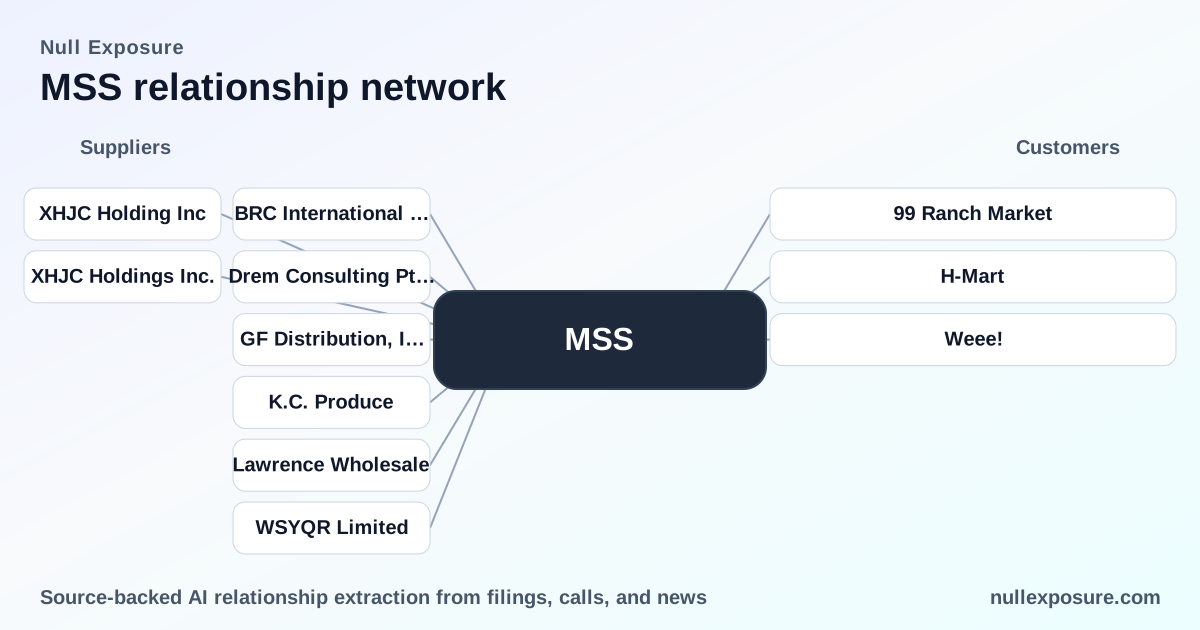
Maison Solutions (MSS): Supplier Map and What Investors Need to Know
Maison Solutions operates as a California-focused specialty grocery retailer that generates revenue primarily through in-store retail sales across leased supermarket locations and related services; the company supports operations with a concentrated vendor base and recent, material investments in retail systems. Investors should view Maison as a thin‑margin, asset-light retailer with heavy insider ownership, meaningful supplier concentration, and near-term capital spending tied to third‑party systems contracts.
For a concise supplier-risk feed and deeper counterparty context, visit https://nullexposure.com/.
The business in one paragraph: how Maison earns and spends
Maison monetizes by operating specialty supermarkets in California, collecting retail sales while outsourcing supply and several operational functions to external vendors. The company reported $121.5 million in trailing revenue with negative EBITDA and net income, a small market capitalization (~$4.97 million) and high insider ownership (75.6%), which concentrates control and financial exposure. Significant line‑items for investors include rent commitments under long‑term leases, concentrated purchases from a handful of suppliers, and system purchases to modernize merchandising and supply‑chain tooling.
Quick read: the supplier list that matters
Maison’s FY2025 10‑K lists five major vendors and identifies two separate system procurement contracts; press filings later flagged one vendor as a related party. Below are the counterparties disclosed and what each relationship implies.
Lawrence Wholesale
Lawrence Wholesale is named as one of Maison’s major vendors responsible for a material slice of purchases; the 10‑K aggregates it with four other primary suppliers that together account for a meaningful share of procurement. Source: Maison Solutions FY2025 10‑K (filed FY2025).
BRC International Inc
BRC International is listed among the company’s major vendors and is included in the disclosure that breaks out the five largest suppliers by percent of purchases for FY2025. Source: Maison Solutions FY2025 10‑K (filed FY2025).
GF Distribution, Inc.
GF Distribution appears in the 10‑K vendor list and is one of the five suppliers contributing to the company’s vendor concentration statistics disclosed for fiscal 2025. Source: Maison Solutions FY2025 10‑K (filed FY2025).
K.C. Produce
K.C. Produce is identified with other major vendors, indicating a supplier role for fresh produce or perishables within Maison’s procurement mix that feeds into overall purchasing concentration. Source: Maison Solutions FY2025 10‑K (filed FY2025).
XHJC Holding(s) Inc.
XHJC is included in the FY2025 vendor list, and external news coverage has further characterized XHJC as a related‑party vendor, an important governance and conflict-of-interest signal cited in securities‑litigation notices and press releases in late 2025. This elevates the counterparty from a commodity supplier to a governance and reputational risk vector. Source: Maison Solutions FY2025 10‑K; related‑party characterization in news releases (GlobeNewswire, Malay Mail, Nov–Nov 2025).
Drem Consulting Pte. Ltd.
Maison executed a System Purchase and Implementation Consulting Agreement with Drem Consulting Pte. Ltd. to acquire a merchandise display planning and management system for $1.5 million, signaling a one‑time capital investment in merchandising technology that will change vendor economics and implementation risk. Source: Maison Solutions FY2025 10‑K (filed FY2025).
WSYQR Limited
Maison entered a Supply Chain Management System Purchase Agreement with WSYQR Limited for $1.45 million, representing a separate, material systems purchase intended to improve supply‑chain operations and inventory visibility. Source: Maison Solutions FY2025 10‑K (filed FY2025).
(If you want a downloadable view of these counterparty relationships and the related contract language, see https://nullexposure.com/.)
What the disclosures and constraints tell investors about operational posture
Maison’s disclosures present a coherent operating model when read together:
-
Contracting posture — long‑term leases, active vendor relationships. The company reports long-term store leases (average remaining term ~15.8 years for store leases) and explicitly states reliance on long-term arrangements for real estate and primary suppliers. This creates fixed-cost rigidity in a low-margin retail model. Source: Maison Solutions FY2025 10‑K.
-
Concentration and materiality are real. Maison discloses that three primary suppliers accounted for ~19.0% of purchases in FY2025 (and 48.0% in FY2024), underlining supplier concentration that can transmit price and supply shocks into gross margins. Source: Maison Solutions FY2025 10‑K.
-
Relationship roles are mixed. The firm classifies suppliers primarily as sellers of goods (the five suppliers contribute single‑digit shares of purchases each), but also engages third parties for services (IT and consulting) and records related‑party purchases totaling ~$909k, indicating cross‑transactional exposure. Source: Maison Solutions FY2025 10‑K.
-
Maturity and spend scale. The WSYQR and Drem contracts (each roughly $1.45–$1.5M) indicate discrete, mid-sized capital investments for a small cap operator; related‑party purchases in the $100k–$1M band reinforce a pattern of meaningful single‑counterparty spend relative to company scale. Source: Maison Solutions FY2025 10‑K.
Investment implications: read supplier signals as strategic signals
-
Operational leverage and supplier shocks matter more here than in large grocers. With slim operating margins and a concentrated vendor base, a disruption at any major supplier, or an unfavorable contract renegotiation, will move EBITDA materially.
-
Related‑party vendor flag is a governance red line. The commentary in external press identifying XHJC as a related party converts a procurement disclosure into a governance risk that can affect investor trust and invite litigation or reserve actions. Source: GlobeNewswire and Malay Mail press coverage (Nov 2025).
-
Capex for systems is a double‑edged sword. The ~$3M combined commitment to new merchandising and supply‑chain systems (Drem + WSYQR) is positive for operational maturity but is material for a company of Maison’s market cap and current negative EBITDA—execution risk is nontrivial. Source: Maison Solutions FY2025 10‑K.
-
Concentration plus insider control increases execution risk. High insider ownership (75.6%) and low institutional ownership compress governance oversight; investors should price a higher premium for counterparty and governance risk.
For deeper counterparty detail and contract language analysis, go to https://nullexposure.com/ and search MSS supplier relationships.
Bottom line and next actions for investors
Maison’s supplier footprint is compact and consequential: a handful of vendors account for a sizable portion of purchases, two vendors are involved in material systems contracts, and at least one vendor (XHJC) is publicly identified as a related party. That combination — low margins, large lease obligations, concentrated procurement, and material systems outlays — creates both a path for operational improvement and concentrated downside risk.
If you are modeling Company-level scenarios, adjust for supplier concentration and execution risk on the newly procured systems; factor in potential governance discounts tied to related‑party exposure. For ongoing coverage and supplier‑level monitoring, visit https://nullexposure.com/ to subscribe to counterparty alerts and document-level traces.