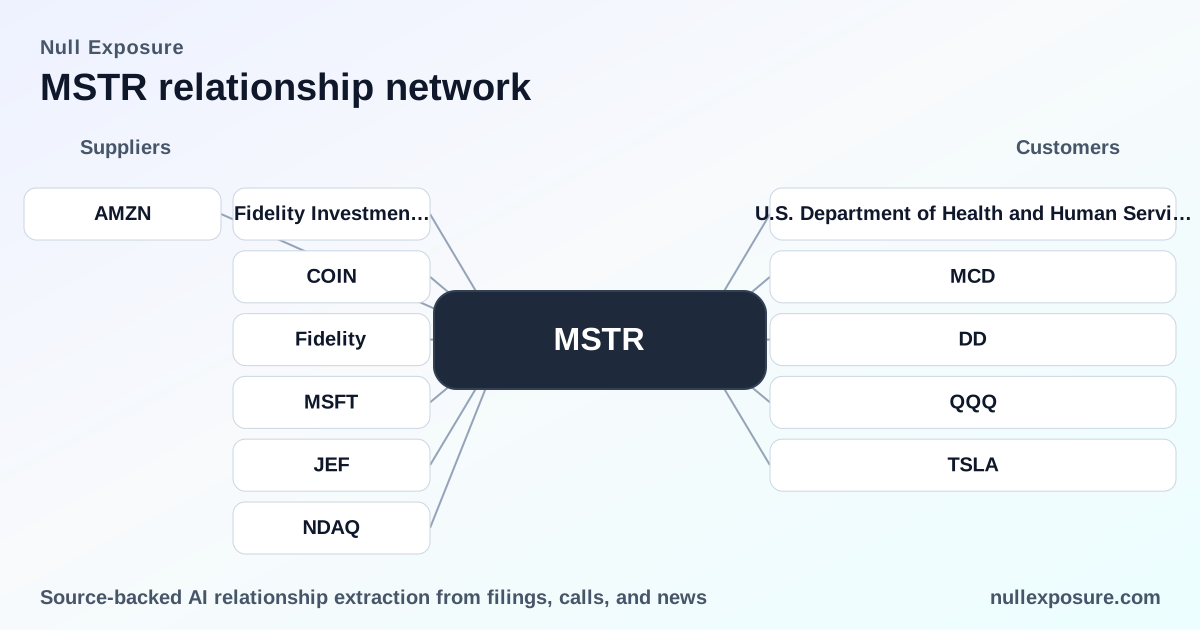
MicroStrategy (MSTR) — supplier map, custody concentration, and what investors should watch
MicroStrategy runs a dual engine: a legacy business intelligence software company that sells licenses and cloud-enabled analytics, and an increasingly dominant treasury function that monetizes balance-sheet allocation to Bitcoin and financial innovations tied to that asset (including bitcoin-backed preferred shares). The firm’s supplier relationships are therefore a hybrid of enterprise-cloud and high-stakes financial counterparties—operational suppliers that support BI delivery and custodial/market counterparties that underwrite its bitcoin strategy. For a succinct supplier-risk briefing and relationship map, visit https://nullexposure.com/.
How MicroStrategy makes money and why suppliers matter
MicroStrategy generates revenue from software licensing, subscriptions and professional services, but valuation is heavily influenced by the company’s Bitcoin holdings and the capital markets activity built around them. Suppliers fall into two pragmatic categories: traditional cloud/infra vendors that enable product delivery and institutional financial counterparties that custody, clear and help monetize the bitcoin treasury. That split drives differing contracting postures—technology suppliers are mission-critical for product continuity but replaceable; custodial and capital-market counterparties are concentration points whose failure would have immediate balance-sheet and market effects.
What company-level signals tell investors about risk posture
- MicroStrategy explicitly states it uses U.S.-based third-party data center hosting and other third-party services, signaling a primarily U.S. operations footprint for critical infrastructure and potential geographic concentration in continuity planning.
- The company also discloses that it holds substantially all bitcoin in custody accounts at U.S.-based, institutional-grade custodians, and that its primary counterparty risk is custodian performance against custody arrangements. These are company-level signals that place custodial counterparties at the center of operational and counterparty risk.
These constraints imply a contracting posture that is service-provider centric and custody-concentrated, with elevated criticality for a small set of financial counterparties and regulated U.S. infrastructure.
Mapping MicroStrategy’s supplier relationships (what each partner contributes)
Below I list every relationship pulled from the supplier results and summarize the economic or operational role each plays.
Fidelity Investments
Fidelity is providing MicroStrategy employees access to bitcoin inside a new 401(k) offering, making MicroStrategy the first employer to use this product and reflecting a closer workforce-level integration with Fidelity’s crypto services. According to Bitcoin Magazine, Fidelity’s 401(k) product enables employee bitcoin investing at MicroStrategy (Bitcoin Magazine, reported 2026). https://bitcoinmagazine.com/business/microstrategy-to-allow-employees-to-invest-in-bitcoin-as-part-of-401k-plan
Coinbase
MicroStrategy transferred roughly 58,390 BTC from Coinbase to Fidelity’s custody platform, demonstrating Coinbase’s role as a liquidity and transfer counterparty for the company’s bitcoin movements rather than a long-term custodian in this instance. The transfer was reported by TS2.Tech in a November 2025 summary of large custody moves. https://ts2.tech/en/strategy-inc-mstr-stock-today-november-26-2025-short-seller-exit-msci-index-risk-and-a-5-1b-bitcoin-move/
Fidelity (custody role)
Fidelity is now recorded as the custodian for about 165,709 BTC held on behalf of MicroStrategy—around a quarter of the firm’s publicly visible bitcoin position—positioning Fidelity as a principal custodial counterparty for the company’s treasury. The custodial status and holding estimates were noted in the same November 2025 reporting on custody balances. https://ts2.tech/en/strategy-inc-mstr-stock-today-november-26-2025-short-seller-exit-msci-index-risk-and-a-5-1b-bitcoin-move/
Microsoft
Microsoft supports MicroStrategy through an integration with Azure that enhances the company’s analytics and cloud-delivered BI capabilities; that partnership strengthens product delivery to enterprise customers and reduces infrastructure risk when Azure is used. This strategic integration was highlighted in a PredictStreet piece syndicated by FinancialContent (September 2025). https://markets.financialcontent.com/wral/article/predictstreet-2025-9-29-microstrategy-mstr-a-deep-dive-into-the-bitcoin-treasury-company
Jefferies
MicroStrategy used a Jefferies ATM facility to sell Class A common stock historically, providing capital-raising flexibility that helped finance bitcoin purchases; Jefferies functions as an investment-banking and distribution counterparty in that context. Bitcoin Magazine documented the ATM sale activity that preceded additional bitcoin purchases (article context, historical). https://bitcoinmagazine.com/business/microstrategy-buys-3907-more-bitcoin-as-total-investment-nears-3-billion
Nasdaq
MicroStrategy listed a third bitcoin-backed preferred stock, STRD, on Nasdaq—using the exchange as the capital-markets venue for structured equity tied to the company’s bitcoin treasury and investor access. Coindesk covered the STRD listing debut in June 2025. https://www.coindesk.com/markets/2025/06/12/strategy-launches-strd-its-third-bitcoin-backed-preferred-stock-on-nasdaq
Amazon Web Services (AWS)
AWS is cited as one of the cloud platforms MicroStrategy supports for its cloud service offering, indicating that AWS is part of the firm’s multi-cloud infrastructure footprint for BI deployments. PredictStreet via FinancialContent mentioned AWS alongside Azure as supported platforms (September 2025). https://markets.financialcontent.com/wral/article/predictstreet-2025-9-29-microstrategy-mstr-a-deep-dive-into-the-bitcoin-treasury-company
How these relationships shape contracting posture, concentration and criticality
MicroStrategy’s supplier profile is bimodal:
- Enterprise cloud vendors (Microsoft Azure, AWS) are operationally critical but replaceable over time through migration; contract maturity and SLAs matter for uptime and customer retention.
- Custodial and capital-market counterparties (Fidelity, Coinbase, Nasdaq, Jefferies) are structurally critical: custody failures, transfer disputes, or exchange/clearing frictions can directly impair the value and fungibility of the bitcoin treasury and the company’s ability to monetize holdings through instruments like STRD.
The company-level signals show geographic concentration in U.S.-based infrastructure and custodians, increasing regulatory and jurisdictional dependency on U.S. frameworks. MicroStrategy’s explicit identification of custodian performance as its primary counterparty risk elevates the importance of counterparty credit, operational resiliency, and contractual clarity for custody arrangements.
If you want a crisp supplier-risk scorecard and counterparty exposure view for portfolio diligence, check https://nullexposure.com/ for synthesized reports.
Investment takeaways and an operational watchlist
- Custody concentration is the single biggest supplier risk. A significant portion of MicroStrategy’s bitcoin is held with a small number of institutional custodians; investors must monitor shifts in custody allocation and contractual protections.
- Capital markets partners matter for liquidity and liability management. Nasdaq listings and Jefferies’ ATM activity are central to how MicroStrategy monetizes or leverages bitcoin holdings; disruption here affects optionality.
- Cloud vendors are mission-critical for software revenue continuity but less existential to the bitcoin thesis. Azure and AWS outages would impact the BI business line; custodial issues hit market value immediately.
- Active monitoring required: Track custody transfers, regulatory developments affecting U.S.-based custodians, and announcements from capital markets partners.
For tailored exposure analysis and supplier-risk monitoring relevant to MSTR positions, start here: https://nullexposure.com/.
MicroStrategy is an unconventional combination of enterprise software and concentrated bitcoin treasury management; investors must evaluate both the product supply chain and the specialized financial counterparties that underwrite its balance-sheet strategy. For deeper diligence and real-time relationship tracking, visit https://nullexposure.com/ and request the supplier-risk brief for MSTR.