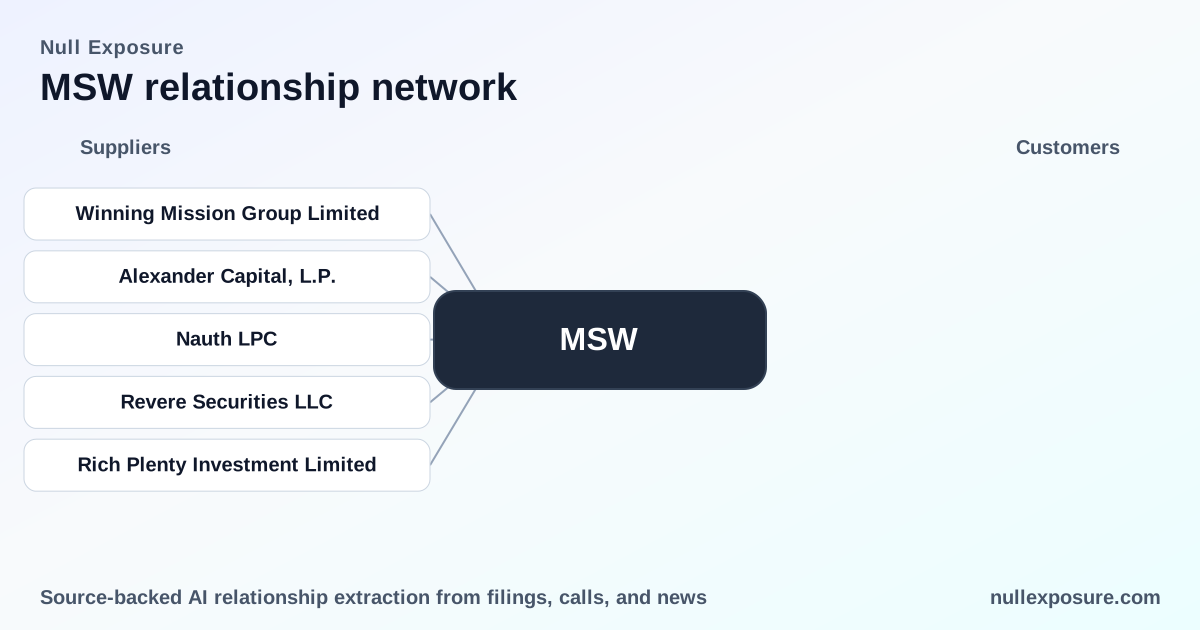
Ming Shing Group Holdings (MSW): Partner Map, Capital Signals, and What Investors Should Price In
Ming Shing Group Holdings operates as a Hong Kong–based civil engineering and construction firm that monetizes through project execution, design-build contracts, and property development revenue streams; the company finances growth and liquidity through capital market transactions, most recently an IPO and a highly unconventional Bitcoin purchase funded by convertible notes and stock warrants. Investors should view Ming Shing as a small-cap, newly public engineering company with negative operating profitability and outsized counterparty exposure tied to capital-raising transactions. For a deeper supplier- and counterparty-level view, visit https://nullexposure.com/.
Why these relationships matter for valuation and operational risk
Ming Shing’s partner map signals two simultaneous dynamics: traditional capital-market support to underwrite and legalize a fresh listing, and a dramatic shift into alternative-asset financing that recalibrates credit and dilution risk. The immediate cash-raising pathway is concentrated in discrete transactions rather than diversified financing sources, while insider control and low institutional ownership change governance dynamics for minority holders. These are company-level characteristics that drive counterparty criticality, contract posture, and maturity:
- Contracting posture: Project-driven revenues imply short-duration contracting with clients, while recent financing is executed through bespoke convertible notes and warrants rather than standard debt facilities.
- Concentration: High insider ownership (66.3%) and a small institutional presence (0.39%) concentrate control and limit traditional market scrutiny or stabilizing institutional demand.
- Criticality: Access to capital is core; the company’s ability to execute backlog and maintain liquidity now rests materially on bespoke counterparties and the outcome of large crypto-related deals.
- Maturity: Having completed an IPO in late 2024 and reporting continued operating losses and a negative gross profit, Ming Shing is at an early public-company maturity stage with attendant liquidity and governance risks.
How the partners stack up — underwriters, counsel, and crypto counterparties
Below I cover every relationship on record in the results and what each partner implies about Ming Shing’s operating and financing posture.
Winning Mission Group Limited
Ming Shing entered a Bitcoin Purchase Agreement with Winning Mission Group Limited to acquire 4,250 Bitcoins for US$482,961,500, structured to be paid at closing via a convertible promissory note and an equity warrant package. According to a GlobeNewswire press release dated August 20, 2025, this transaction transforms a balance-sheet purchase into a suite of long-dated convertible obligations and sizable warrant issuances. (GlobeNewswire, Aug 20, 2025)
Rich Plenty Investment Limited
An assignment associated with the Bitcoin Purchase Agreement allocated half of the convertible promissory note and half of the warrant consideration to Rich Plenty Investment Limited, with each assignee due a principal amount of US$241,480,750 and large warrant tranches. GlobeNewswire’s August 2025 disclosure describes the split and the dual-note / dual-warrant consideration structure. (GlobeNewswire, Aug 20, 2025)
Alexander Capital, L.P.
Alexander Capital acted as the managing underwriter for Ming Shing’s closing of its US$8.25 million initial public offering, establishing the firm as the lead capital-market intermediary for the company’s market entry. The underwriting role is documented in Ming Shing’s November 25, 2024 press release and echoed in secondary coverage. (GlobeNewswire & Yahoo Finance, Nov 25, 2024)
Revere Securities LLC
Revere Securities LLC joined as a joint book-runner alongside Alexander Capital for the IPO, implying they shared distribution and pricing responsibilities for the offering. The joint book-runner role is recorded in the company’s closing announcement from November 2024 and in related financial media coverage. (GlobeNewswire & Yahoo Finance, Nov 25, 2024)
Nauth LPC
Nauth LPC served as counsel to Ming Shing for the IPO, handling company-side legal work for the public offering; Sullivan & Worcester LLP and VCL Law LLP represented the underwriters. The legal engagement is noted in the company’s November 25, 2024 IPO closing announcement. (GlobeNewswire & Yahoo Finance, Nov 25, 2024)
What the relationship map implies for investors and operators
The partner footprint shows a conventional IPO support structure (underwriters plus counsel) followed by an aggressive, nontraditional financing move into cryptocurrency that is executed via convertible notes and massive warrant allocations. That combination creates three priority risks:
- Dilution risk: The warrants tied to the Bitcoin purchase total hundreds of millions of ordinary share equivalents, creating potential substantial dilution if exercised.
- Balance-sheet and liquidity risk: Paying for 4,250 Bitcoins at hundreds of millions in USD via convertible indebtedness stresses an already loss-making operating profile—Ming Shing reported negative EBITDA and a negative gross profit in the trailing twelve months.
- Governance concentration: With insiders controlling two-thirds of the stock and limited institutional ownership, these complex financing arrangements can be executed quickly with limited external countervailing pressure.
Visit https://nullexposure.com/ for counterparty intelligence and monitoring tools that help quantify dilution pathways and concentration exposure across issuers and counterparties.
Practical read for portfolio managers and operations teams
- For equity investors: Price in elevated dilutive risk and balance-sheet leverage hidden inside convertible notes and warrants, not just operating leverage from construction backlog. The company’s negative operating margins and negative return metrics require a financing-sensitive valuation approach.
- For lenders and counterparties: Underwrite counterparty credit with a focus on the contingent equity issuance and cryptocurrency exposure; these are material non-operational sources of risk to repayment and covenant compliance.
- For operations teams and suppliers: Expect working-capital pressure and schedule risk as management prioritizes complex financing over incremental operational expansion absent clearer cash-flow improvements.
Final recommendation and action items
Ming Shing is a high-risk, high-complexity small-cap: the IPO underwriters and counsel provided the market access, but the company’s recent crypto-financing fundamentally alters counterparty risk and dilution mechanics. Investors should require scenario analyses that incorporate full warrant conversion, impairment of cryptocurrency holdings, and the timeline for the convertible notes’ potential conversion. Operators and suppliers should secure payment protections and monitor covenant windows closely.
For a tailored deep-dive into Ming Shing’s counterparties, convertible structures, and dilution scenarios, explore our portal at https://nullexposure.com/ — the firm-level and counterparty-level tracking can be deployed to stress-test holdings and supply contracts.
Concluding thought: treat Ming Shing as a construction company that is financing growth through capital-market engineering rather than steady operating cash flow; price the uncertainty accordingly and verify counterparty documentation before increasing exposure.