M&T Bank (MTB): Supplier relationships that change underwriting and customer intelligence
M&T Bank Corporation operates as a regional commercial bank that monetizes through net interest margin, commercial lending and fee income across consumer and business banking channels. Its capital-intensive model is supported by a mix of long‑ and short‑term borrowings and a stable institutional shareholder base, enabling technology investments that drive customer retention and credit discipline. For investors assessing MTB supplier risk and strategic upside, the company’s recent AI partnerships strengthen customer insights and credit monitoring capabilities while exposing the bank to concentrated, material third‑party dependencies.
Explore further supplier intelligence and relationship mapping at https://nullexposure.com/.
Two strategic vendor relationships that matter now
-
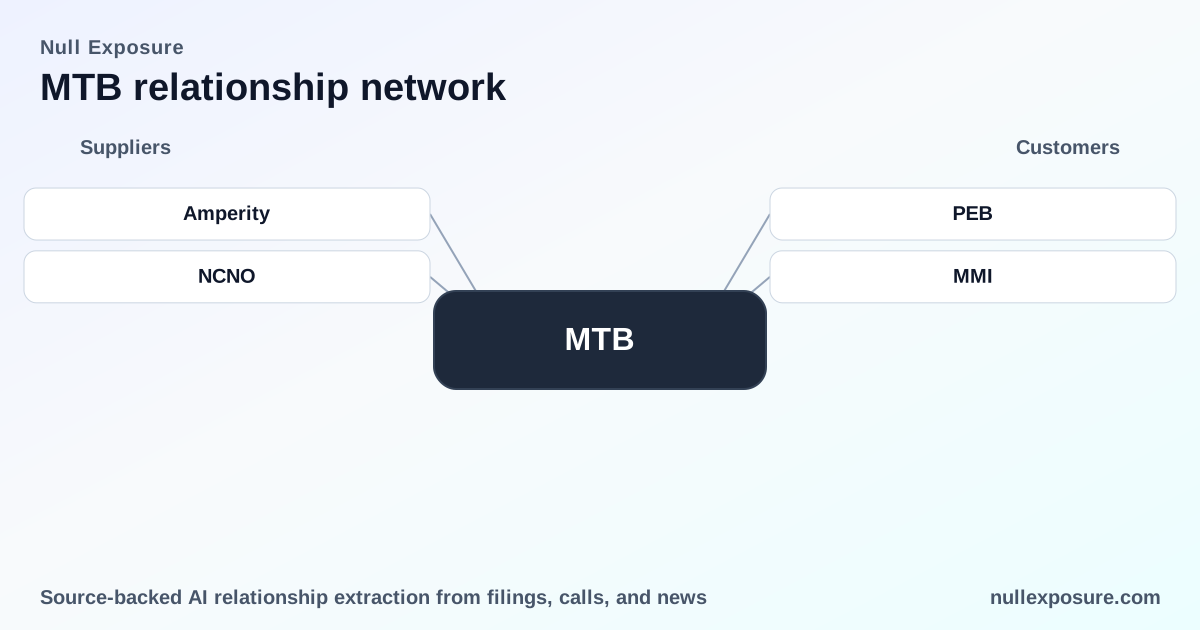
Amperity — In 2025, M&T partnered with Amperity to deploy an AI‑powered customer data cloud platform that unifies customer data across digital and offline channels, improving segmentation and cross‑sell execution. This engagement was reported in a March 2026 market note summarizing Zacks research published via TradingView. (TradingView / Zacks, March 10, 2026)
-
nCino — In 2024, M&T expanded its relationship with nCino to integrate an AI‑driven continuous credit monitoring solution designed to improve credit transparency and surface lending opportunities in the portfolio. That extension was referenced in the same March 2026 TradingView summary of Zacks commentary, which cites the 2024 expansion. (TradingView / Zacks, March 10, 2026)
Why these vendors are strategic — the operational and revenue logic
Both vendor engagements are directly tied to M&T’s ability to grow loans and fees while managing credit loss, not experimental point solutions. Amperity’s unified customer view supports better cross‑sell of deposit and fee products to existing customers, improving lifetime value; nCino’s continuous monitoring enhances early warning for credit deterioration and helps identify new commercial lending opportunities. Together, these suppliers advance two of M&T’s core monetization levers: revenue growth through penetration and margin protection through better credit decisions.
These are not one‑off integrations. The bank’s investment in AI platforms signals a deliberate shift toward data‑driven origination and portfolio management, which changes the operational profile of its vendor relationships from tactical to strategic.
Explore supplier posture and concentration across your portfolio at https://nullexposure.com/.
Company‑level constraints and what they imply for supplier risk
M&T’s supplier posture and balance‑sheet structure create specific operational constraints investors should track.
-
Contracting posture and maturity: M&T maintains both long‑term and short‑term funding on its balance sheet — long‑term borrowings aggregated $12.6 billion and short‑term borrowings $1.1 billion as of December 31, 2024 — indicating a mixed maturity profile that supports multiyear vendor contracts while preserving short‑term flexibility. (Company filing, December 31, 2024)
-
Spend and criticality: Evidence shows vendor spend is material at the company level; the record of aggregated borrowings and the bank’s scale imply investments in technology and third‑party services exceed typical mid‑market budgets. The collected evidence classifies spend in the 100m+ band, a company‑level signal that vendor relationships are financially significant. (Company filing, December 31, 2024)
-
Service provider governance: M&T explicitly requires third‑party service providers to meet or exceed its information security program standards, which elevates vendor oversight and compliance as part of procurement and operations. This indicates a mature vendor‑risk management posture that treats suppliers as critical operational dependencies. (Company filing, information security program language)
These constraints are presented as company‑level signals; they reflect how M&T contracts, budgets and governs third‑party providers rather than attributes of any single vendor.
Risk considerations investors and operators should price in
-
Concentration and execution risk: When suppliers deliver platform capability (customer profile or credit monitoring) the bank’s go‑to‑market and underwriting workflows become dependent on third‑party uptime, model accuracy, and integration quality. Given the bank’s material spend profile, an operational failure would have outsized impact relative to smaller implementations.
-
Vendor compliance and cybersecurity: The bank’s governance mitigates some risk by requiring vendors to meet information‑security standards, but regulatory and reputational exposure remains high for any failures affecting customer data or credit decisions, particularly as AI is embedded in lending.
-
Scalability and cost leverage: These vendor relationships are designed to scale across M&T’s footprint and improve unit economics on existing customer relationships; investors should expect benefits to show up in fee income growth and lower credit volatility over time, provided integrations perform as intended.
M&T’s financial context supports these initiatives: market capitalization ~$30.5 billion, revenue TTM $9.185 billion, profit margin 31% and return on equity ~9.8%, giving the bank both the capital and operating profitability to invest in strategic suppliers (company financials).
How to act on this intelligence
-
For investors: Underwrite a premium for execution on AI-enabled customer and credit capabilities, but also discount for vendor concentration and operational risk until independent performance signals (e.g., improved fee growth, tighter credit metrics) are visible.
-
For operators and vendor managers: Prioritize SLA, model governance and incident response clauses in contracts with strategic vendors like Amperity and nCino, and verify security attestations align with M&T’s stated information security program.
-
For risk teams: Establish continuous validation of third‑party models and regular audits of data flows that feed customer and credit decision engines.
Explore how these supplier dynamics affect valuation and risk at https://nullexposure.com/.
Closing assessment
M&T’s partnerships with Amperity and nCino are concrete, value‑oriented supplier relationships that strengthen both revenue generation and credit discipline. The company’s mixed funding profile and high spend on third‑party services create clear operational constraints that elevate vendor governance and make integration success a material investment thesis factor. Investors should reward demonstrated improvements in cross‑sell and credit volatility while requiring evidence that vendor governance fully mitigates concentration and cybersecurity risk.
For deeper supplier mapping and relationship scoring, visit https://nullexposure.com/.