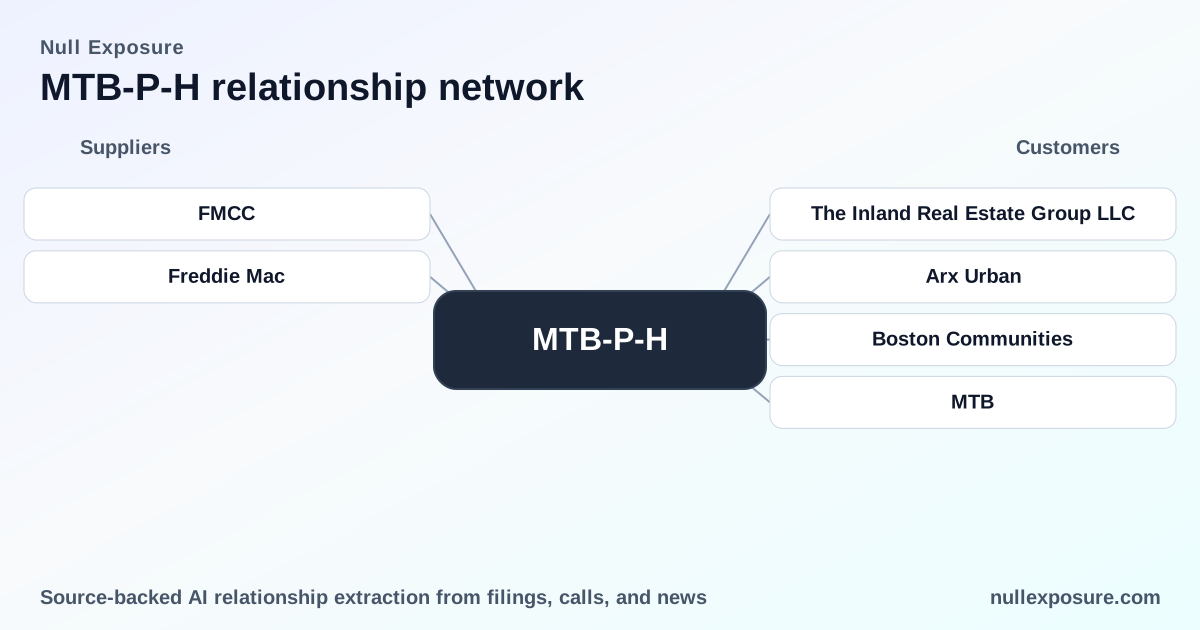
MTB-P-H (M&T Bank preferred): supplier relationships and strategic read-throughs for investors
M&T Bank Corporation operates as a diversified regional bank headquartered in Buffalo, NY, generating revenue through traditional banking channels — net interest margin on lending and investment portfolios, deposit services, fee income from treasury and capital markets activity — while supplementing capital structure and investor returns via preferred stock issuances such as the MTB-P-H series. For investors and operators, the commercial relationships seeded through M&T’s balance sheet and correspondent activities are as important as credit metrics: they reveal where the bank deploys capital, the counterparty mix it leans on for syndication, and the types of project finance that support fee income and long-term asset yields. Explore more about supplier and counterparty intelligence at https://nullexposure.com/.
Why this matters now M&T’s role as both lender and tax-credit investor in housing projects signals a dual revenue stream: traditional loan interest plus structured equity and fee generation from community development finance. That combination supports stable yield on preferred instruments and informs counterparty risk for operators who count on M&T as a funding or syndication partner.
A concise view of documented partner activity The available reporting for MTB-P-H’s supplier relationships is concentrated and transaction-specific. Two news reports in March 2026 document M&T’s execution on a mixed-income housing financing package involving Freddie Mac commitments and M&T-originated construction lending and tax-credit equity. Below I summarize each item exactly as reported.
Recent relationship: HousingFinance report on Boston development
- M&T executed a $19.17 million construction loan and a $19.29 million tax credit equity investment in a Boston mixed-income development, alongside a $6.34 million Freddie Mac unfunded forward LIHTC commitment. According to HousingFinance (March 10, 2026), the two M&T components included state LIHTC equity and federal energy credits and were attributed to M&T bankers Dan Feyock and Bob Nichols. Source: https://www.housingfinance.com/finance/mt-announces-financing-for-boston-development.
Recent relationship: ReBusinessOnline recap of same transaction
- ReBusinessOnline corroborated the package, noting a $6.3 million Freddie Mac unfunded forward commitment under the 9% LIHTC program plus a $19.2 million construction loan and $19.3 million tax-credit equity executed by M&T. The coverage frames M&T as a direct execution partner on the construction and equity legs. Source: https://rebusinessonline.com/mt-realty-capital-provides-44-8m-in-financing-for-mixed-income-housing-project-in-boston/.
What the relationship list tells investors about M&T’s operating posture
- Concentration and strategy: The supplier relationships in this feed are highly concentrated on a specific transaction type — low-income housing tax credit (LIHTC) financings — indicating M&T actively deploys both debt and equity capital in community-development projects. That concentrated evidence is a strategic signal, not an exhaustive map of all counterparties.
- Contracting posture: The transaction-level evidence shows M&T in a direct execution role for construction lending and tax-credit equity, while using third-party commitments (Freddie Mac unfunded forward) to optimize capital and risk transfer. This demonstrates a hybrid approach: originator and investor combined with syndicated or guaranteed components.
- Criticality and counterparty mix: Freddie Mac’s presence as a buyer/committer is material to closing structure, serving as a capacity provider for LIHTC elements that reduce M&T’s long-term capital exposure. For deal counterparties, this means M&T functions as both primary lender and an arranger that leverages agency-style commitments to complete structures.
- Maturity and repeatability: The reporting reflects project finance work that is operationally mature for regional banks — LIHTC syndications and construction lending are standard, recurring activities for an established bank like M&T. That repeatability supports predictable fee and interest income streams, which are favorable for preferred-stock investors.
Constraints and company-level signals
- The supplier-relationship feed contains no explicit constraints for MTB-P-H (no contractual limitations, third-party dependency clauses, or staged funding conditions were surfaced in the provided material). This absence should be treated as a company-level signal: no externally-reported supplier constraints were identified in the sampled coverage, which implies transactional flexibility in the bank’s execution posture but does not replace formal diligence on legal covenants or underwriting exposure. Investors should therefore confirm contract-level details in transaction documents before drawing capital-allocation conclusions.
Risk and diligence checklist for operators and allocators
- Counterparty execution risk: M&T’s role as both lender and tax-credit investor concentrates execution responsibility; operators should validate M&T’s funding commitments and timing triggers, especially given LIHTC syndication schedules.
- Agency dependence: Freddie Mac’s unfunded forward commitment is a structural hinge in these deals; confirm the terms and funding conditions of that commitment to gauge closing risk and residual exposure to M&T.
- Regulatory and credit-readiness: Construction lending plus tax-credit equity carries project completion and regulatory compliance risks; underwriters and investors should verify M&T’s underwriting criteria and reserve treatment for these exposures.
- Reputational and community deployment: Participation in LIHTC projects positions M&T as a community lender — a strength for franchise value but a focus area for regulators and ESG-minded investors.
Practical takeaways for portfolio managers
- This reporting shows M&T actively converting balance-sheet capacity into fee-bearing and yield-generating positions via construction loans and LIHTC equity, which supports predictable cashflow characteristics desirable to preferred-stock holders.
- The counterparty footprint in the sampled relationships is narrow but strategically meaningful: Freddie Mac participation materially supports transaction economics and de-risks long-dated tax-credit investments.
- For ongoing monitoring, subscribe to transaction-level coverage and request deal term sheets directly when M&T is a material sponsor or arranger. For additional relationship intelligence, visit https://nullexposure.com/ to see how supplier-level insights integrate into capital-allocation workflows.
Conclusion: where MTB-P-H sits in a capital allocation view M&T’s activity in LIHTC and construction lending documented here underlines a practical, execution-focused operating model that leverages both balance-sheet lending and structured equity investment to generate diversified revenue streams. For investors in MTB-P-H, the principal implication is that preferred security performance will be influenced not just by macro rate and credit drivers, but by M&T’s regional lending cadence and its ability to syndicate or transfer long-dated risk through partners like Freddie Mac. Validate deal-level commitments and agency links on material exposures, and maintain a watchlist on similar community-finance transactions. Learn more about how supplier relationships affect capital decisions at https://nullexposure.com/.