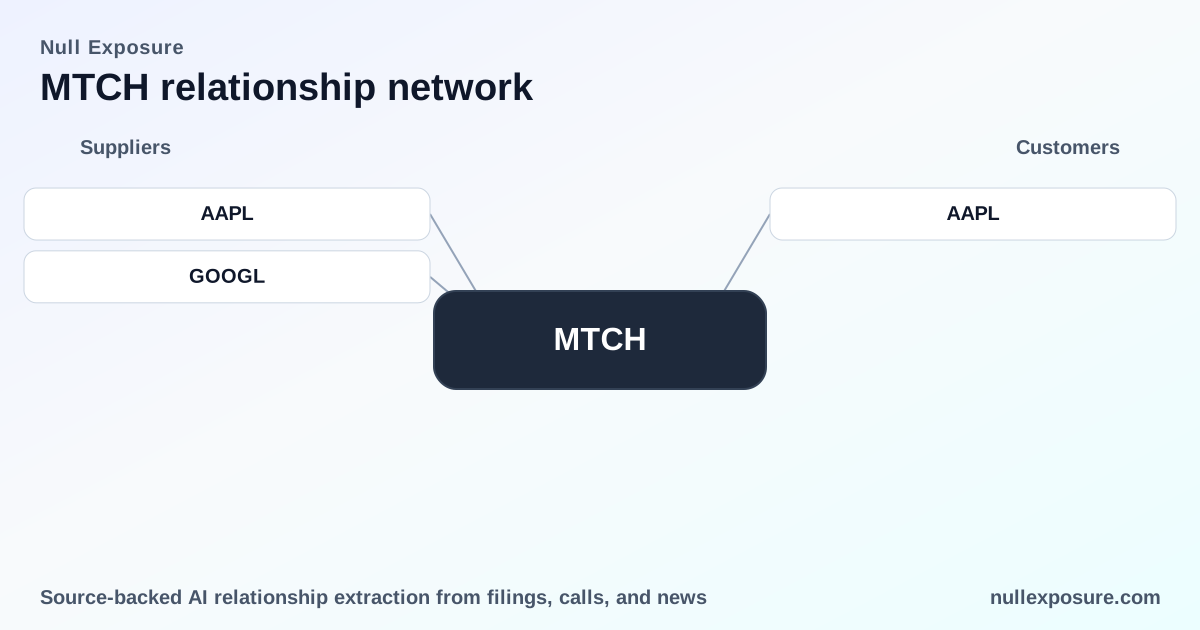
Match Group (MTCH) — supplier map and what investors need to price in
Match Group operates a portfolio of dating platforms (Tinder, Match.com, OKCupid, et al.) and monetizes primarily through subscriptions and in‑app purchases processed through mobile platforms and direct web channels. Revenue is driven by recurring subscription fees and impulse-driven in-app purchases, while distribution and payment economics are materially influenced by third‑party mobile app stores and cloud infrastructure providers. For investor due diligence on supplier risk, see more at https://nullexposure.com/.
Why suppliers matter for valuation and margin risk
Match’s headline economics — roughly $3.49 billion in trailing revenue, a 30% operating margin and an EV/EBITDA multiple near 10.5 — are attractive only so long as distribution and payments costs remain predictable. Platform fee exposure (Apple/Google), distribution concentration, and hosting commitments are direct levers on gross margin and free cash flow. Investors should view supplier relationships as operating constraints that can compress margins quickly if commercial or regulatory dynamics change.
Explore supplier-specific intelligence for your model: https://nullexposure.com/
What the relationship data shows (point-by-point)
Below are the reported relationship notes from the public record. Each result is summarized in plain English with the original source cited.
Apple — Insidermonkey excerpt (FY2026)
Match disclosed that App Store fees it pays could change based on evolving litigation and regulatory changes in the US and abroad, highlighting payment economics as an explicit risk to net revenue. Source: InsiderMonkey transcript of Match’s Q4 2025/ FY2026 commentary (published Mar 10, 2026).
Alphabet Inc. (Google Play) — TradingView / SEC 10‑K reference (FY2026)
Match states it relies significantly on third‑party platforms like the Google Play Store for distribution, underscoring Google as a critical distribution channel for Android users. Source: TradingView coverage of Match’s SEC 10‑K (reported Mar 10, 2026).
Apple Inc. — TradingView / SEC 10‑K reference (FY2026)
The company also relies significantly on the Apple App Store for distribution, confirming Apple’s central role in both customer acquisition and the mechanics of in‑app payments. Source: TradingView coverage of Match’s SEC 10‑K (reported Mar 10, 2026).
Contracting posture, concentration, criticality and maturity — the constraints that matter
The filings and related reporting reveal a small set of concentrated supplier exposures that translate into measurable business constraints:
- Usage‑based payment structure with app stores. Match pays Apple and Google a meaningful revenue share for transactions processed through their payment systems — generally 30% on iOS transactions and 15% for subscriptions purchased on Android devices — creating a direct, variable drag on monetization. (This is explicitly described in the company filing language cited above.)
- Distributor role of app stores. The Apple App Store and Google Play Store are not optional channels; they are primary distribution partners for mobile users and therefore a strategic dependency for user acquisition and payments.
- Service‑provider dependence for front‑end and back‑end hosting. The company cites reliance on data centers and cloud providers — including large cloud operators — to run applications and process transactions, making web hosting and cloud services operationally critical.
- Maturity and multi‑year purchase commitments. Match disclosed purchase obligations tied primarily to web hosting: $68.6M for 2025, $8.7M for 2026, $9.8M for 2027 and $9.0M for 2028, totaling $96.1M. The company also reports lease liabilities in the filings (reported as $103,796 in the excerpt). These figures imply committed spend on infrastructure that is material at the operating margin level.
- Automated spend flags vs. line‑item reality. Model flags indicated larger spend bands in some extractions, but the filing excerpts provide granular commitments (purchase obligations ~ $96.1M), which is the operative number investors should use for cash‑flow sensitivity analysis.
Collectively these constraints create a clear operating profile: highly concentrated distribution/payment relationships with predictable usage‑based fees, paired with essential cloud and hosting commitments that are moderately material to operating cash flow.
How to think about risk and upside
- Downside: Platform fee changes, regulatory outcomes, or aggressive app‑store pricing shifts would directly compress revenue retained per transaction and harm margins given the revenue‑share mechanics. Because a large portion of revenue is processed through these channels, a structural change in app‑store economics is a high‑leverage risk to free cash flow.
- Offsetting factors: Match’s scale (roughly $3.49B revenue TTM, healthy gross profit and a 30% operating margin) provides negotiating leverage and the ability to invest in web/channel diversification; these are real mitigants but not substitutes for the distribution reach app stores provide.
- Operational sensitivity: Hosting and cloud commitments (~$96.1M in purchase obligations) represent a manageable but nontrivial fixed pressure on operating cash; cloud cost efficiency will be an ongoing margin lever.
Practical implications for investors and operators
- Model an explicit line for app‑store revenue share in unit economics (30% iOS; 15% Android subscription) rather than aggregating to a blended merchant fee number.
- Stress test subscriptions growth under scenarios where app‑store effective take rates rise 200–500 bps and cloud costs escalate 10–20%.
- Monitor regulatory headlines and litigation outcomes affecting app payments and platform rules; these events have direct P&L transmission mechanics for Match.
For deeper supplier screening and a dashboard view of contractual exposure, visit https://nullexposure.com/.
Bottom line
Match’s supplier profile is concentrated and economically meaningful: app stores are both distribution channels and payment processors that materially affect revenue retention, while cloud and hosting commitments create fixed operating leverage. These supplier relationships are not peripheral line items — they are core drivers of margin and cash‑flow sensitivity that should be explicitly incorporated into valuation scenarios.
If you want supplier risk baked directly into your financial model and scenario tests, NullExposure provides the detailed signals and filing‑level excerpts investors rely on: https://nullexposure.com/.