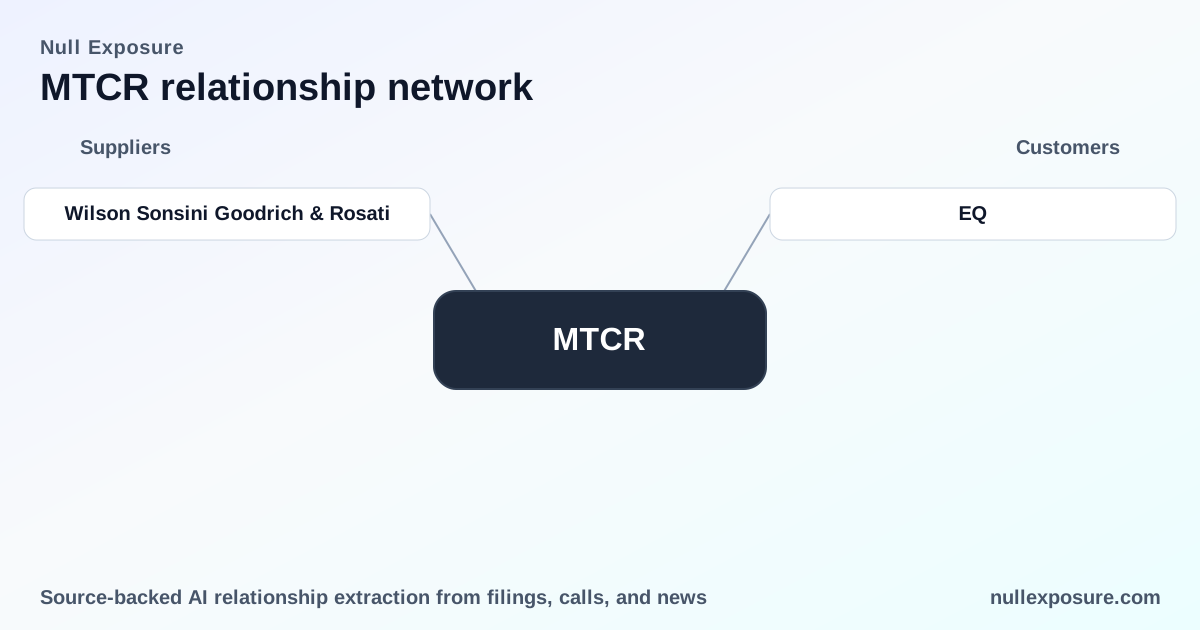
MTCR Supplier Relationships: Legal Counsel Concentration and Strategic Signals
Metacrine (MTCR) operates as a clinical-stage biopharmaceutical company that monetizes through development and strategic transactions—funding discovery and clinical programs until value is crystallized via licensing, partnerships, or M&A. For investors and operators, the supplier footprint—particularly professional services such as outside counsel—is a direct window into how the company structures transactions, protects intellectual property, and executes exits. Legal advisors are a functional lever for value capture in biotechs; observing who handles IP and dealwork sheds light on strategic posture and counterparty quality. Learn more at https://nullexposure.com/.
Why supplier relationships matter for MTCR investors
Professional services suppliers are not generic vendors for a small biotech: they are highly consequential, concentrated, and often long-lived relationships that shape deal terms, IP posture, and regulatory positioning. For MTCR, the public signals available show one dominant legal advisor recurring across both IPO-related IP work and a significant M&A transaction. That concentration is an operational and governance signal worth valuing alongside pipeline and balance sheet metrics.
Wilson Sonsini: the single legal name in the public record
Wilson Sonsini Goodrich & Rosati appears in the public record as Metacrine’s advisor across two distinct episodes:
- Wilson Sonsini represented Metacrine on IP matters connected to its IPO, serving as counsel on patent-related work that supports the company’s public-market positioning and investor due diligence (FY2020). According to Wilson Sonsini’s own insight on the matter, the firm handled patent matters related to Metacrine’s IPO process (Wilson Sonsini insight, FY2020).
- Wilson Sonsini also advised Metacrine on a later transaction—its acquisition by Equillium—serving as transaction counsel during that process (FY2022). The firm’s advisory post documents that involvement in the FY2022 transaction (Wilson Sonsini insight, FY2022).
Key takeaway: MTCR’s public supplier record shows a single, repeat legal adviser handling both IP and transactional work, indicating a consolidated external counsel strategy rather than a fragmented panel of advisors.
What the supplier footprint signals about MTCR’s operating model
Translate the legal supplier pattern into practical company-level signals:
- Contracting posture — centralized and bilateral. The recurrence of Wilson Sonsini indicates MTCR prefers a primary, trusted counsel rather than multiple boutique firms for discrete matters. That structure simplifies negotiation and continuity but concentrates risk.
- Supplier concentration — high. Publicly visible relationships are narrow; high concentration elevates counterparty dependence, giving that adviser outsized influence on deal execution and IP strategy.
- Criticality — elevated. For a clinical-stage biotech, IP protection and transaction execution are mission-critical; the legal advisor is not a peripheral supplier but a strategic partner for value realization.
- Maturity signal — transactional and market-facing. The presence of IPO and M&A advisory roles points to a company in the transition from private development to public market and consolidation activity, implying evolving governance and compliance needs.
These are company-level signals inferred from the supplier footprint; they are not tied to any constraint excerpts because none were provided.
Risk implications investors should price
- Concentration risk: Heavy reliance on a single law firm creates single-point-of-failure exposure in negotiation skillset and institutional memory. In stressed scenarios—rapid deal timelines, litigation, or contested IP—the firm’s bandwidth and conflict landscape matter.
- Operational continuity: Having a single counsel simplifies handoffs but increases operational fragility if the adviser has conflicts or strategic misalignment with future partners.
- Disclosure and reputational linkage: The public record of counsel on an IPO and an acquisition links the adviser’s reputation to MTCR’s outcomes; positive deal outcomes enhance credibility, while contentious litigation or disagreements could amplify investor scrutiny.
Relationship-by-relationship record (complete)
- Wilson Sonsini Goodrich & Rosati — handled patent matters related to Metacrine’s IPO (FY2020). According to Wilson Sonsini’s insight post, the firm generally represented Metacrine on IP issues in connection with its IPO process (Wilson Sonsini insight, FY2020).
- Wilson Sonsini Goodrich & Rosati — advised Metacrine on its acquisition by Equillium (FY2022), acting as counsel on the transaction as documented in the firm’s advisory material (Wilson Sonsini insight, FY2022).
Both entries are drawn from the firm’s public advisory and insight pages reporting their involvement in the respective periods.
What operators should do next
- If you run corporate development or procurement at a biotech: treat repeat external counsel as a strategic vendor—formalize SLAs, conflict escalation paths, and backup counsel arrangements to mitigate concentration risk.
- For legal and compliance teams: document conflict-of-interest scenarios and maintain a second counsel roster for rapid substitution on transactional or litigation matters.
- For investors: incorporate vendor concentration into your risk assessment and model marginal costs for counsel substitution or dual-counsel strategies into downside scenarios.
Explore deeper supplier intelligence and structured supplier risk reports at https://nullexposure.com/ to convert these signals into quantified exposure assessments.
Final read for investors
MTCR’s public supplier footprint is narrow and focused, with Wilson Sonsini handling both IP and deal execution in materially strategic moments. That pattern communicates a centralized, high-trust contracting posture with attendant concentration risk and operational efficiency—each a meaningful factor in valuation and governance assessment. For hands-on investors and operators, the right next steps are operationalizing contingency plans and explicitly pricing supplier concentration into transaction and financing strategies.
For a broader view of supplier exposures and comparative industry benchmarks, see https://nullexposure.com/.