Maris‑Tech (MTEK): Small‑Cap edge AI supplier building credibility through strategic integrations
Maris‑Tech designs and sells video and AI‑based edge computing hardware and software, monetizing through product sales, payload integrations, and defense/IoT contracts that attach high‑margin software value to specialized hardware. The company’s commercial model is project‑driven — revenue flows from discrete integration milestones and hosted payload programs rather than recurring consumer subscriptions — which makes partner validation and milestone delivery central to near‑term value creation. For a concise supplier risk and partner map, visit https://nullexposure.com/.
What Maris‑Tech sells and why that matters to investors
Maris‑Tech is a specialist hardware + software supplier headquartered in Israel focused on military and IoT customers. Its products combine video capture, edge compute, and embedded AI capabilities that convert raw sensor streams into actionable outputs at the point of collection. The company captures value by selling integrated payloads and edge appliances, and by licensing or bundling AI modules with those systems. Financially, Maris‑Tech is a very small public company: market capitalization is roughly $12.5 million with TTM revenue of $3.38 million and negative operating results (EBITDA and EPS both negative), so product wins and partner endorsements are the primary route to re‑rating.
Visit https://nullexposure.com/ for more supplier profiles and comparative context.
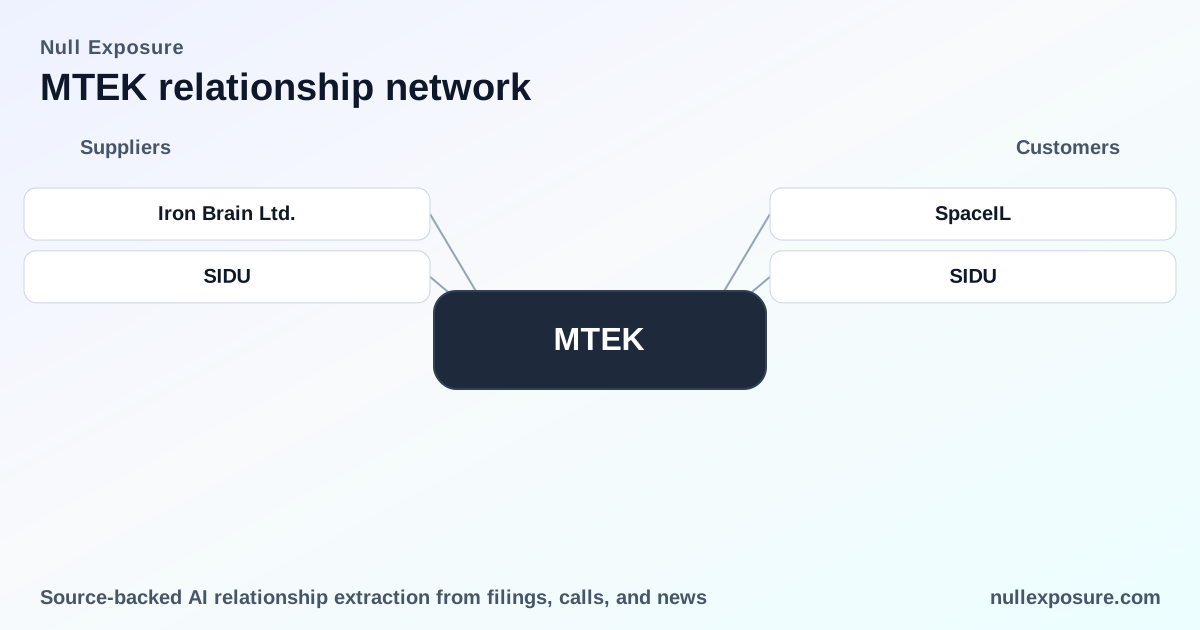
Partnership map: Iron Brain and Sidus Space — what the headlines say
Iron Brain Ltd.
Maris‑Tech announced a strategic collaboration to integrate Iron Brain’s self‑learning AI tools into its edge computing platforms, positioning Maris‑Tech to offer enhanced on‑device intelligence for defense applications. This collaboration was disclosed in a GlobeNewswire press release dated February 3, 2026.
Source: GlobeNewswire press release, Feb 3, 2026.
Sidus Space, Inc. (NASDAQ: SIDU)
Sidus Space confirmed that a Maris‑Tech payload is scheduled to fly aboard LizzieSat‑4, a hosted payload mission intended to demonstrate modular satellite payload integration and on‑orbit edge processing. Sidus’s investor relations release and associated PR coverage (PR Newswire / SpaceDaily / OrbitalToday) described the integration milestone and planned launch later in the year.
Source: Sidus Space investor release and PR Newswire, Jan–Mar 2026.
Why these partnerships change the risk/return calculus
Both relationships are validation events for Maris‑Tech’s go‑to‑market story. Integration with Iron Brain signals product differentiation on the AI software side, while the LizzieSat‑4 hosted payload ties Maris‑Tech into a commercial space distribution channel that broadens addressable markets beyond terrestrial defense systems.
- Strategic validation: Integration announcements with a specialized AI provider and a hosted‑payload satellite operator materially increase the company’s commercial credibility in edge AI and space applications. A successful launch and on‑orbit performance would convert a press release into demonstrable technical and operational proof.
- Milestone‑driven revenue: Both partner engagements are inherently milestone and integration driven; revenue recognition will concentrate around successful integration and deployment events rather than steady recurring revenue.
- High upside, high binary risk: For a company with $3.38M revenue TTM and negative margins, discrete program wins can move the valuation materially; conversely, delivery slips or technical failures produce outsized downside.
Company‑level operational signals and constraints
The data set includes no recorded supplier constraints as part of our relationship capture; that absence itself is a signal — no publicly disclosed contractual encumbrances or supplier dispute filings were captured in the source material. From an operating model perspective the available financial and ownership data communicate the following company‑level characteristics:
- Contracting posture: Project and milestone orientation consistent with defense and hosted‑payload suppliers — contracts will be outcome‑based and tied to integration and flight readiness.
- Concentration: Small revenue base and few high‑profile partners suggest revenue concentration risk; a single payload program or partner ramp can materially alter top‑line trajectory.
- Criticality: The payload integrations indicate that Maris‑Tech supplies critical subsystem hardware/software rather than commodity components; this increases bargaining power on price per program but also increases delivery obligations and certification demands.
- Maturity: Financials show an early‑stage public company: negative EBITDA and EPS, low institutional ownership (~8.5%), and high insider ownership (~40%) point to limited external analyst coverage and insider‑led governance.
Key valuation metrics: Price/Sales ~3.72 and EV/Revenue ~3.61 despite negative margins — these multiples reflect either a market premium for niche edge AI/space exposure or very thin trading in the equity. Investors should weigh these multiples against delivery risk and liquidity constraints.
Risks investors must weigh
- Execution risk is binary. Hosted payload programs and defense integrations have strict testing and launch milestones; missed milestones delay revenue recognition and can erode confidence.
- Liquidity and scale constraints. Market cap (~$12.5M) and a float of ~4.66M shares mean stock moves can be volatile and illiquid.
- Customer concentration and revenue seasonality. A small number of programs provide a large share of revenue; this amplifies volatility around program schedules.
- Capital needs. Negative operating cash flow and negative EBITDA suggest possible future capital raises that could dilute existing shareholders.
Valuation and near‑term catalysts to watch
- Successful integration tests and documented on‑orbit performance from the LizzieSat‑4 mission. Press confirmations or technical status reports from Sidus will be primary catalysts. (Source: Sidus investor release, PR Newswire Jan–Mar 2026.)
- Commercial rollout of Iron Brain integration into customer programs and any licensing or subscription announcements tied to the AI stack. (Source: GlobeNewswire Feb 3, 2026.)
- Quarterly financials and guidance updates showing revenue cadence improvement or order backlog growth.
If you want a supplier risk brief or comparative view of peers in edge AI and hosted payloads, explore https://nullexposure.com/ for similar supplier intelligence.
Actionable next steps for investors
- Track Sidus launch notices and mission integration updates as the highest‑probability near‑term de‑risking events.
- Monitor Maris‑Tech’s earnings releases for backlog details and milestone timing rather than headline revenue only.
- Consider position sizing for a high‑volatility small cap with binary program outcomes; prioritize liquidity that matches holding period expectations.
For a tailored supplier risk analysis and to see how Maris‑Tech compares to other niche hardware‑software providers, visit https://nullexposure.com/ and request a brief.