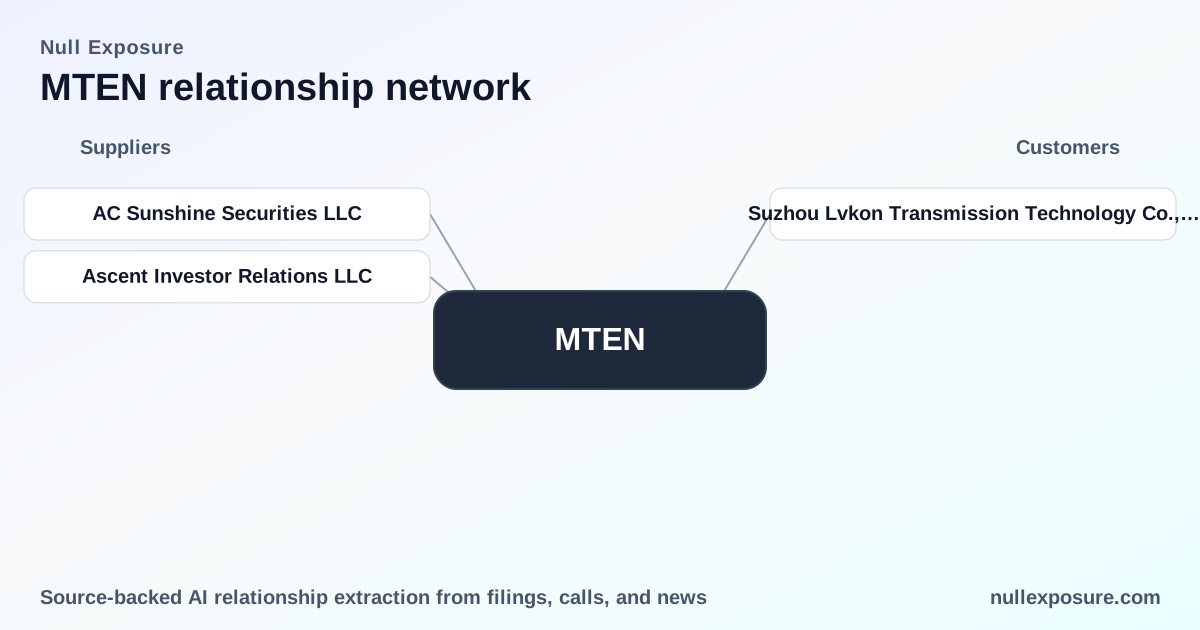
Mingteng International (MTEN) — supplier relationships, capital posture, and implications for counterparties
Mingteng International Corporation Inc. operates as a technology-enabled metal fabrication and manufacturing platform that sells engineered components and systems while monetizing through product sales, contract manufacturing, and strategic partnerships. The company funds growth and working capital through a combination of equity issuance and public market financings, positioning its external supplier relationships and capital partners as critical to near-term liquidity and production scale. For investors and operators evaluating MTEN as a supplier or counterparty, the intersection of capital activity, low institutional ownership, and recent corporate actions defines both operational risk and potential upside.
For deeper supplier and counterparty diligence, see the full Null Exposure platform at https://nullexposure.com/.
Quick business snapshot: what matters to customers and partners
Mingteng reports roughly $10.7 million in trailing revenue with negative profitability metrics (TTM profit margin of -63.1% and diluted EPS deeply negative). That combination signals a business still far from consistent operating scale and dependent on external capital to fund expansion and facilities moves. The company's public profile is thin — a very small float and minimal institutional ownership — which creates concentration risk around equity financing and makes capital-raising events materially impactful to counterparties.
- Concentration and maturity: Shares outstanding are small; institutional ownership is effectively negligible, implying that a few financing transactions can drastically change ownership and liquidity.
- Contracting posture: The firm is actively raising capital through equity mechanisms rather than accumulating debt, indicating an equity-first funding strategy that will influence renegotiation leverage with suppliers.
- Criticality to suppliers: Suppliers to a company under equity pressure should expect accelerated payment negotiations and the potential need to support scaled production ramp with limited margin headroom.
Explore supplier-specific intelligence and monitoring at https://nullexposure.com/.
Relationships disclosed in recent press coverage — what each one means
Below are concise, plain-English summaries of every relationship documented in the recent results, with source references.
-
AC Sunshine Securities LLC — Mingteng entered an at-the-market (ATM) sales agreement with AC Sunshine Securities LLC that allows the company to offer and sell up to $100 million of Class A ordinary shares; this is a direct capital markets arrangement that dilutes existing holders and supplies immediate liquidity. According to a press release reported on The Globe and Mail, the ATM agreement was announced on December 4, 2025 (https://www.theglobeandmail.com/investing/markets/stocks/MTEN/pressreleases/36539267/mingteng-international-corp-announces-100-million-at-the-market-offering/).
-
Ascent Investor Relations LLC — Ascent is acting as Mingteng’s investor relations/communications agent and is listed as the investor and media contact in multiple filings and releases, including notices about the company’s facility relocation and corporate actions. A QuiverQuant summary of the relocation announcement lists Ascent Investor Relations LLC (Tina Xiao) as the investor relations contact in FY2026 (https://www.quiverquant.com/news/Mingteng%2BInternational%2BCorporation%2BCompletes%2BRelocation%2Bto%2BNew%2BProduction%2BFacility%2C%2BEnhancing%2BCapacity%2Band%2BGrowth%2BPotential).
-
Ascent Investor Relations LLC (reverse split notice) — The same IR firm is cited as the contact on the reverse stock split announcement (1-for-200 split effective January 26, 2026), a corporate governance move that compresses share counts and signals microcap restructuring. See the GlobeNewswire release dated January 22, 2026 for details and contact information (https://www.globenewswire.com/news-release/2026/01/22/3223639/0/en/mingteng-international-announces-1-for-200-reverse-stock-split-effective-january-26-2026.html).
What these relationships imply for counterparties and investors
The AC Sunshine ATM agreement is a capital-force multiplier: it unlocks substantial equity capacity ($100 million) that can alleviate liquidity constraints but also creates dilution risk and can change the company's negotiating posture with suppliers. Ascent Investor Relations’ repeated appearance across releases signals the company’s intentional push to manage investor communications and craft a market narrative around facility upgrades and corporate restructuring.
- Short-term supplier negotiation: Expect Mingteng to rely on equity-access terms and public announcements to manage supplier expectations; cash flow unpredictability will push suppliers toward shorter payment terms or escrow-like protections.
- Liquidity buffer vs. governance signal: The reverse split and ATM together are common microcap repair tools — they provide immediate tactical benefits to liquidity and listing status but also indicate a maturity stage where primary market financing dominates strategic options.
If you’re evaluating supplier exposure or contract terms with MTEN, monitor capital events closely; each financing move materially affects credit terms. Additional monitoring is available at https://nullexposure.com/.
Risk profile and operating constraints (company-level signals)
There are no supplier-specific constraints disclosed in the records provided; the following are company-level signals drawn from Mingteng’s public profile and recent corporate actions:
- Capital dependency: The company’s negative profitability and use of an ATM facility indicate high reliance on equity financing rather than operating cash flows — a core constraint on supplier creditworthiness.
- Ownership concentration and illiquidity: Extremely small float and minimal institutional ownership mean market transactions or single financing events will disproportionately affect liquidity and control.
- Operational transition: Public announcements about relocation to a new production facility show capacity expansion but also execution risk during the move; suppliers should treat production ramp and timing as potential points of strain.
These characteristics together create a business that is operationally improving in capacity but financially fragile — a classic scenario where suppliers must trade off near-term order volume against payment and counterparty risk.
Bottom line and recommended actions
Mingteng is a small, capital-intensive fabricator using public equity tools to bridge growth and liquidity gaps. For vendors and investors, the presence of an ATM facility (AC Sunshine) and active investor relations (Ascent) are signals of an equity-funded repair and growth effort — useful liquidity but elevated dilution and execution risk.
Actionable steps:
- Counterparties should require tighter payment terms, milestone invoicing, and performance-based supply agreements.
- Investors should monitor filings and press releases tied to ATM draws and share counts; each issuance will materially change value and creditor confidence.
- Use the company’s communications cadence (Ascent IR contact points) as an early-warning channel for corporate actions and operational updates.
For continuous monitoring and supplier risk scoring on MTEN, visit https://nullexposure.com/ to arrange tailored alerts and counterparty analysis.
Bold final takeaway: Mingteng’s supplier relationships are tightly tied to imminent capital events — treat any new orders or contractual exposure as contingent on active equity financing and negotiate protections accordingly.