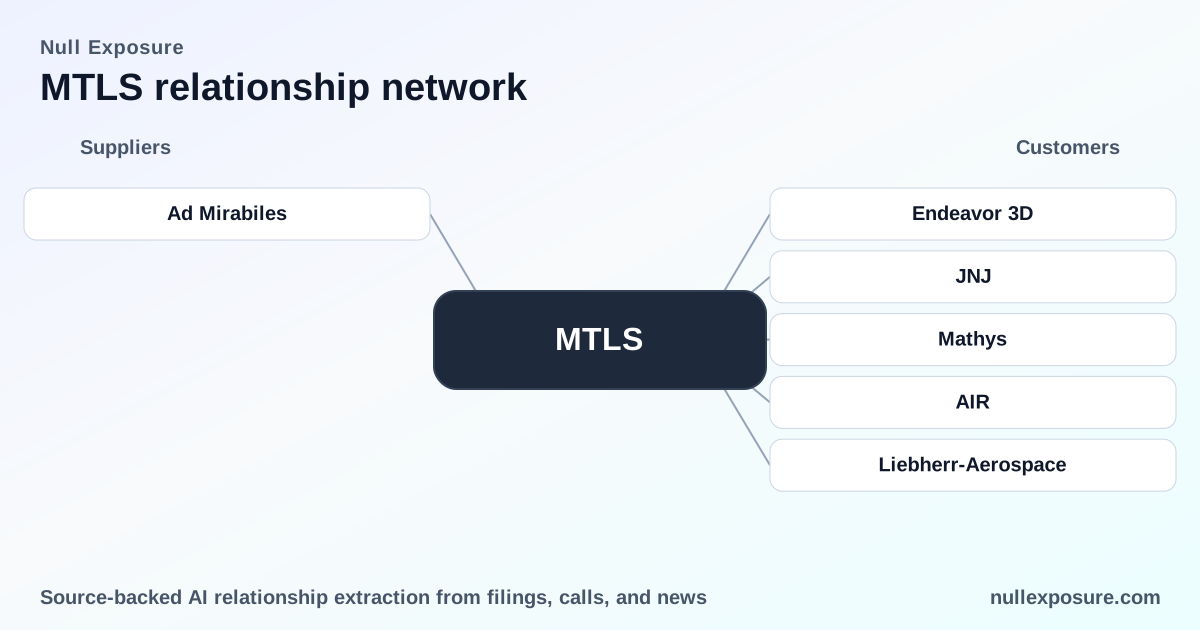
Materialise (MTLS): Supplier Relationships and What They Mean for Investors
Materialise monetizes through a two‑pronged model: software and digital workflow licensing for additive manufacturing plus contract 3D‑printing and medical device production. The company captures value by embedding its software in clinical workflows and by operating manufacturing services for patient‑specific implants and industrial parts, producing $267.6M revenue (TTM) with a market capitalization of $314M and positive EBITDA. For investors evaluating supplier counterparty risk, Materialise’s public footprint shows reliance on certified manufacturing partners to scale medical device production while preserving regulatory traceability and clinical control.
If you want a consolidated view of MTLS supplier exposures for underwriting or diligence, start here: https://nullexposure.com/
Why a single supplier mention matters for a medical‑device supplier
Materialise operates in a regulated vertical where supplier certification and quality management are as important as price. The company sells both software and device‑level outcomes; outsources that bridge clinical needs and manufacturing scale amplify the business’s operating leverage but also introduce operational dependency for device components. Materialise’s financial profile — gross profit $153M, operating margin ~4.4%, EV/EBITDA ~5.9 — shows a business with real manufacturing economics but modest margins, so supplier disruptions can have an outsized short‑term impact on profitability.
The partner list — complete coverage of disclosed relationships
Ad Mirabiles — Europe manufacturer for PEEK cranio‑maxillofacial implants
Materialise added custom PEEK implants to its cranio‑maxillofacial (CMF) portfolio, with each implant manufactured in Europe by Ad Mirabiles under an EN ISO 13485 certified quality management system, enabling surgeons to choose PEEK or titanium within a single Materialise digital workflow. This is a production partnership that transfers implant fabrication to a certified third party while preserving Materialise’s clinical and software interface. Source: VoxelMatters, March 10, 2026.
(That completes the supplier list disclosed in the results examined.)
What the relationship tells investors about MTLS’s operating posture
- Contracting posture: Materialise leverages certified third‑party manufacturers for specialized implant materials rather than vertically integrating every production step. The explicit use of an EN ISO 13485 partner indicates a preference for validated outsourcing capable of meeting medical‑device regulatory standards rather than lower‑cost, non‑certified sources.
- Concentration: Only one partner is disclosed in the supplied results, which signals that Materialise currently relies on at least one named certified external manufacturer for PEEK CMF implants; investors should treat concentration as a measurable exposure and probe the vendor base during diligence.
- Criticality: For the CMF product line, partner manufacturing is critical — implants are patient‑specific, regulated, and cannot be substituted by generic manufacturing without revalidation. The supplier therefore occupies an operationally critical role across manufacturing, traceability, and audit readiness.
- Maturity and compliance: Working with EN ISO 13485 certified partners is consistent with a mature regulatory posture appropriate for medical devices. That lowers certification risk for market access while shifting execution risk to the counterparty.
No supplier constraints were recorded in the provided results; that absence should be interpreted as a lack of disclosed contractual restrictions in the source coverage rather than proof of a broad, diversified supplier base.
If you need a consolidated supplier risk score and counterparty map for MTLS, review the full supplier intelligence at https://nullexposure.com/
Financial and strategic implications for investors
- Revenue and scale: Materialise’s mix of software and outsourced manufacturing enables recurring revenue from software licensing and higher‑margin yet variable revenue from manufacturing services. With Revenue TTM $267.6M and gross profit $153M, the business has scale in both software and production economics.
- Margin sensitivity: Operating margin is modest at ~4.4%, so supplier cost increases, capacity interruptions, or quality nonconformances at a certified partner like Ad Mirabiles would have immediate P&L consequences. Conversely, successful outsourcing preserves capital efficiency and reduces fixed manufacturing investment for Materialise.
- Regulatory leverage: Using an EN ISO 13485 partner reduces the company's regulatory burden for manufacturing control but increases reliance on the partner’s audit performance and documentation processes — a classic tradeoff between compliance risk and capital allocation.
- Valuation context: Market multiples (P/S ~1.17, EV/EBITDA ~5.9) reflect a company with real EBITDA generation but limited margin expansion to date; supplier execution is therefore a lever to improve operating leverage without large CAPEX.
Operational risks you should assess in diligence
- Counterparty operational resilience: uptime, capacity, and spare capacity during demand spikes for CMF implants.
- Contractual terms: exclusivity, lead times, pricing reset clauses, and audit rights — these determine how quickly Materialise can react to supplier performance issues.
- Quality governance: frequency of supplier audits, nonconformance rates, and record retention required for medical device traceability.
- Geographic concentration: the named partner is Europe‑based; supply continuity for other markets (Americas, APAC) requires either local partners or robust logistics.
Bottom line and recommended next steps
Materialise demonstrates a deliberate outsourcing strategy for specialized medical production, leveraging certified partners to scale regulated implant manufacturing while keeping software and workflow control in‑house. That structure reduces capital intensity and supports faster clinical rollouts, but it also places operational dependency on certified suppliers for critical, patient‑specific devices.
For investors and operators, the priority actions are clear:
- Obtain the vendor map and contracts for all regulated product lines to assess concentration and contractual protections.
- Validate audit cadence and nonconformance remediation metrics for each certified partner.
- Stress‑test margins under plausible supplier cost increases to understand downside exposure.
For a focused supplier intelligence briefing and to map MTLS counterparty risk across all product lines, start your review at https://nullexposure.com/
Your next step: consolidate supplier contracts and quality records into a single diligence package and run scenario P&L impacts for supplier outages — if you want help modeling that, visit https://nullexposure.com/ for tools and reports tailored to investor and operator due diligence.