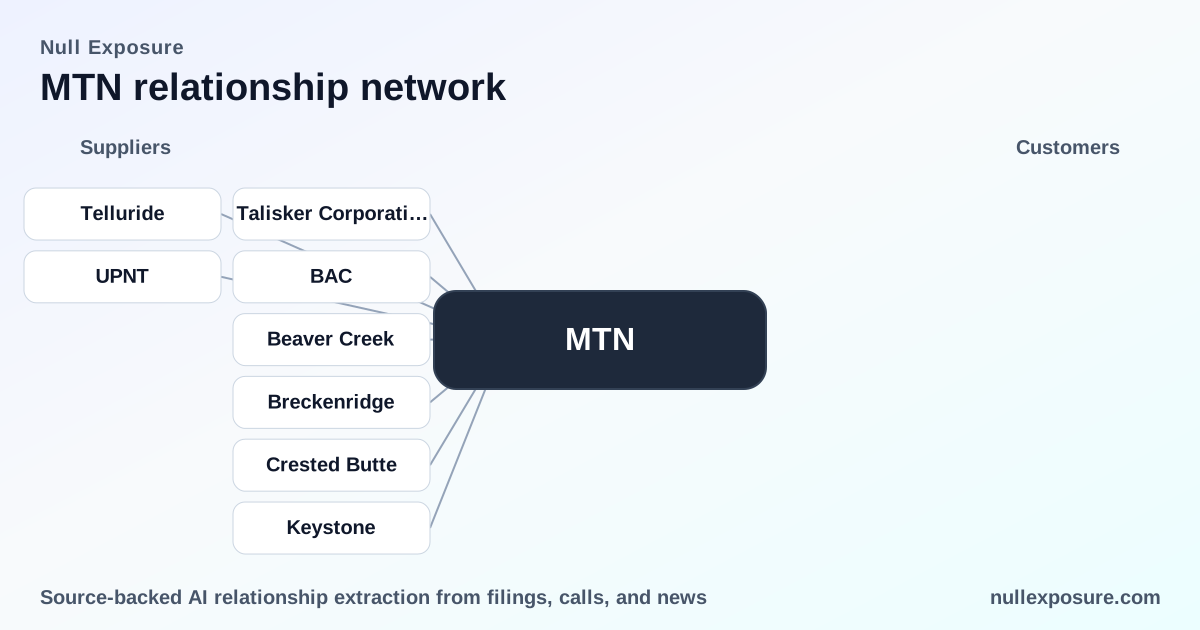
Vail Resorts (MTN) — supplier relationships and what they signal for investors
Vail Resorts operates, owns and manages a portfolio of mountain resorts and urban ski areas and monetizes through season pass sales (Epic Pass), lift tickets, lodging and food & beverage, augmented by real estate and financing structures that smooth cash flow (e.g., Epic FlexPay). The company’s economics center on recurring pass revenue, high-margin on-mountain operations during peak seasons, and long-dated capital and lease commitments that lock in capacity and access. For a concise vendor-risk view and supplier network monitoring, visit https://nullexposure.com/.
How the company’s structure and finances support its supplier posture
Vail is a capital-intensive operator with notable scale and leverage: Market capitalization ~ $4.76B and trailing revenue of roughly $2.92B, with EBITDA around $806M (FY-TTM). That scale supports centralization of critical supplier relationships—resort operations, lodging, and financial counterparties—but also creates fixed-cost sensitivity to weather and discretionary demand. Operating margin (32%) and return on equity (34.6%) underscore a profitable, asset-heavy model where long-term contracts and financing are structural features of the business.
Company-level signals from its public filings and disclosures indicate a long-term contracting posture: Vail issued 6.50% senior notes maturing in 2032 and reports multi-decade finance leases (20-year leases for employee housing at Whistler Blackcomb). These items point to maturity and commitment in capital structure and real-estate-related supplier agreements, which increase fixed obligations but also secure operational continuity. This is a company-level observation drawn from its FY2025 filings and lease disclosures.
Supplier and partner relationships that move the needle
Below I cover every supplier/partner mention in the available records and what each relationship concretely implies for investors.
Talisker Corporation
Vail (through a subsidiary, VR CPC Holdings) entered into a master lease agreement with affiliates of Talisker Corporation covering Park City (the Park City Lease), reflecting a long-term property leasing arrangement that ties asset operations to a third-party landlord structure. This is cited in the FY2025 Form 10-K (reference: Park City Lease language in FY2025 10‑K).
Bank of America (BAC)
Bank of America is listed as the administrative agent under an amended and restated credit agreement, indicating a primary banking relationship and syndicated lender group supporting Vail’s corporate credit facility. This was reported in a TradingView news post covering the March 2026 credit amendment (TradingView, March 2026).
Beaver Creek
Beaver Creek is one of the resorts bundled into the company’s Epic Pass offering, demonstrating direct operational and revenue linkage between pass sales and this resort’s traffic. A Denver7 report on Epic Pass sales (March 2026) lists Beaver Creek among included resorts (Denver7, March 2026).
Breckenridge
Breckenridge is likewise included on the Epic Pass; its inclusion signals route-to-market concentration via the pass platform that drives advance bookings and recurring consumer revenue. The resort inclusion is noted in the same Denver7 Epic Pass piece (Denver7, March 2026).
Crested Butte
Crested Butte is another Epic Pass destination; its presence in pass packaging supports cross-property demand capture and yield management across Vail’s portfolio. The March 2026 Denver7 article lists Crested Butte in the Epic Pass lineup (Denver7, March 2026).
Keystone
Keystone’s inclusion on the Epic Pass means lift access there is part of the company’s bundled consumer product that locks customers into the Vail network and reduces single-resort revenue volatility. The resort appears in the same Denver7 coverage (Denver7, March 2026).
Telluride
Telluride receives a slightly different allocation in pass access (seven days on Epic Pass), indicating a negotiated access arrangement that is more limited than unlimited pass entries but still material for season-pass demand. This was described in the Denver7 article on Epic Pass sales (Denver7, March 2026).
Uplift (UPNT)
Vail offers Epic FlexPay—an installment payment option for passes—powered by Uplift, which allows customers to pay over time and can materially increase pass conversion and ticketing revenues while shifting some receivables/credit risk to a financing partner. This partnership is noted in a Vail Resorts press release about Epic Pass sales (news.vailresorts.com, March 5, 2024).
What these relationships mean for investor risk and return
The network of counterparties shows a strategy of bundling demand through Epic Pass and monetizing via high-margin resort operations while using long-term capital structures to secure real assets. Key implications:
- Revenue stickiness and concentration: Epic Pass relationships with owned resorts (Vail, Beaver Creek, Breckenridge, Keystone, Crested Butte, Telluride) create recurring revenue streams but concentrate operational risk in weather- and demand-sensitive tourism.
- Financial flexibility vs. fixed obligations: The credit facility led by Bank of America and long-dated notes provide liquidity but are coupled with long-term leases and finance commitments—these improve operational continuity but raise fixed-cost leverage.
- Distribution and payment innovation: The Uplift partnership expands purchasing options and likely raises pass uptake, but it also introduces counterparty and receivable dynamics worth monitoring.
Consider three focused risk/benefit points:
- Benefit: Bundled pass economics reduce marginal marketing costs and smooth seasonal volatility through advance sales.
- Risk: Long-term financing and 20‑year leases raise breakeven sensitivity to prolonged demand shocks.
- Operational leverage: Resort-level relationships are critical; disruptions at any major resort in the Epic network have outsized top-line impact.
For governance and exposure monitoring, investors should watch covenant language in amended credit agreements and scheduled maturities for long-dated notes, as these define refinancing and liquidity flexibility (TradingView credit coverage, March 2026; FY2025 10‑K disclosures).
Explore a supplier-risk dashboard and deeper counterparty mapping at https://nullexposure.com/ to track changes in real time.
Constraints and operating-model signals
The filings and evidence provide a clear company-level signal: Vail’s supplier and capital agreements are long-term in nature, reflecting an operational model built around secured access to land and long-lived facilities. The FY2025 disclosure of senior notes due 2032 and finance leases with 20‑year terms for employee housing are the basis for this company-level conclusion. That long-dated posture supports strategic control of core assets but raises sensitivity to extended downturns in travel and discretionary spending.
Investment takeaway and next steps
Vail Resorts is a profitably run, asset-heavy operator that monetizes through pass bundling and resort operations, supported by long-term capital and lease commitments. For investors, that translates to predictable seasonal cash flows and structural fixed obligations—a trade-off between stability and leverage.
If your interest is supplier exposure, counterparty concentration, or the financing covenants that underlie operating flexibility, review the detailed filings and live counterparty feeds. For an integrated supplier-risk view and monitoring tools, visit https://nullexposure.com/. For ongoing alerts and deeper relationship analytics tailored to investor diligence, start here: https://nullexposure.com/.