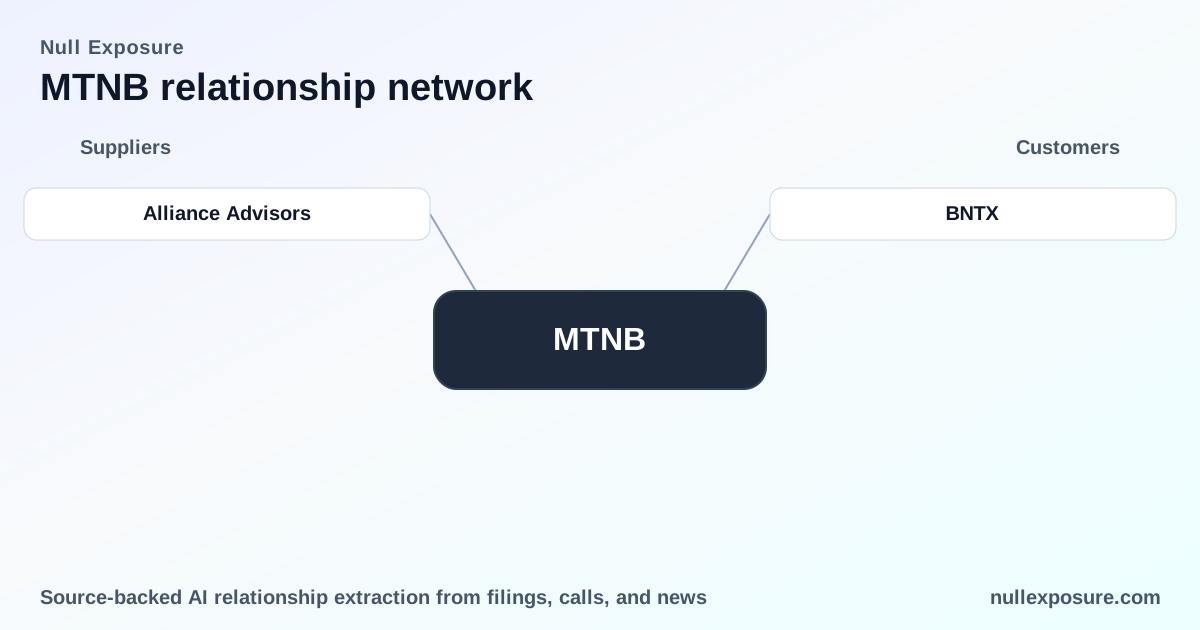
Matinas BioPharma (MTNB) — supplier relationships and what they mean for investors
Matinas BioPharma is a clinical-stage biopharma that monetizes primarily through licensed intellectual property and milestone/royalty streams tied to its lipid nanoparticle (LNC) platform and lead candidate MAT2203, while outsourcing almost all manufacturing and clinical execution to third parties. The company’s financial upside is concentrated in successful clinical progression and downstream licensing/commercial agreements, while near-term value is capped by heavy operational dependence on external manufacturers and CROs and a very small market capitalization. For a structured view of supplier exposure and counterparties, see NullExposure.https://nullexposure.com/
What the public record shows about Alliance Advisors — two entries that point to the same investor contact
-
Matinas’ public releases list Alliance Advisors as the investor relations contact for material corporate announcements. According to a GlobeNewswire press release dated October 31, 2024, Matinas announced termination of MAT2203 partnership negotiations and an immediate workforce reduction and identified Alliance Advisors (Jody Cain) as the investor contact.
According to the GlobeNewswire release (Oct 31, 2024), Alliance Advisors served as the IR contact for that announcement. -
A subsequent Yahoo Finance re-post on March 10, 2026 also lists Alliance Advisors and the same contact information, reflecting continued use of that external IR firm as the company’s communications conduit.
Yahoo Finance (Mar 10, 2026) carries the same Alliance Advisors investor contact details.
Both records are brief investor-contact mentions rather than operational supplier disclosures, but they help establish that Matinas outsources investor relations communications to Alliance Advisors rather than handling all investor outreach internally.
How Matinas’ supplier posture shapes value and risk
Matinas runs a classical small biotech operating model: intellectual property and clinical assets in-house, outsourced development and manufacturing. That posture produces a distinctive set of investment signals:
-
Contracting posture — licensing and contingent economics dominate. The company’s Second Amended and Restated Exclusive License Agreement prescribes royalties on a tiered basis (low single digits to mid-single digits), a one-time sales milestone fee of $100, and an annual license fee of $50 over the license term, indicating monetization via downstream licensee sales rather than large upfront payments. This structure preserves upside for licensees while placing commercialization execution and market risk predominantly off the company’s balance sheet.
-
Concentration and criticality — manufacturing and CROs are single points of failure. Matinas explicitly states it is completely dependent on third parties for manufacture and clinical execution; this elevates counterparties such as contract manufacturers to critical status for timetable and commercial viability. The company has signed with Patheon (a Thermo Fisher subsidiary) to prepare for commercial manufacture of MAT2203, signaling a formal manufacturing engagement. According to Matinas’ disclosures, inability of these third parties to obtain regulatory approval or supply sufficient quantities would halt commercialization.
-
Geography and supply-chain exposure — APAC suppliers figure into the risk profile. The company acknowledges partners and API manufacturing operations in China and other Asian countries, which creates exposure to regional disruptions and regulatory variability that can affect supply continuity.
-
Maturity and stage — supplier relationships skew early and operationally dependent. Many supplier contacts are in an active or prospective stage: Matinas expects to enter agreements with CROs and has yet to finalize formal supply agreements for amphotericin B at scale, making certain relationships prospective rather than mature.
Together these signals mean: value is binary and fragile — clinical success and a commercial license can trigger royalties per the license economics, but operational execution rests on external manufacturers and CROs whose failure would materially damage timelines and cash outcomes.
Named counterparties and contract excerpts that matter
Several constraint excerpts name counterparties and contract terms that are important for diligence:
-
The license agreement (acquired via Aquarius) ties Matinas to Rutgers University intellectual property for the LNC platform and positions Matinas as a licensor of that platform. The license contains royalty tiers and modest fixed fees that favor downstream commercialization partners. This underscores the company’s role as an IP-holder reliant on license monetization.
-
Patheon (Thermo Fisher’s CDMO) is explicitly engaged to prepare for the commercial manufacture of MAT2203, which elevates Patheon from a prospective to a key manufacturing counterparty in Matinas’ supply chain.
-
The company flags CROs (and governmental entities like NIH) as the expected operators for clinical programs, confirming that trial execution is outsourced and that clinical data integrity and timelines depend on third-party performance.
These named relationships are consistent with a strategy of capital-light development and a reliance on partners for scaling production and conducting trials. Investors should treat these counterparty commitments as operational linchpins rather than peripheral vendors.
Relationship-by-relationship record (complete list from the supplier scope)
-
Alliance Advisors — listed as the investor relations contact in the Oct 31, 2024 GlobeNewswire release announcing termination of MAT2203 partnership negotiations and workforce reduction. This shows Matinas uses Alliance Advisors for external communications on material events. (GlobeNewswire, Oct 31, 2024)
-
Alliance Advisors — the same investor contact information appears again in a Yahoo Finance repost on March 10, 2026, confirming continued use of the same external IR firm across subsequent public notices. (Yahoo Finance, Mar 10, 2026)
Both entries are communications contacts; operational suppliers (manufacturers, CROs, licensors) are referenced elsewhere in Matinas’ filings and are treated as company-level constraints below.
Key investment implications and risk checklist
-
Upside is concentrated on clinical progression and licensing deals. Royalty structure gives Matinas recurring upside if MAT2203 or platform products reach commercial sales, but royalties are modest (low-to-mid single digits) and fixed fees reported are minimal.
-
Downside is tied to third-party execution. Failure of manufacturers or CROs to meet quality, quantity, or regulatory timelines is a primary operational risk that can materially delay or prevent commercialization.
-
Supply geography matters. APAC manufacturing footprints create additional geopolitical and public-health exposure that investors must monitor.
-
Communications and governance are outsourced in part. Use of Alliance Advisors for investor relations is a transparency signal to watch in the context of small-cap governance.
If you want a concise counterparty map or a supplier-concentration heat map for MTNB, get a tailored briefing from NullExposure: https://nullexposure.com/
Bottom line and next steps for investors
Matinas is a classic small-cap, clinical-stage IP holder with outsized operational dependence on third-party manufacturers and CROs; its path to value is licensing-driven, with modest royalty economics and high execution risk. For active investors, the critical monitoring items are: (1) confirmation of supply agreements for amphotericin B and finished product capacity, (2) regulatory progress and CRO performance on MAT2203 trials, and (3) any updates to licensing or commercialization partners. If you want an investor-ready supplier risk assessment for Matinas or comparable companies, review NullExposure’s supplier profiles here: https://nullexposure.com/