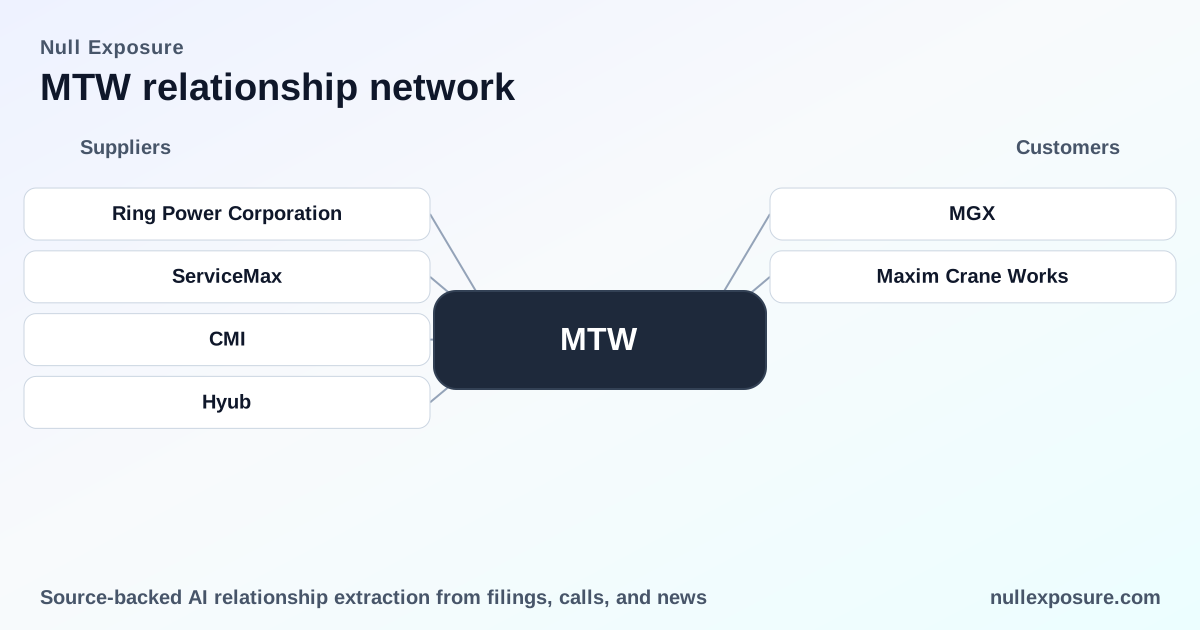
Manitowoc (MTW) — supplier relationships that shape margin and aftermarket economics
Manitowoc Company Inc. designs and sells engineered lifting solutions globally, monetizing through the sale of cranes and related equipment, recurring aftermarket parts and service contracts, and distribution partnerships that extend dealer reach. Revenue is driven by new equipment sales and higher-margin aftermarket services, while capital deployment and cash flow are shaped by long-term leases and strategic acquisitions that reinforce distribution networks.
For investors assessing supplier risk and opportunity, the supplier map tells a clear story about where Manitowoc captures value and where the business is exposed. Learn more and map supplier exposures at https://nullexposure.com/.
Why suppliers matter to MTW’s P&L and valuation
Manitowoc’s margin profile relies on two connected dynamics: supplier-sourced critical components and distribution relationships that convert equipment sales into recurring service revenue. The company reports $2.24B in trailing revenue and a thin profit margin, so small changes in parts cost, engine availability, or distribution coverage have outsized effects on EBITDA conversion. Strategic acquisitions and distribution hires are being used to broaden reach and protect aftermarket channels, which supports long-term service revenue.
A concise set of company-level signals from public disclosures further clarifies operating posture:
- Long-term contracting posture: Manitowoc states that “for the majority of our critical suppliers, we have long-term agreements,” and its leases include terms up to 19 years with renewal and termination options. This is a clear corporate preference for multi-year supplier and occupancy commitments, which supports supply continuity and predictable cost structures.
- Global sourcing footprint: The company sources raw and semi-processed materials globally, indicating exposure to international supply-chain dynamics and currency and trade risks.
- Material spend scale: Operating lease cash flows reported in filings ($30.6M in 2024) imply supplier/lease spend in the ~$10M–$100M band, reflecting material recurring cash commitments rather than trivial line-items.
These signals should be read as company-level characteristics that shape how supplier relationships translate into risk or competitive advantage.
The counterparties that matter (what the filings and press note)
Below are every supplier or partner mention in recent public reporting and press results for MTW, with a short plain-English take and a source reference.
-
Ring Power Corporation — Manitowoc acquired certain assets and distribution rights from Ring Power for $12.9 million as part of strategic distribution expansion. This is an acquisition-driven approach to extend local market coverage and control aftermarket channels. According to a TradingView summary of Manitowoc’s FY2026 10‑K disclosure (reported March 2026), the transaction was recorded as a strategic acquisition.
-
ServiceMax — Manitowoc deployed ServiceMax, a global asset-management platform, to improve technician productivity, streamline contract management, and strengthen long-term customer engagement across its fleets. This is a software-enabled move to lift aftermarket economics and technician efficiency. A Finviz Q2 deep dive on MTW (FY2025) highlighted the expected productivity gains from ServiceMax.
-
Cummins (FY2021 mention) — The Manitowoc Shuttlelift SCD15 carrydeck offered a Tier 4 final Cummins QSF 3.8‑liter engine option that does not require DEF, giving customers lower operating complexity. Product literature covered by ForConstructionPros (FY2021) documented the carrydeck’s Cummins engine option and its operational benefits.
-
Cummins (FY2025 mention) — In new Grove GRT8100‑1 rough-terrain equipment, Manitowoc specified a six-cylinder Cummins B6.7L engine capable of ECO mode to reduce total cost of ownership. ForConstructionPros’ FY2025 launch coverage described how the Cummins engine contributes to TCO savings.
-
Hyub — Manitowoc announced a distribution agreement where MGX will represent Hyub products across 13 U.S. states, reflecting expansion of third-party distribution partnerships to broaden product availability. An InsiderMonkey transcript of the MTW Q4 2025 earnings call (FY2026 reporting) noted the new distribution agreement.
What these relationships imply for investors
Collectively, the relationships and corporate signals point to a supplier strategy focused on control of distribution, careful engineering partnerships for critical components, and longer contractual horizons that protect aftermarket revenue.
-
Distribution-first monetization: Acquisitions like the Ring Power assets and the Hyub distribution agreement show proactive moves to secure market access. Those steps convert equipment sales into recurring parts and service revenue — the higher-margin part of the business.
-
Engine supplier concentration and criticality: Repeated product references to Cummins engines across model years indicate a stable engineering relationship for powertrains, which is a critical supplier dependency. Engine reliability, emissions compliance, and lead times are direct drivers of product availability and warranty costs.
-
Operational resilience via long-term contracts: The company’s preference for long-term supplier agreements and long lease terms reduces churn risk and supports planned capital deployment, but also creates fixed-cost commitments that amplify demand cyclicality.
-
Global sourcing vulnerability: Global sourcing of processed materials improves cost options but links MTW to supply shocks, tariffs, and logistics volatility — factors already discussed in recent market coverage of demand uncertainty and tariff exposure.
If you want a deeper supplier-risk score or a mapped visualization of MTW’s counterparties, start here: https://nullexposure.com/.
Key investment risks and mitigants
- High leverage to aftermarket conversion: Aftermarket revenue is valuable but depends on distribution control and service-platform performance (ServiceMax).
- Supplier concentration: Cummins is a recurring engine partner; loss of that relationship or supply constraints would be disruptive.
- Fixed-cost commitment: Long-term leases and multi-year supplier deals smooth supply but limit flexibility during downturns.
- Geographic exposure: Global sourcing reduces unit costs but increases exposure to trade/tariff cycles.
Practical next steps for analysts and operators
- Validate engine supply contracts and lead-time SLAs with Cummins to quantify single-supplier risk.
- Model aftermarket revenue uplift from ServiceMax deployment against technician productivity gains disclosed in FY2025 commentary.
- Reconcile the financial impact of the Ring Power asset purchase and Hyub distribution agreement on regional revenue mix and parts penetration.
- Stress-test lease and supplier commitments under downside demand scenarios using the $30.6M 2024 operating lease cash flow as a baseline.
For a coordinated supplier risk review and tailored exposure maps, visit https://nullexposure.com/ and request a supplier deep-dive.
Bottom line: controlled distribution and critical components drive value
Manitowoc is executing a clear playbook: secure distribution, lock in critical component suppliers, and upgrade service platforms to convert equipment sales into higher-margin recurring revenue. That positioning reduces volatility on the upside and concentrates operational risk around engine partners, global sourcing flows, and long-term contractual commitments. Investors should underwrite those exposures explicitly when valuing MTW’s aftermarket potential and operating leverage.
Explore detailed supplier intelligence and scenario models at https://nullexposure.com/.