Murphy Oil (MUR) — Supplier relationships, contract posture, and operational implications
Murphy Oil monetizes by exploring, producing and selling crude oil and natural gas across the United States, Canada and international basins, capturing margins through production volumes and midstream arrangements while managing cost exposure through multiyear service and transportation contracts. For investors and operators evaluating supplier counterparty risk, the priority is clear: Murphy runs a production-heavy business with embedded long-term supplier commitments that shift price and availability risk off the company's P&L and onto contracted service providers. For a deeper look at supplier profiles and contract risk, visit https://nullexposure.com/.
What matters to investors: business model drivers and supplier posture
Murphy’s core revenue engine is upstream production and commodity sales; supplier relationships are therefore not ancillary — they are operationally critical. Several company-level signals define the supplier risk profile:
- Long-term contracting posture. Murphy discloses transportation, processing and production-handling contracts with minimum payments extending into the 2040s and 2050s, which embeds fixed-cost obligations even if commodity prices or production mix change.
- Service-provider relationships dominate. The company treats counterparties primarily as service providers for transportation, processing and FPSO or asset services, making these suppliers critical to uptime and commodity realization.
- Material spend concentration. Murphy reports multiyear minimums with annual required payments in the high tens to hundreds of millions, indicating concentrated spend that is material to both cash flow planning and supplier negotiation leverage.
- Geographic concentration in North America operationally relevant. References to U.S. and Canada onshore/offshore contracts imply regional operational dependency and regulatory exposure for a significant portion of contracted services.
These characteristics combine into a predictable operating pattern: high capital intensity, recurring service commitments, and operational dependence on a small set of specialist providers. For service-risk due diligence and counterparty monitoring, Murphy’s supplier profile is best viewed through the lens of contract maturity, minimum-commitment exposure, and the technical criticality of assets sourced from counterparties. Learn more about supplier risk intelligence at https://nullexposure.com/.
How contract terms change the economics
Murphy’s long-term minimum-payment clauses are not just footnote risk — they actively shape free cash flow variability. The company has disclosed required minimum annual payments running roughly $149 million in 2025, declining over the five-year horizon but still material. That structure creates a floor on operating cash requirements and reduces the company’s sensitivity to short-term service-price inflation, while increasing fixed-cost leverage when production or commodity prices fall. Investors should treat these contracts as quasi-fixed obligations that compress financial flexibility under adverse commodity cycles.
Supplier relationships reported (complete coverage)
Below are the supplier relationships identified in the public results, with plain-English summaries and source citations.
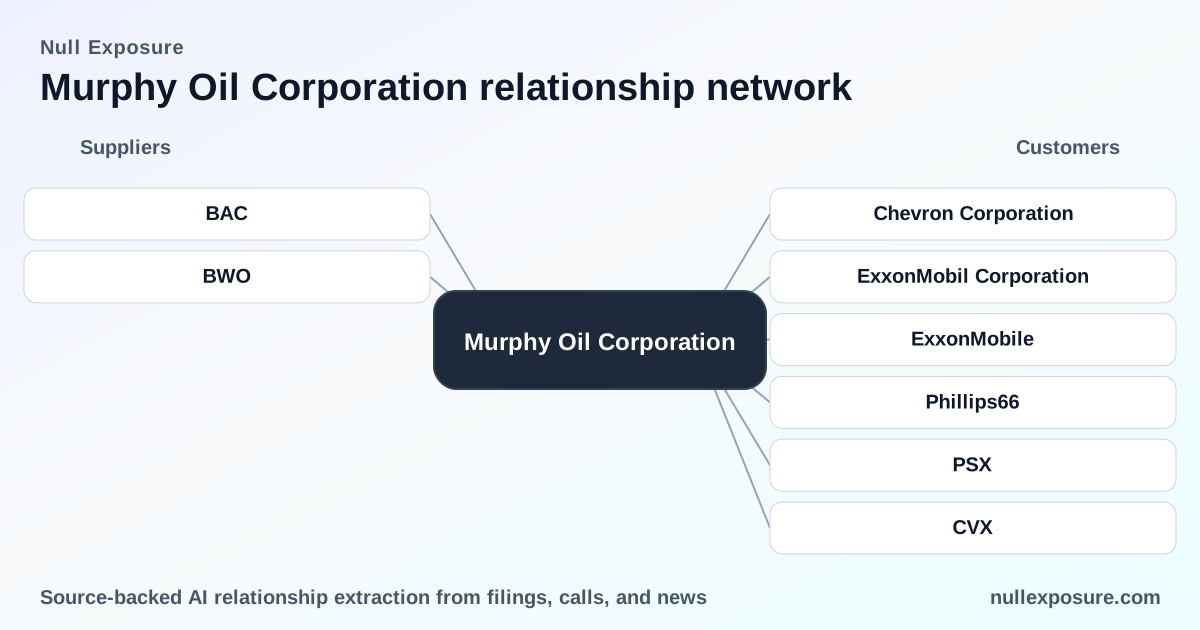
BofA Securities — capital markets placement role
BofA Securities is acting as the physical book-running manager for a Murphy offering, which places BofA in a capital markets execution and distribution role for Murphy’s financing activity. This is a transactional, intermediary relationship connected to Murphy’s funding and liquidity operations. According to a Yahoo Finance press release dated March 10, 2026, BofA’s role is specifically to run the book for the offering (https://finance.yahoo.com/news/murphy-oil-corporation-announces-offering-125200172.html).
BW Offshore — FPSO sale and integrated maintenance services
Murphy acquired a floating production storage and offloading vessel (FPSO) from BW Offshore for $125 million, with payments structured over 2025, and BW Offshore will continue maintenance under a five-year contract while the FPSO supports Gulf of America operations. This is a combined asset-supply and services relationship where BW Offshore supplies critical production infrastructure and ongoing maintenance services. The transaction and contract terms were reported March 10, 2026 via industry coverage (intellectia.ai/ETF news summary; original article: https://intellectia.ai/news/etf/murphy-oil-surpasses-q2-earnings-expectations-repurchases-56m-of-stock).
What each relationship implies for operational risk and finance
- Capital markets partners (BofA Securities). Having an active book-running bank relationship supports Murphy’s ability to access markets quickly and efficiently, reducing execution risk for financings. This is liquidity infrastructure rather than operational dependency.
- Specialist asset and maintenance suppliers (BW Offshore). FPSO procurement and long-term maintenance agreements create operational lock-in: the supplier not only sells a critical asset but also provides services that affect uptime and throughput. This elevates supplier criticality and counterparty operational risk.
Constraints and how they inform risk assessment
The available constraint signals are company-level indicators and should be read as broad, structural features:
- Contract maturity is long-term. Murphy has transportation and processing contracts requiring minimum monthly payments through 2045 (U.S. Onshore and U.S. Offshore) and through 2051 for Canada Onshore. This indicates high contractual maturity and long-dated fixed commitments.
- Supplier role is service-oriented. Disclosures emphasize operating, transportation and production-handling service agreements, so most counterparties are service providers rather than simple vendors.
- Material monetary exposure. Murphy highlights required minimum annual payments of approximately $148.8 million in 2025 and material follow-on obligations, which signals > $100 million spend bands and therefore concentrated counterparty exposure.
- Regional operational footprint. References to U.S. and Canada onshore/offshore contracts point to North American operational concentration for a meaningful slice of supplier commitments.
Together these constraints create a supplier profile defined by long-term, high-dollar, service-critical contracts that reduce variable cost exposure but increase fixed-cost and counterparty reliance. Operational continuity risk becomes a financial risk because disruptions can impair production and cash flow while leaving minimum contractual payments in place.
Investment implications and risk mitigants
- Positive: Long-term contracts insulate Murphy from short-term service cost inflation and provide predictable capacity for production planning; capital-markets relationships support liquidity execution.
- Negative: Long-dated minimum payments and reliance on specialist suppliers (e.g., FPSO providers) concentrate counterparty and operational risk; in a downturn, fixed payments reduce flexibility faster than variable-cost structures would.
- Actionable monitoring: Focus on supplier credit and operational health, contract amendment triggers, and capital markets access terms tied to those counterparties.
Explore supplier-level signals and contract risk dashboards at https://nullexposure.com/ to convert these observations into actionable counterparty monitoring.
Final takeaways for investors and operators
Murphy’s supplier relationships are strategically purposeful: they deliver necessary infrastructure and execution capability but at the price of long-term fixed commitments and service dependence. For investors, the central trade-off is predictability vs. flexibility — stable service economics today in exchange for reduced agility under stress. Operators should prioritize resilience in supplier portfolios, scenario testing for prolonged commodity weakness, and active oversight of specialist suppliers whose uptime directly impacts production revenues.
For more supplier intelligence and to track evolving counterparty exposure, visit https://nullexposure.com/ — use the platform to convert contract disclosures into investable risk signals.