MUSA: Supplier Exposure and What Investors Should Price In
Murphy USA (MUSA) operates a national retail fuel and convenience business that monetizes through fuel retail margins, convenience-store merchandise sales, and property lease economics—notably a portfolio of stores concentrated adjacent to large anchors like Walmart. The company’s profitability is driven by narrow fuel margins offset by high-turn convenience merchandise and long-term contracting arrangements with key suppliers and landlords. For investors evaluating supplier risk, the interplay of long-dated leases, a highly concentrated merchandising supply chain, and active commodity hedging defines the material risk surface. Learn more about supplier signals and model implications at https://nullexposure.com/.
How Murphy USA’s operating model creates supplier sensitivity
Murphy USA generated roughly $17.0 billion in revenue and $1.02 billion of EBITDA on a trailing basis, showing a large top line with a thin operating margin (about 5.25%) and modest net margin (2.77%). The business relies on volume throughput for fuel and high-margin convenience items to lift earnings — that concentration means supplier terms and product mix have outsized effects on EBT and margin outcomes.
- Scale and concentration: The company’s revenue scale gives it bargaining leverage, but merchandising sourcing is concentrated and, therefore, fragile to supplier disruptions.
- Lease and site economics: Many locations operate under long-term arrangements (including master leases on Walmart-adjacent sites), embedding fixed occupancy and extension options that affect cost structure for years.
- Commodity exposure: Murphy uses short-term commodity hedges to manage refined-product price risk, but take-or-pay and other long-term supply commitments anchor fixed purchase obligations.
If you model MUSA, treat supplier contract duration and spend concentration as first-order drivers of downside risk; for detailed supplier flags and comparators, start at https://nullexposure.com/.
What the supplier footprint signals about contracting posture and maturity
Murphy’s public disclosures reveal a clear long-term contracting posture and material supplier concentration:
- The company holds master lease arrangements for stores on or adjacent to Walmart property with ten-year initial terms and multiple five-year extension options, indicating multi-year real-estate commitments that reduce site-level flexibility but secure location economics.
- In 2024, over 78% of merchandise purchases came from a single vendor, Core-Mark, and Murphy renewed a new five-year supply agreement in January 2021, signaling persistent vendor concentration and critical dependence on that relationship.
- Murphy reports take-or-pay contracts to supply terminals with a noncancellable remaining term of about 5.8 years, illustrating medium-term locked-in fuel logistics commitments.
- The company disclosed short-term commodity derivative contracts in place at year end 2024 to hedge refined-product purchase price exposure, while also noting that a 10% move in benchmark commodities would have been immaterial to results — an indicator that hedging programs and balance-sheet scale limit near-term commodity earnings volatility for the firm.
- Purchase obligations reported at ~$545.4 million primarily reflect ongoing retail store construction, land commitments, take-or-pay contracts, and related services, consistent with a >$100M annual supplier spend band.
Collectively, these items show long-dated commitments, high supplier concentration, and material spend, which together elevate counterparty and supply-chain risk even as they stabilize location economics.
Contracting maturity: a double-edged sword
Long-term leases and multi-year supply agreements lock in economics and simplify operational planning, but they also reduce flexibility to re-source quickly or cut costs when product mix shifts or when a concentrated supplier experiences disruption. For investors, this is a structural constraint on downside recovery speed.
Concentration equals criticality
Core-Mark’s share of merchandise purchases is a critical dependency; losing or renegotiating that relationship would necessitate rapid re-sourcing at scale and could compress margins in the near term. Leases with extension options create a similar lock-in on the property cost base.
Supplier relationships disclosed — concise investor notes
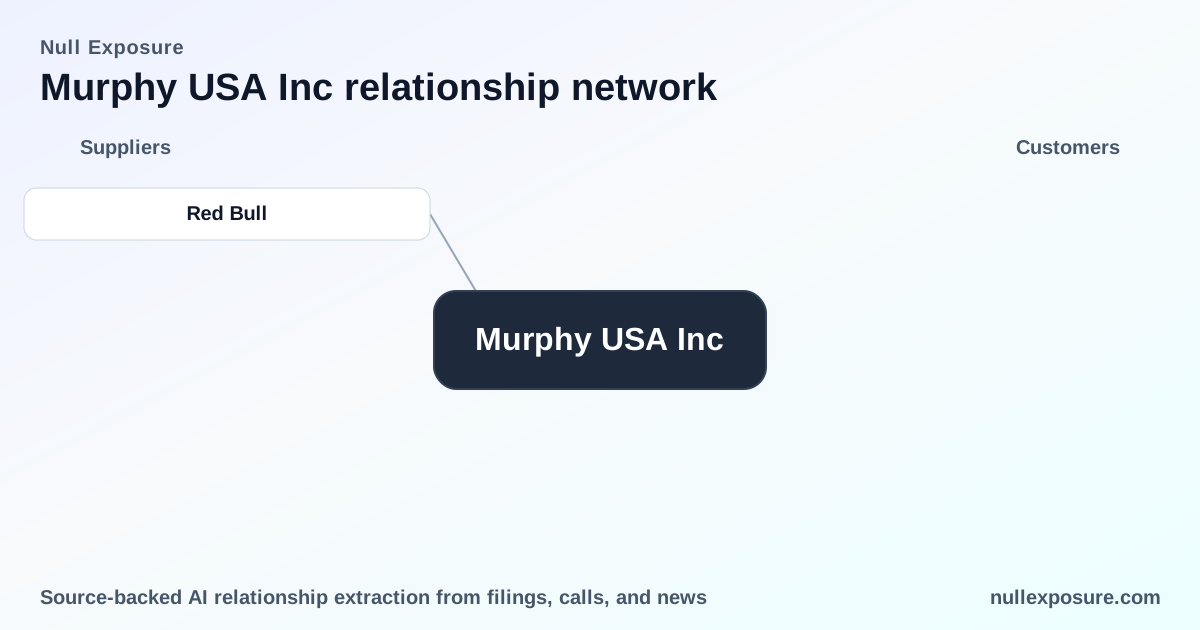
Red Bull
Management called Red Bull “our top EBT item,” signaling that energy-drink sales contribute disproportionately to merchandise profitability at stores; this was referenced during the company’s Q4 2025 earnings call transcript posted on InsiderMonkey on March 10, 2026. (InsiderMonkey, Q4 2025 earnings call transcript, March 10, 2026.)
This is the complete set of supplier relationships surfaced in the provided intelligence.
Risk / reward implications for investors
- Upside drivers: Stable lease footprints next to Walmart anchors, consistent merchandising economics (notably high-margin items such as Red Bull), and active hedging create a predictable cash-flow base and support a premium multiple (forward P/E ~17.95; trailing P/E ~19.1).
- Key risks: Supplier concentration (Core-Mark), long-term take-or-pay logistics contracts, and substantial purchase obligations increase the cost of supplier disruption. Despite hedging, concentration risk remains a latent catalyst for margin shocks.
- Balance-sheet and market posture: With ROE at roughly 64% and low beta (~0.37), the company shows high capital efficiency and low share-price volatility; investors should reconcile the high ROE with the operational constraints of concentrated suppliers and long-term commitments.
Practical monitoring checklist for operators and investors
- Monitor renewal timelines for Core-Mark and other major merchandising suppliers; contract re-pricing or non-renewal would be the highest-impact event.
- Watch the cadence and effectiveness of commodity hedges (quarterly filings), particularly ahead of seasonal fuel cycles.
- Track store-level sales mix trends for energy drinks and other high-EBT items, since these disproportionately move merchandise margins.
For ongoing, supplier-level intelligence and to see how these exposures map to peer portfolios, visit https://nullexposure.com/ for deeper analysis.
Bottom line and next steps
Murphy USA is a high-throughput retail operator with long-term property and supply commitments and a concentrated merchandising supply chain that materially affects margins. Investors should value MUSA not only on fuel throughput but on the sustainability of its high-margin convenience items and the terms of its core supplier and lease contracts. For deal diligence or to monitor contract expirations and supplier concentration in real time, start your research at https://nullexposure.com/.
Key takeaway: concentration and long-term contracts stabilize operations but amplify counterparty and re-sourcing risk — price that into any downside scenario.