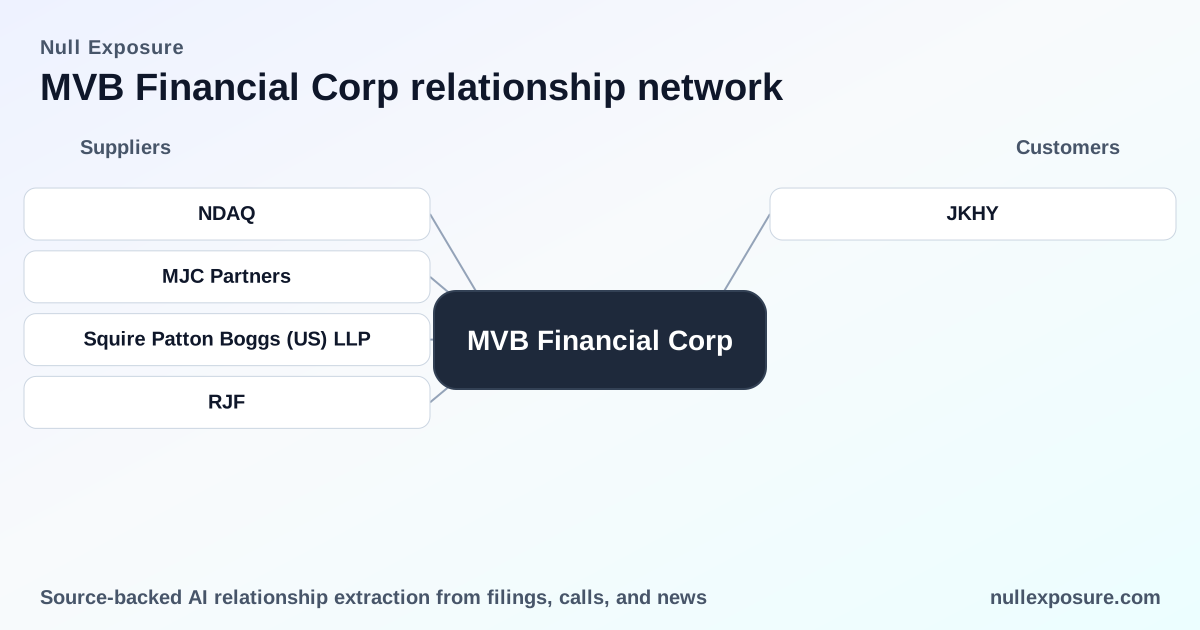
MVB Financial (MVBF) — supplier map and commercial implications for investors
MVB Financial Corp. is the publicly traded holding company for MVB Bank that generates revenue through traditional banking activities (net interest income and fee income) alongside strategic technology and service arrangements tied to its banking platform and occasional asset disposals. The company monetizes core lending and deposit operations while sourcing specialized legal, advisory, market access, and credit facilities from third parties—a mix that supports growth but creates concentrated vendor dependencies worth monitoring. If you want a consolidated view of counterparties and contract signals for MVBF, start here: https://nullexposure.com/.
Why this supplier map matters to investors
Understanding MVBF’s supplier relationships illuminates where operational leverage, contractual lock-ins, and short-term liquidity support live inside the firm. The reported relationships show three categories of external dependency:
- Market infrastructure and listing services that enable capital markets access and public liquidity.
- Professional advisers used in M&A and corporate transactions.
- Bank-lender relationships providing working capital and capital structure flexibility.
Company-level signals from contract language and spend excerpts indicate a preference for licensed software, multiyear service support, and mid-range third‑party spend—all of which affect integration risk, renewal exposure, and expense visibility.
All reported supplier relationships — concise takeaways
Nasdaq — market infrastructure and listing partner
MVB Financial is publicly listed on the Nasdaq Capital Market under the ticker MVBF; Nasdaq provides the exchange listing and related market services that underpin MVBF’s public equity. This relationship is foundational to MVBF’s access to public investors and liquidity (see CityBiz reporting on March 10, 2026 and an SEC filing referencing listing details in FY2025).
Sources: CityBiz article (March 10, 2026) and SEC filing relating to FY2025 stock repurchase disclosures.
MJC Partners — financial adviser on a divestiture
MJC Partners served as MVB’s financial advisor in the sale of Victor Technologies, suggesting MVBF hires external boutiques for transaction execution during strategic portfolio adjustments. The engagement is documented in CityBiz coverage of the FY2025 disposal.
Source: CityBiz article covering the Victor Technologies sale (FY2025).
Squire Patton Boggs (US) LLP — legal adviser for M&A work
Squire Patton Boggs acted as MVB’s legal advisor in the same Victor Technologies transaction, indicating the company engages large law firms for deal counsel and regulatory navigation during disposals. This is cited in CityBiz reporting on the FY2025 transaction.
Source: CityBiz article covering the Victor Technologies sale (FY2025).
Raymond James Bank — credit facility counterparty
MVB entered into a $20 million senior revolving line of credit with Raymond James Bank, reflecting a direct lender relationship that supports liquidity and funding flexibility. The credit facility is disclosed in MVB filings and covered by MarketScreener reporting in FY2026.
Source: MarketScreener report (SEC filing excerpt, FY2026).
What the contract signals say about MVBF’s operating model
The constraint excerpts in MVBF’s disclosures collectively paint a set of operational characteristics investors should treat as company-level signals:
-
Contracting posture — licensed software and licensee role. Excerpts show MVB obtained licenses (for example, a license to MVB Technology from Flexia), which indicates the bank relies on third‑party IP under license rather than wholly owned platforms. Licensed arrangements introduce renewal and vendor-software dependency risk, and they often carry standard indemnities and uptime SLAs that affect operations.
-
Contract tenor — multiyear support commitments. There is explicit mention of a three‑year post-sale support contract with Chartwell, signaling MVBF is willing to enter multi-year engagements for continuity; long-term service contracts reduce short-term reprocurement risk but create medium-term renewal exposure.
-
Role diversity — both buyer and service recipient. The firm functions as a buyer/licensee and as a recipient of professional services, supported by rigorous due diligence and monitoring language on third parties—indicating formal vendor control processes that investors should validate during diligence.
-
Spend profile — mid-size but material vendor spend. MVBF disclosed fees of $3.9 million in 2024 and $2.5 million in 2023 related to a contract, placing certain vendor relationships in the $1M–$10M annual spend band. That range is economically meaningful for a regional bank: big enough to affect margins and vendor negotiation leverage, small enough to concentrate risk across a few providers.
Collectively these signals imply a mature but concentrated supplier posture: MVBF uses established third parties for critical infrastructure and deals, commits to multi-year support, and has vendor spend levels that justify formal oversight.
If you want a vendor-focused intelligence package for MVBF, review offerings at https://nullexposure.com/.
Commercial implications and investment risk vectors
-
Liquidity and capital structure: The Raymond James revolver demonstrates access to committed bank liquidity; assess covenants, utilisation rights, and maturity schedules to understand refinancing risk. Market-reported facilities in FY2026 reduce near-term liquidity strain but create contingent obligations.
-
Market access dependency: Nasdaq listing is a strategic dependency—market disruptions, listing compliance issues, or governance problems would materially affect MVBF’s ability to raise capital or execute repurchases.
-
Transaction and legal advisory reliance: Engagements with MJC Partners and Squire Patton Boggs show transactional capabilities outsourced externally; this lowers execution risk for one-off deals but can raise costs and dependency on third‑party expertise.
-
Vendor concentration and contract renewal exposure: Mid-range annual fees and long-term support arrangements create both stability and renewal exposure. Investors should prioritize contract terms, termination rights, and service-level protections in diligence.
For institutional requests or to commission a deeper counterparty and contract analysis, visit https://nullexposure.com/.
Investor takeaways and recommended next steps
-
Key takeaway: MVBF runs a hybrid model—core banking economics augmented by outsourced technology, advisory, and credit relationships. These suppliers are strategically important but concentrated, producing both operational stability and cliff risks at renewal or failure.
-
Due diligence checklist for investors:
- Obtain copies or material summaries of the Raymond James credit agreement (limits, covenants, maturity).
- Validate Nasdaq compliance history and any material listing-related disclosures.
- Review major licensing agreements (Flexia/MVB Technology excerpt) and service support contracts (Chartwell) for termination, renewal, and liability caps.
- Request vendor concentration metrics and clarify the $3.9M / $2.5M fee items referenced for 2024/2023.
-
Action: For a vendor-level diligence brief tailored to MVBF’s relationships and contractual exposures, see https://nullexposure.com/ and request the supplier intelligence report.
Investors evaluating MVBF should treat supplier relationships as an integral part of the credit and operational story: they provide both flexibility and concentrated exposures that must be quantified before underwriting risk.