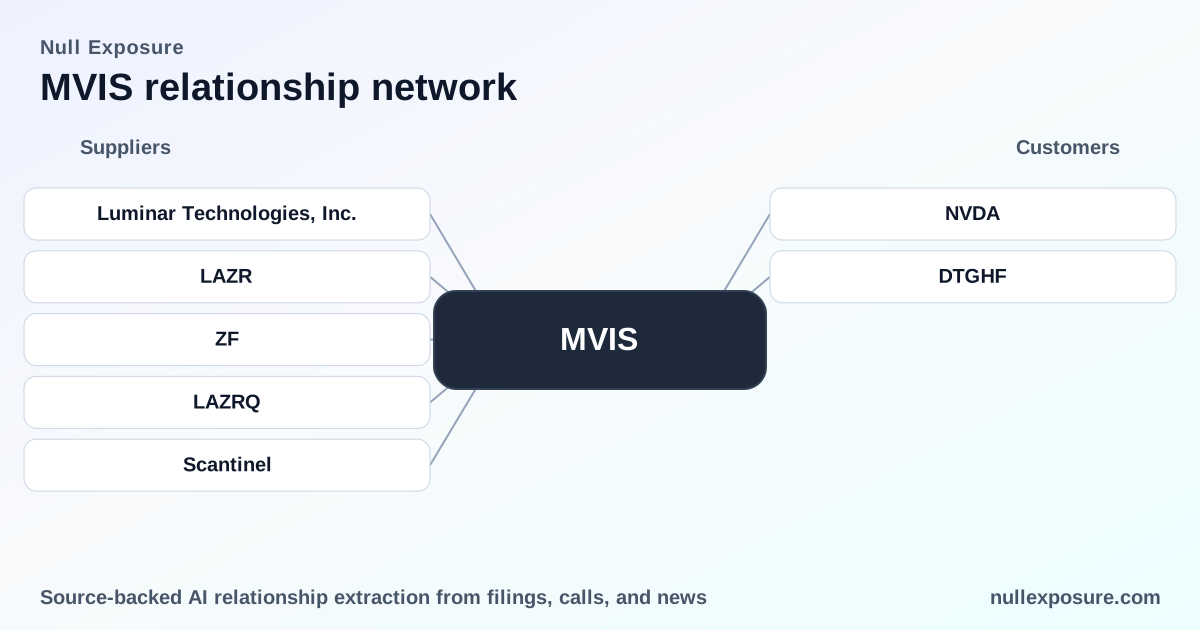
MicroVision (MVIS) — Supplier relationships, strategic moves, and what investors should price in
MicroVision monetizes by selling lidar perception hardware and integrated perception solutions to the automotive, mobility and defense sectors, and by converting intellectual property and acquired product lines into revenue through product sales, services, and production contracts. The company funds growth through strategic asset acquisitions and production commitments that shift it from a pure-research vendor toward a manufacturing and supply-partner posture. Investors should value MVIS as a small but strategic lidar manufacturer that is building recurring production streams while absorbing integration and single-source supplier risks. For more structured supplier and counterparty intelligence, visit https://nullexposure.com/.
A concise investment thesis up front
MicroVision is transforming from a technology IP developer into a vertically integrated supplier by acquiring complementary lidar assets and closing production deals with automotive partners. Revenue will increasingly depend on production contracts and the commercial deployment of acquired product lines, rather than licensing alone. That transition increases near-term capital intensity and execution risk but creates a clearer path to scale if the company converts development wins into volume production.
(If you want a deeper supplier map and contract-level detail, see our resources at https://nullexposure.com/.)
What the Luminar asset purchase changes on the cap table and roadmap
MicroVision announced an agreement to acquire specified lidar assets from Luminar Technologies in early March 2026, including IP, inventory tied to the Iris and Halo sensors, key engineering and operations personnel, and certain commercial contracts and orders. Multiple press reports and the company announcement described the deal as an Asset Purchase Agreement for roughly $33 million in cash plus assumption of certain liabilities, executed through Luminar’s bankruptcy process under Section 363. According to the company release and contemporaneous coverage, the transaction is intended to broaden MicroVision’s lidar product lineup and accelerate commercial traction. (See MicroVision press release via Access Newswire and the Yahoo Finance summary, both dated March 10, 2026; TradingView and SahmCapital coverage in March 2026.)
Why it matters: the Luminar assets convert market-validated product designs and order backlogs into MicroVision-owned inventory and customer relationships, shortening time-to-revenue for mid-range and long-range lidar segments and adding immediate engineering headcount.
ZF: production commitment that underwrites early volume
MicroVision references a production commitment with ZF that underpins high-volume deliveries and supports a $30–$50 million revenue range over the next 12–18 months from the perspective disclosed in a company update. The company also stated that inventory for the MOVIA L product was built from the ZF automotive-grade product line in France, indicating an operational relationship that includes supply chain, quality and production alignment with an established automotive Tier 1. (See MicroVision Q1 2025 results press release and Q3 2025 earnings call excerpts; reporting surfaced in Newswire and an earnings transcript in 2025/2026.)
Why it matters: ZF provides a credible manufacturing and regulatory channel into OEM programs, converting MicroVision’s product capability into signed production commitments. That relationship materially increases revenue predictability versus early-stage R&D contracts.
Scantinel: plugging a technology gap for long-range physics
MicroVision has publicly discussed integrating Scantinel’s 1550 nm FMCW long-range lidar technology with MicroVision’s existing 905/940 nm time-of-flight portfolio to create a broader product stack for passenger, commercial and defense use cases. Analysts and update narratives highlight that the combination aims to improve product mix and earnings power as programs move into production. (See updated coverage aggregated in March 2026 via industry commentary and the SimplyWall.St narrative.)
Why it matters: the Scantinel integration is a product-line extension that addresses long-range sensing physics and opens higher-value program opportunities, particularly in defense and commercial vehicle segments that prize range and wavelength diversity.
Relationship-by-relationship roundup (concise, sourced)
- Luminar Technologies, Inc.: MicroVision agreed to acquire specified lidar sensor assets, IP, inventory, and certain contracts and personnel from Luminar in a transaction announced March 10, 2026; the purchase price disclosed in multiple outlets was approximately $33 million, executed through Luminar’s bankruptcy process. (See MicroVision press release on Access Newswire and the Yahoo Finance coverage, March 10, 2026; TradingView and SahmCapital reporting in March 2026.)
- ZF: MicroVision’s production commitment with ZF enables commitments to high-volume deliveries and supports a projected revenue range in the tens of millions over the near term; inventory for MOVIA L was built from ZF’s automotive-grade line in France. (See MicroVision first quarter 2025 results press release and Q3 2025 earnings call transcript, filings and press coverage in 2025/2026.)
- Scantinel: Integration of Scantinel’s 1550 nm FMCW long-range lidar with MicroVision’s 905/940 nm stack creates a full-stack offering designed for passenger, commercial and defense programs and is positioned to drive higher-value program mix as production ramps. (See industry narrative coverage in March 2026, including SimplyWall.St.)
Operating-model constraints and what they signal for investors
MicroVision’s public disclosures and excerpts point to several company-level operating characteristics:
- Contracting posture — longer-term production commitments exist. A filing disclosed remaining future minimum payments of approximately $6.3 million expected through 2025 and 2026, which is consistent with longer-term payment profiles rather than purely spot purchasing.
- Supplier concentration and manufacturing role. The company has historically relied on single- or limited-source suppliers for critical components (MEMS, MEMS die, ASICs), indicating a manufacturer role with concentrated upstream dependencies and limited supplier redundancy.
- Spend scale and financial profile. The company-level signal for supplier spend is in the $1M–$10M band, consistent with the disclosed future minimum payments and the company’s stage — material for a small cap but modest relative to Tier-1 OEM budgets.
Collectively, these constraints imply a company that is shifting into production with concentrated but contractually-backed spend, which elevates execution and supplier concentration risk while improving revenue visibility if production commitments are fulfilled.
Investment implications and risk checklist
Key implications:
- Upside if integration and production scale succeed — Luminar assets and the ZF production commitment create a clearer route to revenue growth and margin expansion as program cadence shifts from development to volume.
- Execution and supplier concentration are primary risks. Single-source components and the need to industrialize newly acquired product lines create near-term operational risk and capital intensity.
- Valuation sensitivity to conversion of contracts into funded production. Market multiples should reflect the binary nature of converting product wins and asset acquisitions into steady production revenue.
If you want supplier-level risk scores and contract timelines mapped to cashflow scenarios, explore our supplier intelligence hub at https://nullexposure.com/ for tailored reports.
Bottom line and next actions for investors
MicroVision’s acquisition of Luminar assets, an active production commitment with ZF, and a technology integration with Scantinel reposition the company from a pure-tech developer toward a manufacturing supplier with greater revenue visibility but higher execution requirements. Investors should price in integration execution, single-source supplier risk, and near-term capital needs, while valuing the tangible upside from converted orders and production agreements.
For a focused supplier-risk briefing or to commission a counterparty deep-dive on MVIS relationships, visit https://nullexposure.com/ and request the MicroVision supplier dossier.