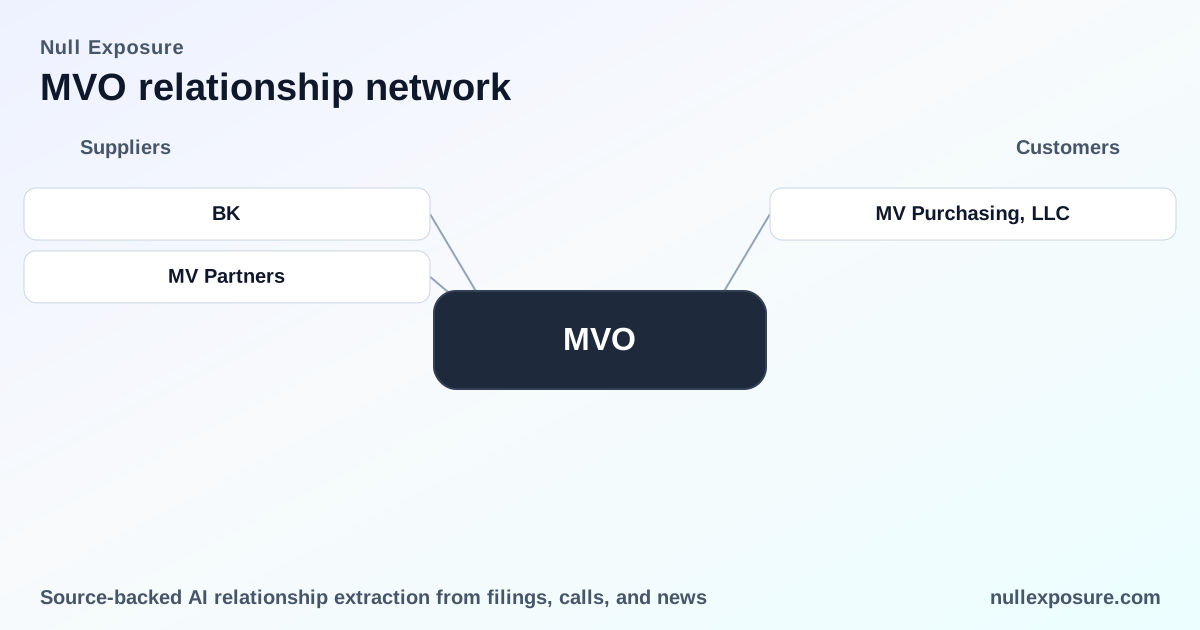
MVO supplier relationships: where costs, control and counterparty risk live
Thesis: MV Oil Trust (MVO) monetizes legacy oil and gas interests by collecting net profits from a portfolio of mature Mid‑Continent properties while outsourcing day‑to‑day operations and administration to third parties; the trust’s economics are driven by fixed contractual service charges to MV Partners and trustee services from BNY Mellon, creating predictable expense lines but concentrated operational dependence. Learn more or request deeper relationship analytics at https://nullexposure.com/.
How MVO runs the business and why suppliers matter
MVO is structured as a trust that receives net profits from oil and gas properties and then distributes proceeds to unitholders. The trust outsources core back‑office functions and operational activity, which converts variable field execution and operating risk into relatively predictable service spend lines. That outsourcing creates two investor realities: (1) cost visibility (explicit fees reported annually and by operator‑level charges) and (2) counterparty concentration (material reliance on a small set of named providers for administration and trust services). For a capital allocater, those features reduce some operational uncertainty but amplify counterparty and contract risk that should be priced alongside commodity exposure.
Known supplier relationships and what they do for MVO
MV Partners — the operating and administrative anchor
MV Partners is the trust’s contracted administrative service provider and also functions as an operator on affected wells; the trust pays MV Partners a quarterly administrative services fee for accounting, bookkeeping and informational services, and the operator‑basis charges produced approximately $3.6 million in 2024 for properties MV Partners operated. According to the trust’s FY2024 reporting (SEC 10‑Q summarized on TradingView), the annual administrative fee was $121,549 for 2024 and administrative fees escalate by 4% each year. The same FY2024 filing describes the underlying properties as being operated on a contract operator basis with MV Partners performing engineering, accounting and administrative functions. (Source: Trust SEC 10‑Q, FY2024, reported on TradingView.)
The Bank of New York Mellon Trust Company, N.A. — trustee and distribution agent
The Bank of New York Mellon Trust Company, N.A. serves as Trustee for the trust and is named in distribution communications and filings; the trustee role is referenced in the trust's distribution announcement and in expense disclosures within SEC filings. A BusinessWire distribution announcement in January 2026 explicitly names BNY Mellon as Trustee in the context of the trust’s fourth‑quarter distribution, and the trust’s FY2024 SEC disclosures also list payments to the trustee among reported expenses. (Sources: BusinessWire press release, January 2026; Trust SEC 10‑Q, FY2024, reported on TradingView.)
Contracting posture, concentration and operational maturity — how constraints shape risk
MVO’s supplier relationships reveal a distinct operating model profile that matters for investors assessing supplier credit and continuity risk:
-
Long‑term contracted services with explicit fee mechanics. The trust has a written administrative services agreement with MV Partners that obligates quarterly payments for the term of the trust and terminates only on termination of the net profits interest or by mutual agreement, which creates predictable expense runs and raises the cost of switching providers. (Company signal: long_term contract_type drawn from FY2024 filings.)
-
Concentration of critical functions. MV Partners provides both administrative services and acts as contract operator for many underlying wells; this dual role concentrates operational criticality in a single supplier rather than distributing functions across multiple vendors. (Company signal: relationship_role = service_provider; multiple evidence excerpts in FY2024 filing.)
-
Mature asset base increases sensitivity to operating economics. The underlying properties are mature, with many in production since the early 1900s, which increases sensitivity to commodity price movements and operating cost escalation; mature assets also increase the importance of skilled operations and maintenance from the contracted operator. (Company signal: relationship_stage = mature.)
-
Spend profile is material and bifurcated. Reported expense lines show two distinct spend bands: an administrative fee in the low six figures ($121,549 in 2024) and operator‑basis charges measured in multiple millions (totaled $3.3M in 2022, $3.4M in 2023 and $3.6M in 2024 for MV Partners‑operated properties). That split means supplier disputes or cost shocks could be meaningful relative to distributable cash. (Company signal: spend_band = 100k–1M and 1M–10M.)
What investors should watch next
-
Monitor any amendments or termination language for the administrative services agreement with MV Partners: a long‑term contract is only protective if counterparties remain solvent and operationally capable. The fee escalation (4% annual increase) is also a structural cost tail that reduces distributable cash in sustained low‑price scenarios.
-
Track BNY Mellon’s trustee disclosures and any changes in trustee fees or practices. Trustee continuity is operationally low‑frequency but high‑impact for distributions and administrative controls.
-
Watch operator performance metrics and well‑level production trends in the Mid‑Continent region (Kansas, Colorado). Given the mature footprint, small changes in production or maintenance spend can have outsized effects on net profits.
If you need a focused counterparty risk brief or contract‑level exposure mapping for MVO, visit https://nullexposure.com/ to request a custom analysis.
Investment implications and a short checklist for diligence
-
Cash‑flow predictability vs counterparty concentration. The trust’s fixed fee arrangements provide predictable expense recognition, which helps near‑term modeling, but reliance on MV Partners for both operator and admin functions adds bilateral operational dependency.
-
Expense escalation is structural. The administrative fee escalator (4% per year) and multi‑million operator charges represent recurring outflows that reduce leverage capacity and distributable earnings during commodity drawdowns.
-
Operational criticality warrants operational diligence. Investors should add supplier operational KPIs and contractual termination clauses to their standard diligence playbook for MVO exposures.
For a commissioned supplier‑risk memo or to explore how these supplier dynamics affect portfolio allocation, go to https://nullexposure.com/ and request a tailored briefing.
Bottom line
MVO’s supplier architecture is simple, visible and concentrated: MV Partners supplies essential operating and administrative services under a long‑term contract with explicit fees, while BNY Mellon provides trustee functions tied to distributions. That structure trades some operational unpredictability for concentrated counterparty risk — a trade investors must quantify alongside commodity exposure when valuing the trust.