MaxCyte (MXCT): Supplier relationships, concentration risks and what investors should do next
MaxCyte sells high-value cell-engineering instruments and consumables built around its proprietary Flow Electroporation® platform and monetizes through a hybrid model of equipment sales, recurring reagent/consumable revenue, and fee-for-service collaborations with biopharma partners. The company captures value by placing scalable instruments into partner labs and then selling the consumables and development services that support therapeutic programs — a model that generates durable upside if installed base growth and partner pipeline activity scale. For a more complete vendor risk view, see https://nullexposure.com/.
How MaxCyte’s supplier posture underpins its commercial model
MaxCyte’s business relies on two distinct supply streams: precision instrument components (electronics, custom parts) and clinical/production-grade consumables. Instruments are capital-intensive, lower-frequency revenue drivers; consumables deliver recurring, higher-margin annuity-like revenue. That split creates a supply dependency profile where single-source weaknesses in instrument components can constrain growth or delay customer shipments, while interruptions in consumables supply directly affect recurring revenue traction and contract performance.
MaxCyte’s public profile shows high institutional ownership and analyst buy-side support, but operating profitability remains negative and top-line growth is modest, so supplier disruptions would have an outsized impact on near-term cash flow and the company’s ability to execute commercialization milestones. For vendor risk benchmarking and monitoring tools, visit https://nullexposure.com/.
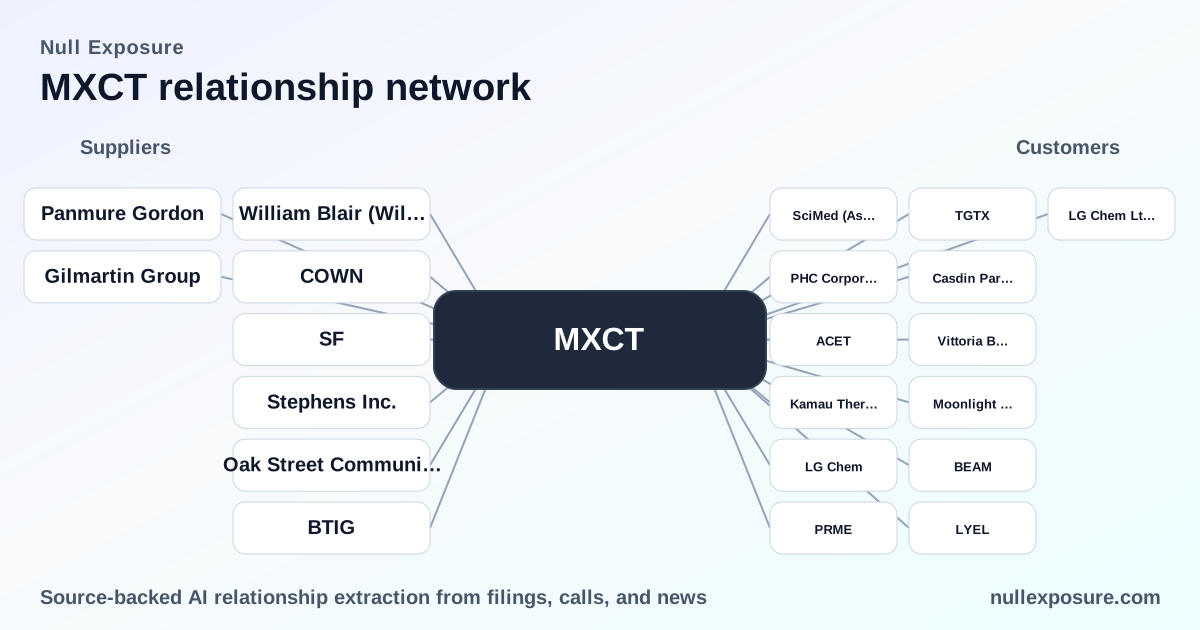
Who MaxCyte is working with (documented relationships)
Below are every named relationship surfaced in the recent public releases relevant to MaxCyte’s supplier and underwriting activities, with concise plain-English summaries and source references.
William Blair
William Blair acted as a joint book-running manager and representative of the underwriters for MaxCyte’s upsized offering tied to the company’s approval to list on the Nasdaq Global Select Market. This positions William Blair as a lead financial intermediary on MaxCyte’s capital markets activity. According to a PR Newswire release on March 10, 2026, William Blair was among the joint book-runners for the offering.
Cowen
Cowen served alongside William Blair and Stifel as a joint book-running manager and underwriter representative on the same offering, executing capital markets placement activities for MaxCyte. The PR Newswire release dated March 10, 2026 lists Cowen as a joint book-running manager.
Stifel
Stifel participated as a joint book-running manager and underwriter representative for MaxCyte’s upsized offering and Nasdaq listing approval, handling placement and distribution responsibilities. This is documented in the PR Newswire release on March 10, 2026.
Stephens Inc.
Stephens Inc. served as a co-manager on the offering, supporting syndicate distribution and marketing efforts around MaxCyte’s equity transaction. The role is described in the PR Newswire announcement dated March 10, 2026.
BTIG
BTIG acted as a co-manager on MaxCyte’s offering, taking part in syndicate duties to place the upsized equity issuance. PR Newswire coverage from March 10, 2026 lists BTIG among the co-managers.
Panmure Gordon
Panmure Gordon served as the company’s nominated adviser consulted by MaxCyte’s independent directors; the independent directors concluded the related-party transaction terms were fair and reasonable after consulting Panmure Gordon. The PR Newswire release (March 10, 2026) references Panmure Gordon’s role in that governance consultation.
Oak Street Communications
Oak Street Communications is referenced as MaxCyte’s media contact for financial reporting and press releases, handling media relations for the company’s Q4 and full-year 2025 preliminary results. The GlobeNewswire posting syndicated by The Globe and Mail on March 10, 2026 lists Oak Street Communications as media contact.
Gilmartin Group
Gilmartin Group is MaxCyte’s investor relations advisor, cited as the IR contact for the company’s financial results and investor communications for Q4 and full-year 2025. MarketScreener and GlobeNewswire items from March 10, 2026 identify Gilmartin Group as investor relations counsel.
What the supplier constraints reveal about operational risk
MaxCyte’s own disclosures present company-level signals of supply concentration and single-source dependencies rather than relationship-specific constraints.
- The company reported that approximately 56% of purchases for the year ended December 31, 2023 were from a single supplier, a clear concentration that elevates procurement risk and bargaining leverage against MaxCyte. This is a company-level disclosure you must treat as material when modeling downside scenarios.
- For the year ended December 31, 2024, around 16% of additions to inventory were sourced from one supplier, reinforcing an ongoing concentration in the supply chain.
- MaxCyte states it maintains relationships with multiple custom parts manufacturers and electronics suppliers, but some instrument components continue to be provided by a single source, which makes instrument manufacture partially single-sourced.
These constraints drive several actionable inferences for investors and operators: contracting posture is defensive and supplier-dependent; concentration is high; supplier criticality is acute for instruments and moderately acute for consumables; maturity of the supplier network is mixed—MaxCyte has multiple suppliers, but critical single-source components persist. For structured supplier risk tracking and scenarios, see https://nullexposure.com/.
Investment implications and operational priorities
MaxCyte’s model delivers recurring revenue potential but operationally is sensitive to supply interruptions. Key investment signals:
- High supplier concentration is a clear single-point-of-failure risk that can disrupt instrument shipments and revenue recognition.
- The company is capital-market active — several reputable banks and brokers underwrote a recent upsized offering — which strengthens liquidity in the near term but does not substitute for supply redundancy.
- MaxCyte’s financials show negative EBITDA and limited scale (market cap ≈ $86.5M, revenue TTM ≈ $34.4M), so supplier shocks would compress cash runway and investor sentiment rapidly.
Operators should prioritize dual-sourcing for critical components and greater inventory buffers for consumables tied to contracted partner programs. Investors should stress-test cash flow and revenue scenarios assuming partial fulfillment delays.
Bottom line and next steps for due diligence
MaxCyte’s growth is real but supply concentration is a material risk that investors must price explicitly. The company’s advisor and underwriting relationships are high quality and support capital access; however, control of the manufacturing and parts supply chain is the operational lever that will determine whether recurring consumable revenue scales as forecast.
- If you are evaluating exposure to MaxCyte, incorporate supplier-concentration scenarios into valuation and covenant tests.
- For procurement or partnership diligence, request documentation of second-source timelines, lead times, and inventory policy for the components representing the 56% and 16% disclosures.
For an actionable vendor-risk briefing and ongoing monitoring, go to https://nullexposure.com/. If you want tailored surveillance across MaxCyte’s supplier network and capital markets counterparties, start at https://nullexposure.com/.