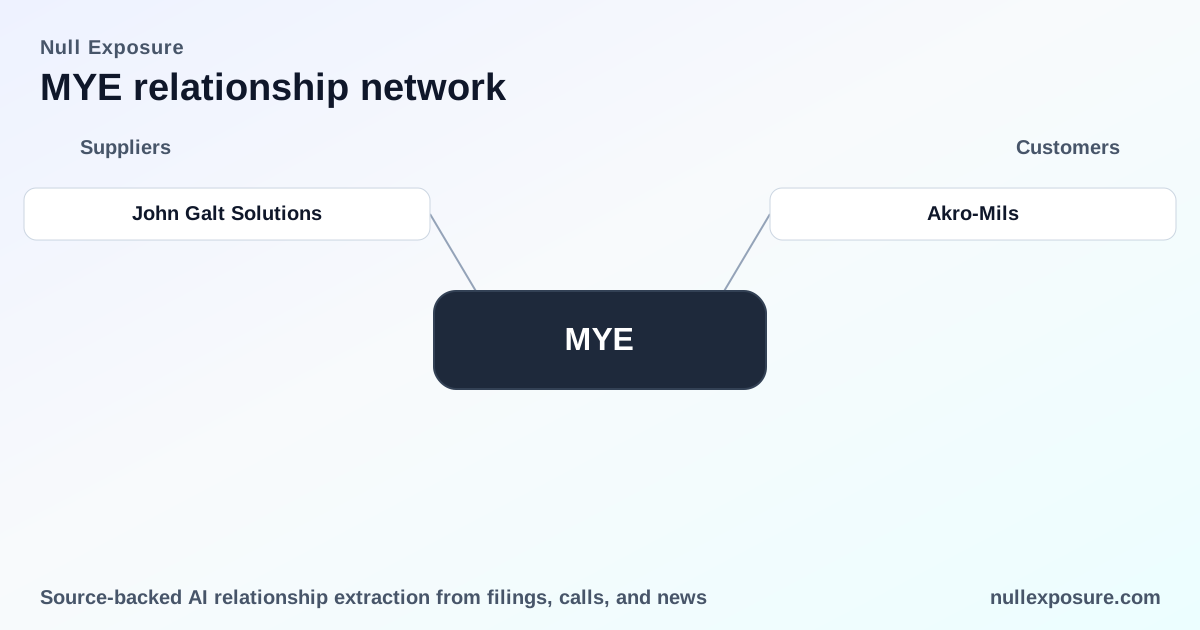
Myers Industries (MYE) — Supplier Relationship Profile and Investment Implications
Myers Industries manufactures and sells polymer-based products across industrial, agricultural, automotive, commercial and consumer markets and monetizes by scaling manufacturing throughput, selling differentiated molded and resin-based products, and capturing aftermarket and replacement demand through distribution channels. Supplier relationships are a key operational lever because raw-material resin supply, logistics into North America, and selected service partnerships affect cost of goods sold, margin stability and the company’s ability to standardize processes across business units. For a concise, investor-grade supplier view, visit https://nullexposure.com/.
The business model in plain English: where suppliers sit in the P&L
Myers is a manufacturing-first company: raw materials (primarily plastic resins) flow into production and finished products ship to a wide mix of industrial and consumer end markets. The company generates roughly $826 million in trailing revenue with operating margin near 10% and an EV/EBITDA multiple around 9.7x — a profile consistent with a mid-cap industrial supplier with moderate cyclicality. Because Myers purchases substantially all of its raw materials from third parties, procurement cost and continuity directly influence gross margin and output cadence, while investments in planning and enterprise systems are the mechanism to extract incremental operational efficiency.
Visit https://nullexposure.com/ for a full supplier-focused due diligence brief.
The John Galt Solutions relationship — what was announced
John Galt Solutions implemented its Atlas Planning Platform at Myers to standardize planning processes and support growth across separate business units, according to a Newswire release dated March 10, 2026. This engagement is an enterprise software deployment intended to improve cross-unit planning and forecasting at Myers, which should reduce working-capital friction and improve production scheduling. (Newswire, March 10, 2026: https://www.newswire.com/news/myers-industries-turned-to-john-galt-solutions-to-transform-and-22429266)
Takeaway: this is a service/technology partnership focused on operational efficiency rather than a raw-material supply contract.
How company-level constraints shape supplier exposure
The record includes several company-level signals that frame how investors should think about supplier risk and strategic posture.
- Long-term contracting posture: Myers is a party to a multi-year loan agreement (Seventh Amended and Restated Loan Agreement, dated September 29, 2022), which signals a degree of financial maturity and multi-year planning embedded in capital structure documents. This is a corporate-level indicator of planning horizon rather than a supplier contract.
- North American centered supply chain: deliveries of materials and supplies are primarily by commercial truck from U.S. and Canadian suppliers, with rail used for resin at certain plants — a geography profile that concentrates logistics risk in North America but reduces intercontinental shipment exposure.
- Supplier materiality profile: broadly dispersed: Myers states that the loss of any single supplier would not be materially adverse in most cases, though certain specialty resin grades have limited suppliers and short-term capacity disruptions are possible. This suggests low supplier concentration overall with pockets of criticality for specific resin types.
- Buyer-first relationship role: Myers purchases substantially all raw materials from third-party suppliers, underscoring the company’s exposure to commodity resin markets, freight and vendor performance.
- Use of third-party service providers: the company engages independent auditors and other professional service firms and discloses fees and pre-approval policies — conventional governance signals rather than operational dependency.
These constraints are company-level signals and not specific to any one vendor unless the underlying excerpt names that vendor.
Operational implications for investors and operators
The John Galt deployment and the company-level constraints together outline a practical risk/reward map:
- Efficiency upside through systems: implementing a standardized planning platform across business units directly addresses inventory, forecasting and scheduling inefficiencies. For operators, expect incremental working-capital release and smoother production runs; for investors, this translates into potential margin expansion and a healthier working-capital cycle.
- Commodity and logistics risk persist: the company’s buyer posture and North America-centric delivery model mean input-cost volatility (resin prices) and trucking capacity are first-order risks to gross margin. While Myers signals low supplier concentration, certain resin grades remain a critical single-source risk.
- Capital structure supports multi-year operational planning: the presence of an amended and restated loan agreement indicates financing continuity that allows Myers to invest in systems and process improvement without immediate refinancing pressure. This is a supportive backdrop for multi-year operational programs like Atlas.
If you want a deeper supplier-by-supplier walk-through or to monitor supplier announcements, see the full supplier coverage at https://nullexposure.com/.
What this means for risk-adjusted valuation
Myers’s current multiples (forward PE ~13.9, EV/EBITDA ~9.7x) price in a degree of operational normalcy but leave room for improvement if systems wins and better procurement execution materialize. Key variables that would move the valuation are real reductions in working capital, stabilization of resin input costs, and demonstrable margin gains from planning standardization. Conversely, a shock to specialty resin availability would pressure near-term margins and working capital.
Practical next steps for investors and procurement teams
- For investors: track operational KPIs tied to the John Galt rollout — days of inventory, forecast accuracy and working-capital turns — as early signals of realized benefit.
- For operators: accelerate capture of planning KPIs and create supplier contingency plans for specialty resin grades to mitigate single-source risk.
- For analysts: monitor procurement cadence and freight metrics given the North American delivery footprint; persistent cost pressure there should be visible in gross-margin trends.
Final thought: Myers is positioned like a classic industrial operator — supplier relationships are broadly non-material in the aggregate but critical at the resin-grade level; enterprise systems deployments such as the John Galt engagement are the pragmatic levers that convert operational improvements into shareholder value. For an investor-grade dossier and ongoing supplier monitoring, visit https://nullexposure.com/.
Sources referenced in this note include the March 10, 2026 Newswire release on the John Galt Solutions implementation and Myers Industries’ public filings and disclosures describing its loan agreement, supply logistics and supplier materiality language.