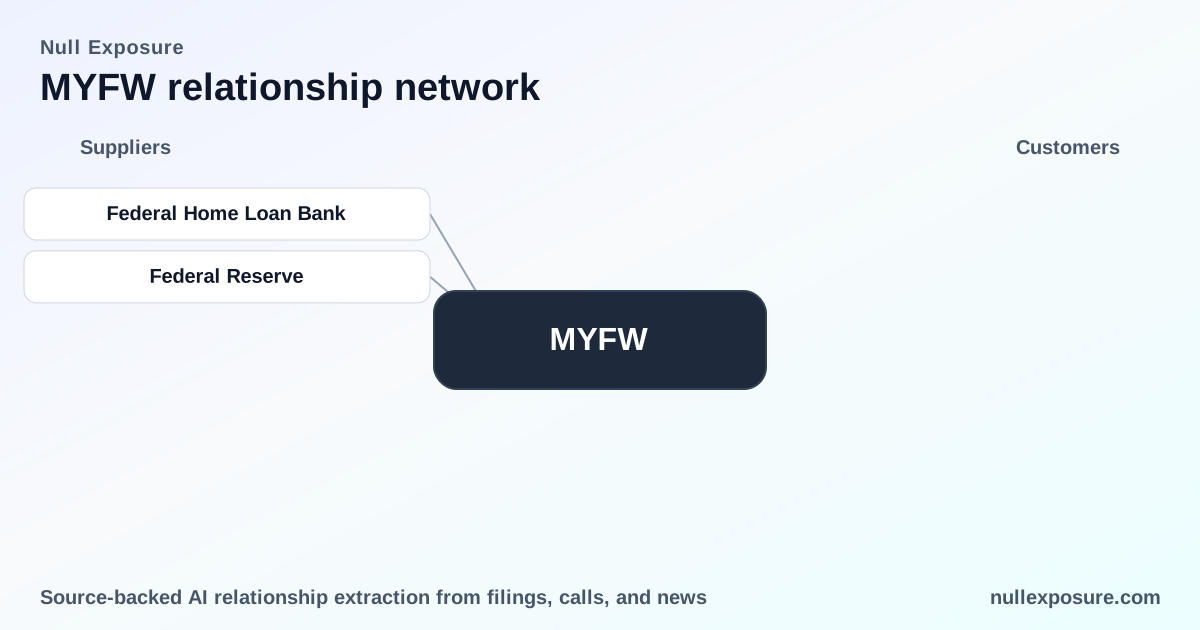
First Western Financial (MYFW): How two short-term funding relationships shape liquidity and risk
First Western Financial operates as a regional financial holding company, monetizing through a mix of interest-bearing lending and deposit spreads, private banking and trust fees, and asset management fees. Its balance-sheet funding strategy relies in part on wholesale borrowings from central credit providers; those funding lines and associated hedges materially influence liquidity dynamics and interest-rate sensitivity. For investors and operators evaluating supplier and counterparty relationships, the precise terms, maturities and hedge posture with Federal Home Loan Bank and Federal Reserve facilities are essential inputs to cash-flow and stress scenarios. Explore deeper coverage and supplier-risk analytics at https://nullexposure.com/.
Two lenders, one consolidated story: why these relationships matter to shareholders
First Western disclosed a rapid reduction in combined borrowings from the Federal Home Loan Bank (FHLB) and the Federal Reserve between June and September 2025, and it runs an interest-rate hedge expressly tied to FHLB borrowings. These elements drive three practical consequences for investors: funding cost volatility, near-term maturity concentration, and hedge effectiveness that influences net interest income.
Federal Home Loan Bank — a hedged, explicit funding source
First Western reported that FHLB borrowings are part of a wholesale funding package that fell to a combined $50.9 million as of September 30, 2025. The company also documented an interest-rate swap executed March 21, 2023 with a $50.0 million notional designated as a cash-flow hedge of certain FHLB borrowings, hedging SOFR (receive float/pay fixed) through April 1, 2026. This establishes a long-term contracting posture around FHLB exposure and creates a defined maturity point when hedge and associated borrowings both converge. According to the company’s third-quarter 2025 press release (Oct 23, 2025) and the company’s prior disclosures, the FHLB relationship is both a funding and hedging focal point for the bank. (Source: First Western press release, Oct 23, 2025; company disclosure on swap execution and notional as reported in annual filings through Dec 31, 2024.)
Federal Reserve — an ancillary but materially reported backstop
First Western disclosed Federal Reserve borrowings as part of the same combined $50.9 million outstanding at September 30, 2025, down from $163.4 million as of June 30, 2025. The Federal Reserve exposure is reported alongside FHLB borrowings in the company’s third-quarter 2025 release, establishing the Fed as a material, short-term liquidity provider during periods of elevated funding needs. While the interest-rate swap is explicitly tied to FHLB borrowings in company disclosures, the combined reporting shows the Fed facility is a functional component of First Western’s wholesale funding posture. (Source: First Western press release, Oct 23, 2025.)
What the contracts and constraints tell investors about operating posture
The company-level disclosures and the swap documentation produce clear signals about First Western’s business model and supplier risk:
- Contracting posture — long-term hedge on a discrete piece of wholesale funding. The interest-rate swap executed in March 2023 and designated as a cash-flow hedge runs into April 2026, signaling multi-year management of interest-rate exposure for the FHLB borrowing it covers.
- Maturity concentration — a near-term cliff for hedge and funding. With the swap terminating April 1, 2026 and borrowings already reduced sharply, the company faces a defined decision point where funding and hedge strategy must be reset.
- Concentration and criticality — wholesale lines are non-trivial relative to balance-sheet size. A swing from $163.4 million to $50.9 million in a quarter changes liquidity buffers materially and demonstrates that wholesale funding is a lever the company uses aggressively.
- Maturity and transition risk — roll or replace at prevailing rates. As hedges roll off and funding balances shift, net interest margin and liquidity coverage will be sensitive to market funding costs and deposit behavior.
These are company-level constraints derived from public disclosures; the swap excerpt explicitly links hedging to FHLB borrowings, allowing attribution for that relationship. For readers who want a consolidated vendor-risk dashboard and claim-level visibility, visit https://nullexposure.com/ for direct access to supplier analytics.
Financial context that amplifies relationship importance
First Western’s balance-sheet and operating metrics provide context for how impactful these wholesale relationships are to equity holders. The company had trailing twelve‑month revenue of about $97 million, a market capitalization near $236 million, a price-to-book of roughly 0.89, and return on equity around 5.1% as of the latest quarter (2025). Given modest ROE and tight margins, wholesale funding swings and hedge results will flow directly into net interest income and short-run earnings variability. These figures are drawn from the company’s latest public filings and quarter-end disclosures.
Practical investor takeaways and recommended actions
- Monitor the April 2026 horizon: the swap maturity creates a discrete event where funding strategy and hedging posture must be updated; investors should stress-test scenarios for roll costs and deposit retention.
- Watch funding balances quarterly: the $112.5 million decline in combined borrowings between June and September 2025 shows the company can materially change its wholesale funding posture within a single quarter; tracking this provides an early signal of liquidity management choices. (Source: First Western press release, Oct 23, 2025.)
- Treat FHLB as a core supplier: the explicit hedge linkage makes the FHLB relationship operationally critical rather than peripheral; any change to access or terms would have immediate earnings and liquidity implications.
- Incorporate hedge effectiveness into earnings models: the receive-float/pay-fixed swap tied to SOFR will influence net interest margins as SOFR and fixed-rate curves move.
If you manage counterparty risk or allocate capital to regionals, ensure your scenario models incorporate the hedge maturity profile and historical volatility in wholesale borrowings. For a centralized view of supplier exposures and event-driven alerts, visit https://nullexposure.com/.
Closing assessment
First Western’s supplier footprint for wholesale funding is compact but strategic: two central credit lines (FHLB and Federal Reserve) that have been actively managed and hedged. The combination of a $50.0 million hedge tied to FHLB borrowings and a sharp quarter-over-quarter reduction in combined borrowings creates a clear near-term focus for operators and investors. The structural signal is simple and actionable—funding strategy and hedge renewals, not core operating margins, will drive the next phase of earnings volatility. For ongoing monitoring and supplier relationship intelligence, check the full supplier insights at https://nullexposure.com/.