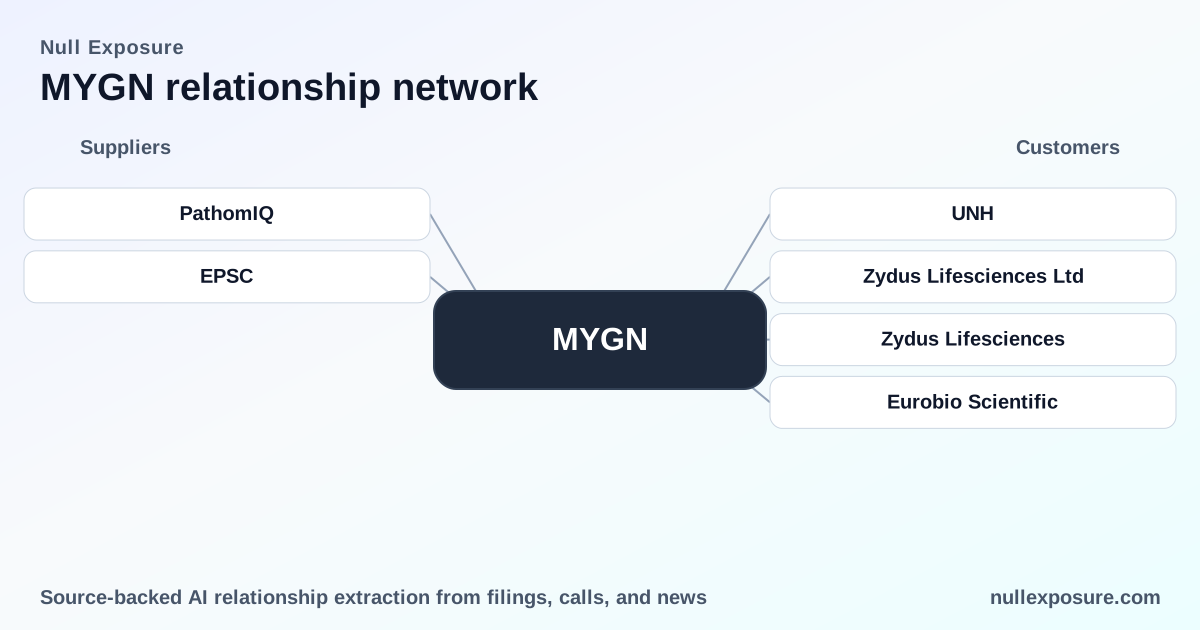
Myriad Genetics (MYGN): supplier relationships and what they mean for investors
Myriad Genetics operates a diagnostics business that monetizes through clinical laboratory testing, diagnostic kits, and companion digital assessments sold to providers, health systems, and patients. Revenue is generated when tests are ordered and processed; the company leverages proprietary assays (e.g., Prolaris) and clinical workflows integrated into electronic medical records to drive volume. For a focused read on supplier risk and partner signals, visit the NullExposure homepage: https://nullexposure.com/.
How Myriad’s business works in practice
Myriad is a molecular diagnostics company that bills for tests, retains gross margins from lab work, and invests in product extensions (AI-enhanced assays, EMR integrations) to grow utilization. Trailing revenue is $824.5M with gross profit of $576.6M, yet the company shows negative net income and EBITDA, signaling operational leverage where volume trends and partner-driven workflow improvements materially affect cash flow. Analysts are mixed: consensus target around $7.78, and forward PE of ~46x implies growth expectations despite current negative EPS.
Supplier and partner relationships called out in disclosures
PathomIQ — an AI partner for Prolaris (GlobeAndMail / Motley Fool, March 10, 2026)
Myriad stated it is on track to launch an AI-enhanced Prolaris prostate cancer test in Q2 that combines molecular and AI analysis based on its partnership with PathomIQ, positioning this partner as a technology collaborator on a core oncology product line. Source: Q4 2025 earnings transcript republished by The Globe and Mail / Motley Fool (March 10, 2026).
PATHOMIQ — same partnership noted in the Myriad earnings call transcript (InsiderMonkey, March 10, 2026)
The company repeated on the earnings call that the Prolaris AI upgrade is based on a partnership with PATHOMIQ, reinforcing PathomIQ’s role as a product-development supplier rather than a distribution channel. Source: Q4 2025 earnings call transcript posted at InsiderMonkey (March 10, 2026).
Epic — EMR integration to drive test identification and volumes (InsiderMonkey, March 10, 2026)
Myriad referenced an integration of its MyGeneHistory assessment into Epic in September, which is designed to improve provider identification of patients eligible for hereditary testing and to streamline the ordering workflow—an operational relationship that directly supports test volume growth. Source: Q4 2025 earnings call transcript posted at InsiderMonkey (March 10, 2026).
What the constraints say about Myriad’s operating model
Myriad’s supplier constraints—drawn from its disclosures—paint a coherent picture of a diagnostics operator with concentrated and operationally critical supplier relationships:
- Long-term contracting posture: The company discloses leases with multi-year terms (example: a 12‑year lease), indicating long-horizon capital commitments for lab space and fixed-cost infrastructure.
- Concentration and single-source risk: Disclosures flag that single-source suppliers can be disruptive, which is a direct signal that key inputs (equipment, specialized reagents) are concentrated and critical to throughput.
- Logistics dependency: Myriad relies on commercial courier services to move biological specimens; disruptions in courier networks are presented as materially harmful to testing continuity.
- Third-party specimen collection and phlebotomy: The business outsources specimen collection in some regions to third‑party labs and clinics, which creates operational dependency on service providers for end-to-end testing logistics.
- Hardware and specialty reagent reliance: The company depends on a small set of suppliers for sequencing machines, enrichment hardware, robotics, and specialty reagents, underscoring hardware and consumable concentration risk.
- Third‑party IT and cloud hosting reliance: Myriad uses external IT, including cloud-based hosting and data centers, introducing continuity and security dependencies outside its direct control.
These are company-level signals; none of the constraint excerpts explicitly bind a particular constraint to PathomIQ or Epic, so treat these as broad supply-chain and infrastructure characteristics rather than relationship-specific limitations.
Why these relationships matter to valuation and operational risk
- PathomIQ partnership is a product catalyst. The AI-enhanced Prolaris release is a high-impact product extension for a core oncology franchise; commercialization success will influence utilization, pricing power, and future margin expansion. This makes PathomIQ strategically significant as a technology supplier.
- Epic integration is a volume lever. Embedding MyGeneHistory into Epic’s EMR is a direct mechanism to increase test identification and ordering—a workflow improvement that converts into measurable revenue upside if adoption and clinician behavior change follow through.
- Supply and logistics exposure compresses optionality. The company’s dependence on single-source hardware, specialty reagents, couriers, and third-party collection implies that operational disruptions translate quickly into revenue and margin swings, which is especially consequential given Myriad’s negative profitability and operating leverage.
For deeper supplier risk profiles and to track partner signal changes over time, visit NullExposure: https://nullexposure.com/.
Investment implications — actionable takeaways
- Positive read: Partnerships with PathomIQ and Epic are constructive; they target two levers that move revenue—product innovation and improved clinical workflow—and can accelerate recovery in utilization. These are value-creating tie‑ups when executed effectively.
- Risk read: The company’s high supplier concentration, logistics dependencies, and outsourced specimen collection are structural risks that amplify downside when operations are disrupted; these risks are salient given Myriad’s negative margins and high operating leverage.
- Valuation lens: Given the current market cap and negative EPS, investor returns will be driven by volume recovery, successful commercialization of AI-enhanced assays, and stability of third‑party supply/logistics. The company’s forward multiple implies a growth narrative that depends on these partner-driven catalysts.
Bottom line: where to look next in diligence
Focus diligence on three practical items: (1) execution and commercialization timelines and reimbursement for the AI-enhanced Prolaris product, (2) measurable adoption and order-flow impact from the Epic integration, and (3) contractual terms, redundancy, and contingency plans for single-source hardware, reagent suppliers, and courier networks. These will determine whether partner relationships are growth accelerants or concentration vulnerabilities.
For ongoing monitoring of Myriad’s supplier and partner signals, see NullExposure’s portal: https://nullexposure.com/. For targeted supplier intelligence and alerts, visit https://nullexposure.com/ to subscribe and track changes to partner disclosures.