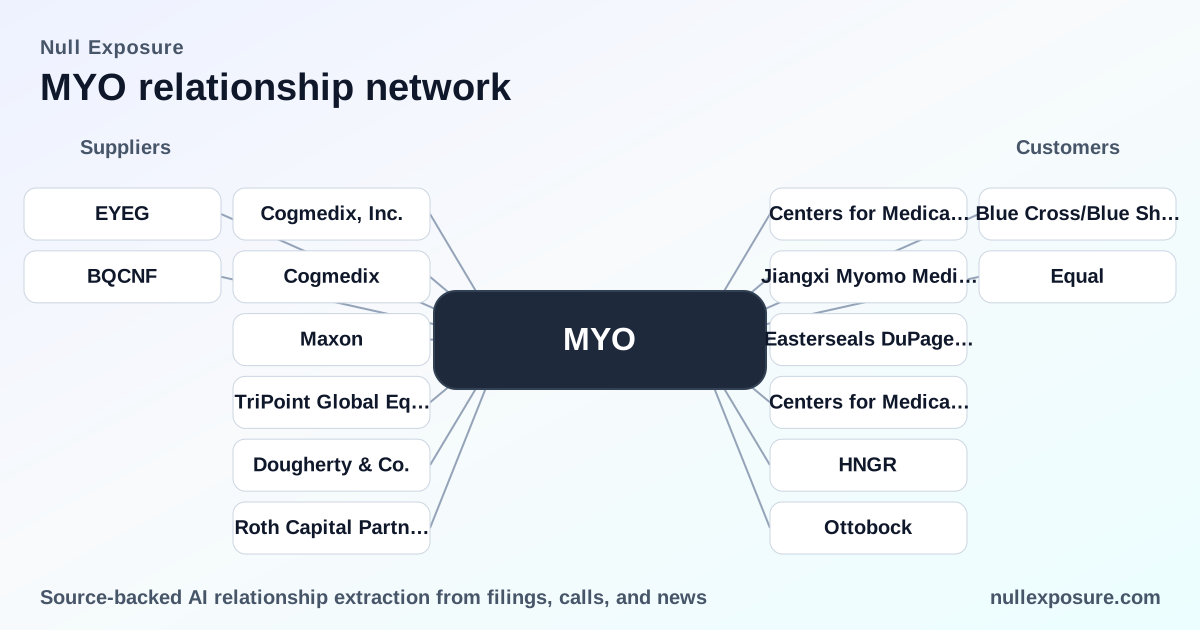
Myomo Inc (MYO) — Supplier relationships that shape production and liquidity
Myomo is a niche medical‑robotics company that designs and sells myoelectric orthoses (MyoPro) and monetizes primarily through device sales and direct billing to insurers, supplemented historically by licensing arrangements. The company outsources critical electromechanical assembly and selected components while using third‑party clinical partners for fittings; those supplier and capital‑markets relationships materially determine Myomo’s production capacity, unit economics, and capital access. For supplier diligence and relationship intelligence, see https://nullexposure.com/.
How Myomo runs the business and gets paid
Myomo sells a wearable, myoelectric orthosis to patients and healthcare providers and largely bills insurers directly under a “direct billing” channel, including device evaluation, measurement and fitting performed by Myomo clinical staff or contracted O&P (orthotics & prosthetics) professionals. Device revenue is the primary top‑line driver; Myomo’s gross margin profile reflects the mix of in‑house services and outsourced manufacturing and component costs. The company’s FY2025 figures show negative operating leverage historically, underscoring the importance of supplier cost control and stable production runs.
For procurement and counterparty risk assessment, review Myomo’s supplier footprint at https://nullexposure.com/.
Why these supplier and capital relationships matter
Myomo’s operating model is outsourced production plus direct clinical services, which creates a dual dependency: continuity of manufacturing (electromechanical kits and components) and access to clinical partners who deliver fitting and billing. That structure drives four practical constraints for investors and operators:
- Contracting posture: Myomo relies on contract manufacturing rather than internal scale manufacturing for electromechanical assembly, shifting supply risk to vendors.
- Concentration and criticality: A limited set of suppliers for motors, subassemblies and 3D printed parts concentrates operational risk and affects lead times and margins.
- Contract maturity and IP posture: Historical licensing obligations—some expired—affect royalty flows and IP leverage over time.
- Service coupling: Continued use of O&P providers for fittings ties reimbursement outcomes to clinical partner performance.
For deeper supplier due diligence, visit https://nullexposure.com/ to map counterparties and contractual detail.
Vendor-by-vendor relationship breakdown
Below are every relationship surfaced in company filings and media, with a concise plain‑English takeaway and the source context.
-
Cogmedix, Inc.
- Myomo contracts Cogmedix as a contract manufacturer for certain subassemblies and sources components and raw materials from them, making Cogmedix a primary production partner for electromechanical kits. According to Myomo’s FY2024 10‑K, manufacturing for the electromechanical kit is provided by Cogmedix (a Coughlin Companies subsidiary). The Robot Report also noted that Myomo outsourced robotics component manufacturing to Cogmedix (news report, FY2019).
-
Maxon
- Maxon supplies small motors used in Myomo’s devices; motors are cited as a core component enabling all‑day battery performance. The Robot Report reported use of Maxon motors in Myomo’s products (news report, FY2019).
-
AB Corp (inferred symbol: EYEG)
- Myomo sources 3D‑printed orthotic components from AB Corp, indicating outsourcing of custom component fabrication to a specialist supplier as disclosed in the FY2024 10‑K.
-
TriPoint Global Equities
- TriPoint acted as lead managing selling agent and book runner for an equity offering tied to Myomo’s earlier fundraising and public listing processes, reflecting a capital markets relationship used to raise growth capital (CrowdFundInsider coverage, FY2016).
-
BANQ (TriPoint’s online division; inferred symbol BQCNF)
- BANQ (TriPoint’s online division) was named alongside TriPoint as a selling agent and book runner for the same offering that facilitated Myomo’s capital raise and NYSE listing expectations (CrowdFundInsider coverage, FY2016).
-
Dougherty & Co.
- Dougherty & Co. served as co‑manager on a public offering that Myomo executed, illustrating the use of boutique investment banks for equity syndication (MassDevice coverage on the FY2020 offering).
-
Roth Capital Partners
- Roth Capital Partners was the sole book‑running manager on a FY2020 offering (with Dougherty & Co. as co‑manager), showing continued reliance on boutique capital‑markets dealers to raise liquidity when needed (MassDevice, FY2020).
Note: Cogmedix appears in both filings and earlier press coverage; both sources confirm an ongoing manufacturing outsourcing relationship (FY2024 10‑K and FY2019 reporting).
Operational constraints and what they imply for partners
Myomo’s constraints paint a coherent operating posture rather than isolated metrics:
- Licensing and IP: Myomo historically held an exclusive license from MIT for certain patent rights that required royalties tied to net sales. The license expired in November 2023, which changes Myomo’s royalty exposure and could alter IP leverage—this is a company‑level signal from licensing disclosures covering 2006 through the license termination period.
- Geography: Myomo sells and deploys its devices in the United States, Europe and Australia, creating multi‑jurisdictional reimbursement and logistics complexity.
- Manufacturing role: The company explicitly identifies Cogmedix as its contract manufacturer for electromechanical kits, establishing Cogmedix as a critical supplier whose performance is material to device production.
- Service providers: Myomo uses O&P clinical partners for fittings in certain cases, which links reimbursement and deployment speed to those third‑party clinical vendors rather than internal staff alone.
- Contract stage: The terminated MIT license (expired November 2023) is an explicit constraint that materially changed the company’s contractual landscape.
These signals combine to define a vendor strategy that is outsourced, geographically distributed, and sensitive to single‑supplier performance—important for any investor or operator negotiating terms or contingency plans.
Investment implications and recommended next steps
- Operational risk is concentrated around production suppliers (Cogmedix) and key components (Maxon motors). Investors should insist on supply‑continuity clauses, dual‑sourcing pathways, and inventory buffers in modelling.
- Capital access is episodic and facilitated by boutique banks (Roth, Dougherty, TriPoint/BANQ). Monitoring capital markets relationships and potential dilution from future offerings is critical to assessing runway.
- IP cost structure has shifted post‑MIT license expiry, which simplifies royalty risk but places greater emphasis on internal IP strategy and potential litigation exposure.
For investor tools and structured supplier intelligence on Myomo and peers, visit https://nullexposure.com/.
Final takeaways
Myomo’s business is growth dependent on stable outsourced manufacturing and reliable clinical reimbursement channels. The supplier map shows a small number of high‑impact partners on both the production and capital sides — a concentration risk that both investors and operators must price into valuation and operational planning. For targeted supplier diligence, contractual language templates, or counterparty risk scoring tailored to medical device suppliers, go to https://nullexposure.com/.